
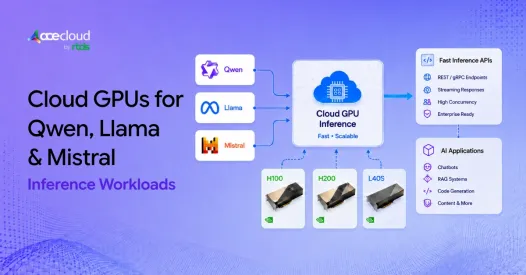
Choosing the best cloud GPU for LLM inference in 2026 is no longer about picking the fastest accelerator. Pick the wrong GPU, and you can overpay for unused compute, hit VRAM limits, increase p95 latency, or struggle to serve long-context requests at scale.
The better question is: which GPU fits your model size, context length, latency target, serving framework, concurrency needs, and cost ceiling?
For most teams deploying open-weight LLMs,
- NVIDIA H200 is a strong production default for many LLM inference workloads, especially when memory capacity, CUDA maturity and framework support matter. It should still be benchmarked against the actual model, context length, batch size and latency target. It offers a strong balance of high VRAM, memory bandwidth, CUDA ecosystem maturity and production readiness for many open-weight LLM deployments.
- NVIDIA B200 or GB200 is better for premium, high-throughput workloads where scale matters more than cost control. NVIDIA describes GB200 NVL72 as a rack-scale system that connects 36 Grace CPUs and 72 Blackwell GPUs through a 72-GPU NVLink domain.
- AMD MI300X is a strong memory-capacity option for long-context inference and large open-weight deployments. AMD lists MI300X with up to 192GB HBM3 and 5.3TB/s peak theoretical memory bandwidth.
- NVIDIA L40S or A100 80GB can be more cost-effective for smaller models, quantized inference, batch jobs, dev/test and prototyping where H200/B200 memory or throughput is not required. NVIDIA lists the L40Sdata center GPU memory tier at 48GB with 864GB/s bandwidth.
This blog compares the best cloud GPUs for Qwen, Llama, and Mistral by workload, not just by raw specs.
Which Cloud GPU Should You Choose by Workload?
If you want a fast shortlist, here is the quick answer for teams comparing cloud GPUs for Qwen, Llama, Mistral, Mixtral, and other open-weight LLM workloads.
| Workload | Best cloud GPU | Why |
|---|---|---|
| 7B to 13B chat or prototype | L40S/ A100 | Lower cost, enough VRAM for quantized inference and small batches |
| 30B to 34B inference | A100 80GB/ H100/ H200 | Better throughput and memory balance for production serving |
| 70B dense inference | H200/ MI300X | Higher VRAM and bandwidth reduce memory pressure and improve batching |
| Long-context RAG | MI300X/ H200/ B200 | KV cache growth makes memory capacity and bandwidth critical |
| High-concurrency SaaS inference | B200/ GB200/ H200 | Higher throughput improves batching economics and cost per token |
| LoRA/ QLoRA fine-tuning | H100/ H200/ MI300X | Strong VRAM plus mature frameworks for adapters and mixed precision |
| Full fine-tuning or distributed training | B200/ GB200/ H200 clusters | Interconnect, scale, and platform maturity matter most |
Key Takeaway:
If you want the safest production choice, start with H200. If memory capacity is the main blocker, evaluate MI300X. If you run a premium AI product with high request volume, evaluate B200 or GB200. If you are still prototyping, start with L40S or A100 before moving upward.
How Do Qwen, Llama, and Mistral Workloads Differ?
Workload fit matters more than peak specs because context length, KV cache, batch size, precision, routing overhead, serving framework and concurrency determine real production throughput.
| Model family | Qwen | Llama | Mistral/Mixtral |
|---|---|---|---|
| Common use | Coding, reasoning, multilingual apps, agents, long-context RAG | General assistants, copilots, RAG, internal tools, SaaS inference | Efficient endpoints, MoE serving, enterprise AI, long-context workflows |
| What stresses the system | Long prompts, verbose tool output, retrieval chunks, high concurrency | Many deployment tiers from small quantized models to 70B-class production workloads | MoE routing, total parameter storage, active-parameter compute, long contexts, serving architecture and framework support |
| Main bottleneck | VRAM and bandwidth because of KV cache growth | Throughput economics and operational consistency | Memory behavior, routing overhead, and latency variance |
| What to validate | Tokens/sec, p95 latency at 8K to 32K context, KV cache headroom | Cost per 1M tokens, batching efficiency, peak p95 latency | Latency variance under load, batching stability, memory pressure |
| GPU takeaway | Default to H200. Choose MI300X when memory capacity is the limiter | Use two tiers: L40S/A100 for smaller or quantized workloads, H200 for production 70B-class workloads | Start with H200 for CUDA maturity. Consider MI300X or B200-class infrastructure for memory-heavy MoE, long-context or high-throughput workloads after benchmarking |
Key Takeaway:
- Qwen3-8B supports a native 32,768-token context length and has been validated up to 131,072 tokens using YaRN. For production, teams should still test latency, accuracy and memory behavior at their real context length.
- Llama 4 Scout has 17B active parameters,16 experts, and 109B total parameters. Meta describes it as supporting a 10M-token context window and offering single-H100 efficiency, while Azure notes single-H100 fit depends on on-the-fly INT4 quantization. In production, actual usable context length still depends on serving framework, batch size, KV cache memory, latency target, concurrency, and provider limits.
- Mistral Large 3 has 41B active parameters, 675B total parameters and a 256K context window according to Mistral’s model documentation; note that Hugging Face’s model card breaks this down as a 673B-parameter language model with 39B active plus a 2.5B vision encoder. That makes memory planning and serving architecture especially important for Mistral-style workloads.
What GPU Selection Criteria Actually Matter for Open-Weight LLMs?
Open-weight LLM performance depends less on peak compute and more on memory fit, bandwidth, batching, and deployment stack compatibility.
VRAM and model fit
VRAM determines whether weights, KV cache, and your target batch size fit without offloading to system memory. When offloading happens, latency becomes unpredictable and throughput drops, which usually increases cost per token. Therefore, VRAM is the first filter you should apply before comparing hourly prices.
Memory bandwidth and token generation
LLM inference is often memory-bound during token generation because the model repeatedly reads weights and updates cache. Higher memory bandwidth typically improves tokens per second at the same batch size, which reduces GPU time per request. This matters most for long-context inference, RAG with large prompts, high output lengths and multi-tenant serving where you rely on batching.
Precision and quantization support
You can reduce GPU requirements using FP8, INT8, or INT4 quantization, and you can also shrink KV cache with attention optimizations. However, quantization can affect quality, tool-call reliability, and framework support, especially when you mix long contexts with structured outputs. For production, you should standardize supported formats per model tier, then validate accuracy and latency together.
Framework and software compatibility
CUDA maturity often matters as much as raw specs when you need predictable performance and fast incident response. In practice, you should verify compatibility with vLLM, TensorRT-LLM, SGLang, Hugging Face Transformers, PyTorch and llama.cpp for your chosen GPU family, model architecture, quantization format and deployment OS/container stack. Additionally, you should treat ‘works’ as insufficient and require measured throughput, p95 latency, and memory utilization.
Multi-GPU interconnect
Fine-tuning, full training, and sharded inference depend on fast GPU-to-GPU communication. If your model requires tensor parallelism or pipeline parallelism, weak interconnect can erase theoretical compute gains. Therefore, you should evaluate NVLink, NVSwitch, PCIe topology, InfiniBand/Ethernet fabric or AMD Infinity Fabric/XGMI where relevant as part of the platform decision, not as an afterthought.
GPU availability and cloud region fit
GPU availability can be as important as GPU specs. A technically ideal GPU is not useful if it is unavailable in your region, locked behind quota limits, or priced too high for always-on inference.
For production workloads, include region availability, support response time, network latency, quota flexibility, and migration effort in the GPU selection process.
Note: For many teams, H200 remains a safer NVIDIA default because CUDA support is broader across LLM tooling; this is an ecosystem and operational-readiness argument, not only a hardware-spec argument.MI300X becomes more compelling when memory capacity is the bottleneck and the team is comfortable with ROCm-based deployment.
Quick Comparison of H200, B200, MI300X, L40S, A100, and H100
Before choosing a cloud GPU, compare each accelerator by workload fit, not just memory size or hourly price. The right GPU is the one that gives your workload the best balance of VRAM, bandwidth, latency, throughput, framework compatibility, availability, and cost per 1M tokens.
| GPU | Best For | Main Strength | Limitation |
|---|---|---|---|
| NVIDIA H200 | Production LLM inference, long-context RAG, 70B-class workloads, high-concurrency serving | 141GB HBM3e, strong memory bandwidth, CUDA maturity, strong production readiness | Higher cost than A100 or L40S |
| NVIDIA B200 / GB200 | Premium SaaS inference, frontier-scale workloads, distributed training, very high throughput | Blackwell-class performance, strong FP4/FP8 support, high interconnect scale | Usually overkill for small models, prototypes, and low-volume inference |
| AMD MI300X | Memory-heavy inference, long-context workloads, 70B-class deployments, cost-sensitive open-weight LLMs | 192GB HBM3 and strong memory bandwidth | ROCm readiness and framework compatibility must be validated |
| NVIDIA H100 | Production inference, fine-tuning, established CUDA-based LLM stacks | Mature ecosystem, strong availability, proven performance | Less memory headroom than H200 |
| NVIDIA A100 80GB | Cost-controlled inference, LoRA/QLoRA, smaller production workloads | Mature, widely supported, useful 80GB tier | Older generation with lower bandwidth than H100 or H200 |
| NVIDIA L40S | Smaller models, quantized inference, batch jobs, dev/test, prototypes | Lower-cost 48GB GPU for optimized workloads | Not ideal for large dense models, long-context RAG, or high-concurrency serving |
Key Takeaways:
- Choose H200 when you need the safest production default.
- Choose B200 or GB200 when throughput and scale matter more than cost control.
- Choose MI300X when memory capacity is the main bottleneck.
- Choose L40S or A100 when smaller models, quantization, and budget control matter most.
Note: B200 and GB200 different. B200 is a Blackwell GPU platform used in systems such as DGX B200, while GB200 refers to Grace Blackwell system architecture that combines Blackwell GPUs with Grace CPUs at larger scale.
Which GPU is Best for Each Model Family?
Choosing by model family helps teams avoid overprovisioning, underpowered deployments, and costly bottlenecks during production inference.
Best cloud GPU for Qwen
For Qwen workloads,
- Choose H200 when running production inference, long-context prompts, agentic workflows, or high-concurrency serving.
- Choose MI300X when memory capacity is the dominant constraint.
- Choose L40S, A100, or H100 for smaller Qwen models, quantized deployments, development environments, and lower-volume inference.
This is especially important because Qwen workloads often involve coding, reasoning, multilingual applications, and long-context retrieval. As context length increases, KV cache becomes a larger part of the infrastructure cost.
Best cloud GPU for Llama
For Llama workloads,
- H200 is a strong default for production inference, especially for many 70B-class, long-context assistant and enterprise RAG workloads, but it should be benchmarked against context length, concurrency and precision targets.
- B200 or GB200 is better for high-concurrency SaaS inference and premium throughput.
- L40S or A100 can be enough for smaller Llama models or heavily quantized deployments.
Llama 4 Scout’s single-H100 efficiency is useful, but it should not be interpreted as a universal rule for all production workloads. Once you add concurrency, larger context windows, strict latency targets, multi-tenant serving and KV-cache pressure, H200, MI300X or B200-class infrastructure may become more practical depending on the serving stack
Best cloud GPU for Mistral
- For smaller Mistral models, L40S, A100, or H100 can be enough.
- For Mixtral-style MoE models, Mistral Large-style workloads, long-context inference or enterprise deployment, H200, MI300X or B200-class infrastructure may be a stronger fit after validating total parameter storage, active parameter compute and framework support.
The key is to avoid sizing Mistral workloads only by active parameters. MoE models may activate fewer parameters per token, but total parameter storage, routing, serving framework support, and memory pressure still matter.
Mistral Large 3’s 41B active parameters, 675B total parameters, and 256K context window make that tradeoff clear.
Which GPU is Best with LLM Use Case?
Each LLM use case stresses GPUs differently, so the best choice depends on latency, memory pressure, concurrency, and optimization goals.
Real-time chat inference
For production-grade chat inference, H200 is the best balanced option. It offers enough memory and bandwidth to support larger models, higher concurrency, and tighter latency requirements.
For smaller assistants, internal tools or low-volume use cases, L40S, A100 or H100 may be more cost-effective depending on availability and pricing. The right way to compare them is not just hourly pricing. Measure tokens per second, p95 latency, batch size, GPU utilization, and cost per 1M tokens.
Long-context RAG
For long-context RAG, choose H200, MI300X, or B200. Retrieval chunks, long prompts, conversation history, and large output windows can make KV cache the bottleneck. A GPU with enough memory for weights may still struggle when context length and concurrency increase.
This applies to legal document review, codebase analysis, enterprise search, customer support knowledge bases, financial research, and agentic workflows. If long context is central to the product, start your evaluation with H200 or MI300X rather than budget GPUs, and include B200 if throughput or premium latency is business-critical.
Fine-tuning and adaptation
For LoRA and QLoRA fine-tuning, H100, H200, or MI300X are strong choices. For full fine-tuning, distributed training, or larger model adaptation, consider B200, GB200, or H200 clusters.
Fine-tuning is more sensitive to VRAM, optimizer/activation memory, checkpointing, interconnect, framework compatibility, data loading and training stability than simple inference. Teams should also consider checkpoint storage, data loading, experiment tracking, and cloud region availability.
Multi-tenant SaaS inference
For multi-tenant SaaS inference, choose B200 or GB200 when premium throughput and latency are business-critical. Choose H200 for balanced production use. Choose MI300X when memory capacity is especially valuable and the team has ROCm readiness.
Azure’s MI300X VM lists configurations with 8 AMD Instinct MI300X GPUs, each with 192GB HBM3, and positions the series for deep learning, generative AI, and HPC workloads. That makes MI300X especially relevant for teams evaluating memory-heavy inference at scale.
Evaluate H200, B200, GB200, MI300X, H100, A100 and L40S for your Qwen, Llama, Mistral, RAG, fine-tuning and SaaS inference workloads with AceCloud GPU experts.
How to Calculate the Real Cost of Cloud GPU Inference?
If you only compare GPU-hour pricing, you can accidentally choose the most expensive platform for your real workload.
GPU-hour pricing limitations
Hourly prices do not capture throughput, batching efficiency, or idle time between requests. A cheaper GPU can cost more per 1M tokens if tokens per second is low or if p95 latency forces you to run underutilized.
Cost per useful output
You should calculate cost per useful output using metrics tied to outcomes, such as:
- Cost per 1M tokens
- Cost per successful request
- Cost per completed fine-tuning run
- Cost per production workload
This approach forces you to include both performance and reliability in the same number.
Simple cost formula
Use this simplified formula:
Cost per 1M tokens = total GPU cost during test ÷ total tokens generated × 1,000,000For production planning, calculate this separately for:
- Average request length
- Peak request length
- 8K, 32K, and 128K context scenarios
- Normal load and peak concurrency
- On-demand and spot pricing
Real cost variables
You should model these variables explicitly:
- GPU-hour price and minimum billing granularity
- Tokens per second at target batch size and context length
- Quantization level and accuracy impact
- KV cache memory growth and headroom
- Idle time and autoscaling behavior
- Spot vs on-demand pricing and interruption handling
- Storage and egress for RAG corpora and logs
- Engineering overhead for optimization and incident response
- Provider region and latency to your users
- Serving framework optimization
GPU waste reduction
Start with the smallest GPU that meets latency and memory goals, then scale upward only when measurements prove you need it.
L40S is often a strong cost-control tier because NVIDIA lists 48GB memory and 864GB/s bandwidth, which can be enough for smaller models, quantized inference, and batch jobs.
How to Compare Cloud GPUs?
A consistent methodology helps you avoid conclusions that only apply to one benchmark or one request shape.
You should disclose these inputs for every test:
- Model name and parameter size
- Quantization format, such as BF16, FP16, FP8, INT8, or INT4
- Serving framework, such as vLLM, TensorRT-LLM, SGLang, llama.cpp, or PyTorch
- Context length and prompt shape, including retrieval chunk count for RAG
- Batch size and concurrency settings
- Input and output token lengths
- Tokens per second
- p95 latency
- GPU utilization
- Cost per 1M tokens
- Provider region
- Pricing date
- Spot or on-demand pricing
- Autoscaling assumptions
- Failure and retry behavior
This disclosure makes results comparable across vendors and reduces the risk of buying based on an unrepeatable demo.
Frequently Asked Questions
NVIDIA H200 is the best overall choice for most production Qwen, Llama and Mistral workloads because it balances high memory, strong bandwidth, CUDA maturity and production readiness.
MI300X can be better for memory-heavy inference because it offers up to 192GB HBM3 and 5.3TB/s peak theoretical memory bandwidth. H200 is often safer when CUDA maturity, TensorRT-LLM support and NVIDIA ecosystem compatibility are central to your stack.
B200 is worth it for high-volume, latency-sensitive and multi-tenant inference where you can keep utilization high. It is usually unnecessary for small models, internal tools and early prototypes where VRAM fit and cost control matter more.
Yes. L40S can run smaller or quantized Qwen, Llama and Mistral models. It can also support development environments and batch jobs. However, it is not ideal for large dense models, high-concurrency serving or long-context RAG where KV cache growth dominates memory.
VRAM and memory bandwidth often matter more than raw FLOPS because inference repeatedly reads weights and grows KV cache with context length and batch size. You should still measure prefill throughput, decode tokens per second, p95/p99 latency and GPU memory utilization because framework optimizations can change bottlenecks.
ROCm is increasingly viable for MI300X deployments, especially when teams standardize versions and validate their serving stack early. CUDA remains broader across many production toolchains, which can reduce integration and troubleshooting time.
H100 is still a strong production GPU for many LLM inference and fine-tuning workloads, especially when 80GB memory is enough and CUDA maturity or availability matters.
Choose a provider based on GPU availability, region, pricing model, managed Kubernetes support, storage and networking costs, support quality, migration effort and whether the provider can support your production inference stack.

