

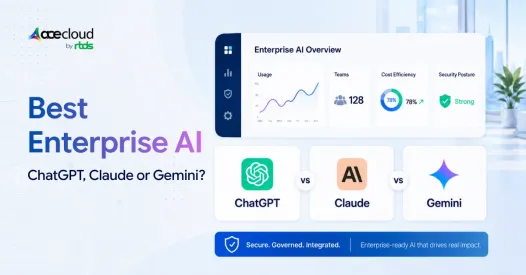
Someone tests ChatGPT, Claude, and Gemini. The demos look impressive. The model answers are fluent. The pricing pages seem manageable. A few teams start using them for writing, coding, research, support, analytics, or internal knowledge work. Then the real enterprise questions arrive.
Can this connect to our systems? Can legal approve it? Can security govern it? Can engineering build agents on top of it? Can finance predict the cost? Can employees actually use it inside their daily workflows without creating a shadow AI problem?
That is when the comparison changes.
The question is not which AI feels smartest in a demo. The real question is which enterprise AI assistant can become part of your operating model.
Recent enterprise AI research shows why the stakes are rising. Deloitte’s 2026 State of AI in the Enterprise report found that 34% of organizations are already using AI to deeply transform products, services, core processes, or business models, while another 30% are redesigning key processes around AI. AI is no longer just a productivity experiment. It is becoming enterprise infrastructure.
That is exactly where the wrong platform choice costs the most.
This article compares ChatGPT vs Claude vs Gemini for the things enterprise AI teams actually care about: workflow fit, business app integrations, data privacy, governance, coding, agents, cost control, deployment strategy, and infrastructure readiness.
TL;DR: Which Enterprise AI Assistant Should You Pick?
If you don’t have time for the full breakdown:
- Pick ChatGPT Enterprise if you want a broadly capable enterprise assistant for research, data analysis, coding, content creation, multimodal work, and agentic tasks, with integrations across both Google and Microsoft environments and strong enterprise administration and privacy controls.
- Pick Claude Enterprise if your priorities include complex document analysis, coding through Claude Code, long-form reasoning, and detailed security, retention, audit, and compliance controls. Validate its performance against your specific workloads rather than assuming it will always outperform competing platforms.
- Pick Gemini Enterprise if your organization is heavily invested in Google Workspace and Google Cloud and wants tightly integrated AI agents, multimodal workflows, business-data grounding, and access to Gemini models with very large context windows.
You can roughly compare them like this across the dimensions that matter most to enterprise AI teams:
| Evaluation area | Recommended starting point |
|---|---|
| Coding and agentic engineering | Claude Enterprise or ChatGPT Enterprise |
| Multimodal and long-context analysis | Gemini Enterprise or Claude Enterprise |
| Broad workplace adoption and ease of rollout | ChatGPT Enterprise |
| Google Workspace and Google Cloud integration | Gemini Enterprise |
| Regulated document workflows | Claude Enterprise |
| API cost control at scale | Test Gemini, ChatGPT, and Claude against real prompts |
The best enterprise strategy is usually not choosing one assistant for every use case. It is choosing the right model for the right workflow.
At a Glance: Platform Overview
Before comparing workflows and governance, start with the basics: who provides each platform, what they support, and where they fit.
| Platform | Provider | Context positioning | Modalities | Positioning |
|---|---|---|---|---|
| ChatGPT Enterprise | OpenAI | Varies by ChatGPT surface and selected model. OpenAI’s current frontier API model GPT-5.5 supports a 1,050,000-token context window and 128,000 max output tokens | Text, image, code, data analysis, voice, and multimodal workflows depending on plan and tool availability. GPT-5.5 API currently lists text input/output and image input | Broadest workplace AI adoption and multimodal productivity |
| Claude Enterprise | Anthropic | Claude Opus 4.8 and Claude Sonnet 4.6 support 1M-token context windows in Anthropic’s current model overview | Text, code, reasoning, and vision workflows, depending on selected model and product surface | Long-context reasoning, coding, regulated workflows, structured outputs |
| Gemini Enterprise | Gemini 3.1 Pro Preview lists a 1,048,576 input token limit and 65,536 output token limit | Text, images, audio, video, PDFs, and code as inputs, with text output for Gemini 3.1 Pro Preview | Google-native AI agents, multimodal workflows, enterprise search, and grounding |
*Note: This comparison includes both enterprise assistant products and representative API model specs. Enterprise seat plans, API access, context windows, admin controls, and model availability can differ by contract, product surface, region, and deployment model.
Key Differences
Enterprise AI value depends on more than model quality. Context handling, ecosystem fit, governance, deployment model, and infrastructure readiness decide how well each platform scales in production.
Model quality is not the same as enterprise fit
A model can perform well in benchmarks and still be the wrong enterprise default if it creates integration friction, weak governance, high latency, unpredictable costs, or poor user adoption. Enterprise AI value depends on how well the assistant works inside existing workflows, permissions, data systems, and infrastructure.
Context Window
- OpenAI API list GPT-5.5 with a 1,050,000-token context window and 128,000 max output tokens.
- Anthropic’s model overview lists Claude Opus 4.8 and Claude Sonnet 4.6 with 1M-token context windows.
- Gemini 3.1 Pro Preview states that gemini-3.1-pro-preview has an input token limit of 1,048,576 and an output token limit of 65,536.
If your workflows involve entire codebases, full regulatory filings, long research archives, or large internal knowledge bases, Gemini 3.1 Pro Preview, Claude Opus 4.8, Claude Sonnet 4.6, and GPT-5.5 API all deserve evaluation.
The real differentiator is not just context length. It is how accurately each model uses that context, how much it costs, how long it takes to respond, and how well it integrates with your enterprise systems.
Role in Each Ecosystem
ChatGPT Enterprise is OpenAI’s enterprise assistant product for broad workplace adoption, with API and agentic development handled through adjacent OpenAI developer surfaces. Do not merge ChatGPT Enterprise seat features with OpenAI API model specs without labeling the distinction.
- Cross-functional workplace AI adoption across HR, sales, marketing, finance, operations, support, product, and engineering.
- Multimodal productivity, including writing, data analysis, image workflows, voice workflows, and coding support depending on product surface.
- Apps, connectors, company knowledge, and custom integrations for connecting ChatGPT to enterprise tools and data sources.
Claude Enterprise is Anthropic’s precision tool for technical and regulated teams optimized for:
- Long-context reasoning, compliance analysis, and legal document review.
- Agentic software development via Claude Code.
- API-first deployments where reasoning quality, coding performance, and output correctness matter more than interface breadth.
Gemini Enterprise / Gemini Enterprise Agent Platform is Google’s Workspace-and-Cloud-aligned enterprise AI platform family; specify whether you mean Gemini for Workspace, Gemini app, Gemini API, Vertex AI/Gemini Enterprise Agent Platform or NotebookLM Enterprise.
- Workspace-native AI agents across Gmail, Docs, Sheets, Slides, Meet, and Drive.
- Multimodal pipelines combining text, audio, video, PDFs, images, and code.
- Search-grounded reasoning through supported Google Search grounding capabilities.
Business App Integrations
- Gemini is strongest for Google Workspace and Google Cloud environments. It is the most natural fit when enterprise data already lives across Gmail, Docs, Sheets, Slides, Meet, Drive, BigQuery, and Google Cloud services.
- ChatGPT Enterprise is strong for flexible workplace adoption across mixed app environments, especially where teams need a common AI assistant across many departments.
- Claude is strongest for technical, coding, document-heavy, long-context and API-led workflows where output quality, careful reasoning and codebase/document analysis matter. Validate broad workplace adoption separately because Claude’s ecosystem fit differs from Microsoft/Google productivity suites. It may require more planning when companies need deep productivity-suite embedding across non-Anthropic ecosystems.
Comparing ChatGPT, Claude and Gemini by Enterprise Features
A feature comparison table is useful only when it reflects real enterprise decision factors, not generic AI checklist items. Compare best-fit profile, governance depth, integration strategy, deployment posture, and operational maturity.
| Evaluation factor | ChatGPT Enterprise | Claude Enterprise | Gemini Enterprise |
|---|---|---|---|
| Best fit | Broad workplace AI adoption | Long documents, coding, reasoning | Google Workspace and Google Cloud teams |
| Strongest ICP | Cross-functional teams | Engineering, legal, compliance, research | Google-centric enterprises |
| Knowledge work | Very strong | Very strong | Strong, especially in Workspace |
| Coding | Strong | Very strong | Moderate to strong, workflow-dependent |
| Long-context work | Strong, varies by ChatGPT surface and selected model. GPT-5.5 API supports up to 1,050,000 tokens | Very strong. Claude Opus 4.8 supports 1M context, and Claude Sonnet 4.6 supports 1M context with API-specific availability | Very strong. Gemini 3.1 Pro Preview supports 1,048,576 input tokens |
| Multimodal work | Strong | Moderate | Very strong |
| Business app integration | Strong | Moderate to strong | Very strong for Google ecosystem |
| Governance | Strong enterprise controls | Strong enterprise controls | Strong Google admin and Workspace controls |
| AI agents | Strong | Strong | Strong, especially in Google ecosystem |
| Best deployment fit | Broad SaaS and API adoption | API and technical workflows | Workspace, Cloud and agent workflows |
Key Takeaway:
This AI model comparison is not a universal ranking. A ‘very strong’ rating does not automatically mean that platform is the right choice for your organization. Enterprise teams evaluating ChatGPT, Claude, and Gemini in 2026 are making architectural decisions that can shape governance, AI adoption, integration strategy, and infrastructure planning for years, not just selecting a chat interface for the next quarter.
Also Read: Claude Opus 4.5 vs Gemini 3 Pro vs Sonnet 4.5
How Do ChatGPT, Claude, and Gemini Compare on Security, Privacy, and Governance?
For teams, governance should come before pricing. A platform may look powerful in demos, but if it cannot meet your data privacy, access control, audit, retention, and compliance requirements, it will not scale safely.
Data Training and Retention
- OpenAI does not train models on organization data by default across ChatGPT Enterprise, ChatGPT Business, ChatGPT Edu, ChatGPT for Healthcare, ChatGPT for Teachers, and its API platform. It also lists encryption, retention controls, compliance support, data residency for eligible customers, SSO, SCIM, role-based access controls, user analytics, and audit logs API.
- Anthropic’s Claude Enterprise is built for workforce-wide deployment under central governance, with identity management, data controls, audit infrastructure, and enterprise contractual structure. Anthropic states customer data on Claude Enterprise is not used to train its models by default and retention is configurable. Keep this claim, but separate Claude Enterprise, Claude API, Claude Code Enterprise and consumer Claude data-handling terms.
- Google Workspace Gemini keeps business data confidential and that data, including business data in Gmail, is not reviewed by humans or used for generative AI model training outside the customer’s domain without permission. Google also highlights DLP controls, logging, granular user access controls, data sovereignty options, and compliance certifications.
Connector and Permission Governance
The governance risk increases when an enterprise AI assistant connects to business apps, drives, ticketing systems, CRMs, code repositories, and customer records. Teams should evaluate whether the assistant only retrieves data the user is authorized to access, whether connector activity is logged, and whether admins can restrict access by user, group, department, or workflow.
Agent Governance
AI agents create a higher governance requirement than simple chat. Enterprise teams should evaluate tool access, approval checkpoints, rollback options, audit trails, action logs, cost per completed task, and human review requirements. An agent that can search, summarize, draft, update, or trigger workflows must be governed like an operational system, not a basic productivity feature.
Governance Checklist
Before rollout, ask:
- Are prompts, files, and outputs used for training by default?
- Can admins enforce SSO, SCIM, RBAC, and MFA?
- Are audit logs and usage analytics available?
- Can retention settings be configured?
- Can connectors be restricted by user, group, or department?
- Can agent actions be reviewed before execution?
- Is sensitive data protected by DLP or equivalent controls?
- Are data residency and compliance needs supported?
- Can production workloads run in private, dedicated, regional, customer-controlled or contractually restricted environments, and what telemetry/logs leave that boundary?
When Should You Not Choose ChatGPT, Claude, or Gemini?
When ChatGPT Enterprise May Not Be the Best Default
Do not choose ChatGPT as the only platform if your organization is deeply Google-native and the primary need is permission-aware enterprise search across Workspace and Google Cloud.
Also be careful if your highest-value workloads are regulated document review, long-context legal analysis, or engineering workflows where Claude or another specialized model performs better in internal tests.
When Claude Enterprise May Not Be the Best Default
Do not choose Claude as the only platform if your main goal is broad, non-technical employee adoption across every department.
Claude can be excellent for engineering, legal, compliance, research, and document-heavy workflows, but it may not be the easiest company-wide default for general workplace productivity.
When Gemini Enterprise May Not Be the Best Default
Do not choose Gemini as the only platform if your organization is not invested in Google Workspace or Google Cloud.
Gemini is strongest when Google ecosystem fit matters. If your engineering team needs advanced codebase-aware workflows, or your teams operate across a mixed enterprise stack, you should test Gemini against ChatGPT and Claude before standardizing.
Which Enterprise AI Assistant is Best for Specific Workflows?
Each platform performs differently across business functions. Here’s how ChatGPT, Claude, and Gemini align with common enterprise workflows.
Knowledge Work
Use ChatGPT for broad knowledge work across mixed teams, writing, research synthesis, meeting notes, and business analysis.
Use Gemini for Google Workspace-native knowledge work where business content already lives in Gmail, Docs, Sheets, Slides, Meet, and Drive.
Use Claude when knowledge work involves long documents, dense regulatory material, or multi-step reasoning chains.
Coding and Engineering
Claude and ChatGPT lead. Claude is best for codebase-aware workflows, refactoring, structured software tasks, and autonomous engineering agents. ChatGPT is strong for debugging, code explanation, and broad development support.
Regulated Teams: Legal, Compliance, Finance
Claude is a strong starting point for legal document review, compliance analysis, risk review, policy interpretation and document-heavy regulated processes, but final selection must depend on internal accuracy tests, retention settings, auditability, access controls and legal review.
However, final selection should depend on data retention policies, governance requirements, auditability, access controls, and deployment model, not capability benchmarks alone.
Google Workspace Teams
Gemini is the clear recommendation for organizations deeply invested in Gmail, Docs, Sheets, Slides, Meet, Drive, and Google Cloud, where native integration can deliver faster adoption without heavy connector setup.
Customer Support and Service Operations
Customer support teams should evaluate the platforms based on knowledge retrieval, escalation handling, agent permissions, CRM integration, conversation quality, and cost per resolved ticket.
ChatGPT is strong for support drafting, agent-assist workflows, and internal knowledge support. Gemini is strong when support knowledge lives in Google Workspace, Drive, or Google Cloud systems. Claude is strong for policy-heavy responses, regulated service environments, and careful escalation summaries.
Analytics and Decision Intelligence
For analytics workflows, ChatGPT is strong for exploratory analysis, spreadsheet reasoning, reporting, and explanation. Gemini is strong for teams using Google Sheets, BigQuery, and Google Cloud. Claude is useful when the analysis requires reasoning through dense documents, policy constraints, or written business context.
AI Agents and Orchestration
The right platform depends on the agent’s task, tools, data access, security model, and deployment environment. Google Cloud’s 2025 ROI of AI report found that 52% of executives say their organizations are actively using AI agents, confirming agentic capability is now a core evaluation criterion, not a future consideration.
Pricing: ChatGPT vs Claude vs Gemini Enterprise
Below is an approximate comparison for API usage. Always verify current pricing on official product pages.
| Platform / model example | Public API pricing example | Notes |
|---|---|---|
| OpenAI GPT-5.5 | $5 input, $0.50 cached input, $30 output per 1M tokens | GPT-5.5 also lists a 1,050,000-token context window and 128,000 max output tokens. |
| Claude Opus 4.8 | $5 input, $25 output per 1M tokens | Anthropic lists Opus 4.8 as a 1M-context model for coding, agents, and high-stakes enterprise tasks. |
| Claude Sonnet 4.6 | Starts at $3 input and $15 output per 1M tokens | Anthropic says Sonnet 4.6 features a 1M context window, with the 1M window currently available in beta on the API. |
| Gemini 3.1 Pro Preview | $2 input / $12 output per 1M tokens for prompts under 200K tokens, and $4 / $18 for prompts over 200K tokens | Gemini 3.1 Pro Preview lists a 1,048,576 input token limit and 65,536 output token limit. |
*Note: These are API examples, not full enterprise contract comparisons. Enterprise seat pricing, committed-use discounts, support, compliance terms, and deployment requirements may change the final TCO.
Rule of Thumb
- Gemini can be cost-efficient for some high-volume multimodal and long-context workflows, but cost depends on prompt size, output length, grounding, and agent design.
- ChatGPT Enterprise can be attractive when broad employee productivity and familiar adoption justify the seat investment, while OpenAI API pricing may be competitive when caching and model selection are optimized.
- Claude can cost more for some workloads, but it may justify the cost when the business value of one correct answer is high, such as compliance review, engineering refactoring, legal analysis, or revenue-critical workflows.
Compare model fit, multi-model routing, cloud GPU requirements, Kubernetes, RAG infrastructure, governance boundaries and production costs with AceCloud experts.
Also Read: DeepSeek V3.2 vs ChatGPT 5.1 vs Gemini 3 Pro
How to Choose: A Simple Checklist
Use this decision framework when you design your enterprise AI stack.
1. What Is Your Dominant Workload?
Heavy coding, refactors, and production engineering agents
- Start with Claude Enterprise for agentic and codebase-aware workflows
- Add ChatGPT Enterprise for teams that need broad IDE-style debugging and code explanation
Multimodal analytics, search, and Workspace productivity
- Start with Gemini Enterprise
- Use Claude for deep-reasoning and compliance-heavy jobs where Gemini’s accuracy is inconsistent
Broad, cross-functional workplace productivity
- Start with ChatGPT Enterprise and use it as the company-wide default
- Add Claude or Gemini for specialized teams with higher-precision requirements
2. How Strict Is Your Cost Constraint?
Very strict cost controls and high-volume API traffic
- Favor Gemini API / Gemini 3.1 Pro Preview for cost-sensitive API workloads only if your prompts stay in the lower pricing tier and grounding/agent loops are controlled. Do not use $2/$12 as a blanket Gemini Enterprise price.
- Layer in prompt caching, batching, and summarization steps to control token spend
Moderate cost sensitivity
- Mix ChatGPT and Claude Sonnet 4.6 by use case for the best performance-per-dollar ratio
Cost less important than accuracy
- Use Claude Opus 4.8 for core revenue or compliance-critical flows only if internal evaluation proves it materially improves correctness, reliability or review burden versus GPT-5.5, Gemini 3.1 Pro or lower-cost Claude models.
- Route cheaper models for standard productivity tasks
3. How Much Do You Care About Ecosystem Lock-in?
Already deep in Google Cloud and Workspace
- Gemini Enterprise will integrate most smoothly and deliver the fastest adoption ROI
Already invested in OpenAI (direct or Azure)
- Standardize on ChatGPT Enterprise for productivity only if employee adoption, governance, connector coverage and admin controls fit; add Claude, Gemini or API models for specialized technical workflows based on evaluation results.
Multi-cloud or on-prem strategy
- Plan for model routing across providers using abstraction layers
- Avoid forcing a single-vendor architecture on workflows that have different requirements
How Should Enterprises Roll Out ChatGPT, Claude, or Gemini in 90 Days?
First 30 Days: Define Use Cases and Governance
Start with 5 to 10 high-value workflows. Examples include internal knowledge search, customer support drafting, legal document review, engineering assistance, finance analysis, meeting summaries, and sales enablement.
Define data access rules, approved use cases, restricted use cases, human review requirements, retention needs, and admin ownership.
Days 31 to 60: Test Models on Real Workflows
Run the same enterprise tasks across ChatGPT, Claude, and Gemini. Compare:
- Accuracy
- Hallucination rate
- Reasoning quality
- Citation quality
- Code usefulness
- Document handling
- Latency
- Token cost
- User adoption
- Security controls
- Integration effort
Use real documents, real prompts, real teams, and real acceptance criteria.
Days 61 to 90: Scale the Winning Workloads
Roll out the strongest platform by department or workflow. Add monitoring, usage analytics, cost dashboards, security review, model-routing rules, and feedback loops.
For production AI, plan infrastructure around inference, RAG, vector search, evaluation, observability, GPUs, Kubernetes, and compliance.
90-Day Takeaway: The goal is not to pick a model once. The goal is to build a repeatable enterprise AI evaluation and deployment system.
Final Verdict: Which AI Assistant Should Enterprise Teams Choose?
- Choose ChatGPT Enterprise if your priority is broad workplace AI adoption, cross-functional productivity, user familiarity, flexible tooling, and enterprise-wide rollout.
- Choose Claude Enterprise if your priority is coding, long-context reasoning, document-heavy workflows, regulated analysis, careful writing, and structured outputs.
- Choose Gemini Enterprise if your priority is Google Workspace, Google Cloud, multimodal workflows, enterprise search, and Google-native AI agents.
But the strongest enterprise strategy is often not choosing one permanent winner. It is building a governed multi-model architecture where each assistant is routed to the workflows it handles best.
That approach helps enterprise AI teams improve quality, reduce vendor lock-in, control cost, strengthen governance, and scale AI beyond isolated pilots.
Make the Right ChatGPT vs Claude vs Gemini Decision with AceCloud
The best choice in ChatGPT vs Claude vs Gemini depends on workflows, product surface, data sensitivity, governance model, integration path, latency target and cost model.
ChatGPT fits broad workplace AI adoption, Claude fits coding, long-context reasoning, and regulated documents, while Gemini fits Google Workspace, multimodal workflows, and enterprise search. But for enterprise AI teams, the bigger challenge is turning that choice into a secure, scalable rollout.
AceCloud can help teams evaluate model fit, plan multi-model routing, control AI infrastructure costs and deploy production AI workloads across cloud GPUs, Kubernetes, storage, networking and observability. Avoid implying AceCloud directly controls SaaS assistant governance inside OpenAI, Anthropic or Google contracts.
Whether you are testing assistants or scaling AI agents, AceCloud can help you move with clarity. Book a free consultation and talk to an expert to choose and deploy the right enterprise AI stack.
Frequently Asked Questions
ChatGPT is better for broad productivity across mixed teams. Claude is better for long documents, coding, and careful reasoning. Gemini is better for Google Workspace, Google Cloud, and multimodal workflows. The right answer depends on your specific use cases and infrastructure.
The safest choice depends on data privacy rules, model training settings, retention requirements, connector permissions, audit log depth, compliance certifications, and admin controls. All three offer enterprise data-protection controls in their enterprise/commercial offerings, but defaults, retention, connector permissions, audit logs, data residency and contractual terms differ significantly. However, defaults and configurations differ significantly across platforms.
Gemini is strongest for Google Workspace and Google Cloud. ChatGPT offers broad workplace flexibility with connectors, apps/company knowledge and OpenAI ecosystem integrations; avoid using “plugin ecosystem” if the article means current enterprise connectors and custom integrations. Claude is strong for technical, document-heavy, and API-led workflows. No single platform leads across every integration scenario.
ChatGPT Enterprise is often a strong fit for broad adoption because it supports HR, sales, marketing, support, finance, product, and engineering simultaneously, with a familiar interface that reduces change management friction significantly.
Claude is very strong for coding, refactoring, codebase analysis, and structured engineering workflows. Claude Code is a strong option for autonomous and codebase-aware software development workflows in 2026, but do not call it “one of the strongest” unless supported by your own benchmark or a cited evaluation. ChatGPT is also strong for debugging, code explanation, and general development support.
Yes. Gemini Enterprise is the strongest fit for companies that rely heavily on Gmail, Docs, Sheets, Slides, Meet, Drive, and Google Cloud, where native integration removes the need for additional connectors or API configuration.
Many enterprise teams should adopt a multi-model strategy. Different models perform better for different workflows, departments and data requirements. A routing layer that matches the model to the task can improve output quality, reduce vendor lock-in and control cost more effectively than a single-platform mandate.
Monitor license usage, API calls, token consumption, context length, grounding costs, agent workloads, latency, model routing efficiency, GPU infrastructure costs and production deployment spend continuously. Cost allocation should map AI spend to business outcomes, departments, workflows and successful task completion. Flat per-seat tracking is insufficient once API usage, grounding, agents, retrieval and self-hosted infrastructure are involved.

