Quick Answer
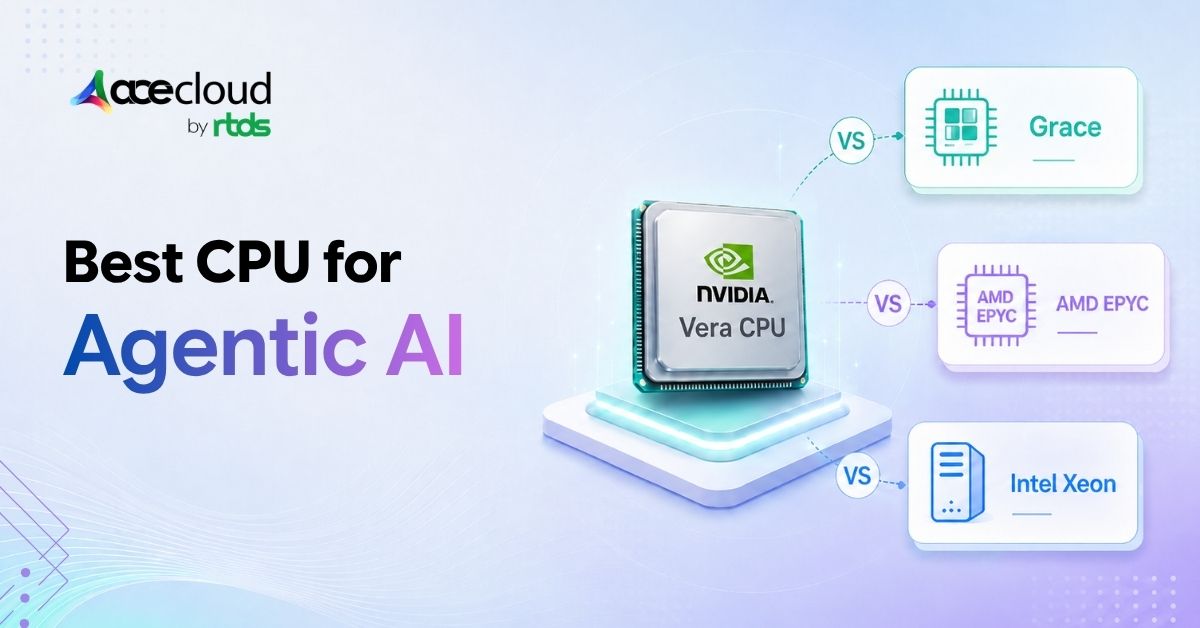
NVIDIA Vera is likely to be the strongest host CPU for agentic AI systems built around Rubin GPUs because it combines high memory bandwidth with a coherent NVLink-C2C connection. AMD EPYC and Intel Xeon remain stronger alternatives when x86 compatibility, conventional memory capacity, mixed-vendor accelerator support, or general-purpose infrastructure matter more.
Key takeaways:
- Vera’s primary advantage is CPU-to-GPU integration, not simply a core count.
- Vera represents a major memory, threading, and interconnect upgrade over NVIDIA Grace.
- AMD EPYC 9575F offers high frequency x86 performance and greater accelerator flexibility.
- Intel Xeon 6980P provides more cores, large memory configurations, and broad enterprise compatibility.
- There is no universal winner. The right CPU depends on the wider AI platform and workload.
For years, the GPU has dominated discussions about AI infrastructure. Faster accelerators, larger GPU memory, and higher interconnect bandwidth have driven successive improvements in model training and inference.
Agentic AI changes the equation. An AI agent does more than generate tokens. It retrieves information, calls APIs, executes code, interacts with databases, runs isolated environments, and coordinates multiple operations before completing a task. Much of that work occurs on the host CPU.
This makes CPU performance, memory bandwidth, and CPU-to-GPU communication increasingly important to overall AI system performance.
What is the NVIDIA Vera CPU?
The NVIDIA Vera CPU is a custom Arm-based data center processor designed for agentic AI, reinforcement learning, analytics, and Rubin GPU systems. It handles CPU-side operations such as orchestration, tool execution, data preparation, memory management, and control flow.
Unlike NVIDIA Grace, which uses Arm Neoverse V2 cores, Vera uses 88 custom NVIDIA-designed Olympus cores. NVIDIA’s Spatial Multithreading technology provides two hardware threads per core, giving the processor 176 threads in total.
NVIDIA Vera Specifications:
| Specification | NVIDIA Vera |
|---|---|
| CPU architecture | Armv9.2 |
| Core design | NVIDIA Olympus |
| CPU cores | 88 |
| Hardware threads | 176 |
| L2 cache | 2 MB per core |
| Shared L3 cache | 164 MB |
| Maximum memory | Up to 1.5 TB LPDDR5X |
| Memory bandwidth | Up to 1.2 TB/s |
| CPU-to-GPU bandwidth | Up to 1.8 TB/s NVLink-C2C |
| On-chip fabric bandwidth | 3.4 TB/s bisection bandwidth |
| Host I/O | PCIe Gen 6 and CXL 3.1 |
| Primary accelerated platform | NVIDIA Vera Rubin |
NVIDIA’s design priorities are visible in these specifications. The company is not attempting to win solely by adding the largest possible number of cores. Vera instead emphasizes single-thread responsiveness, memory throughput, predictable performance under load, and fast communication with NVIDIA GPUs.
Its LPDDR5X memory subsystem supplies up to 1.2 TB/s of bandwidth and up to 1.5 TB of capacity. NVIDIA’s second-generation Scalable Coherency Fabric connects the cores, cache, memory, I/O, and NVLink-C2C on a single compute die.
The defining capability, however, is the coherent NVLink-C2C connection. It provides up to 1.8 TB/s of bandwidth between Vera CPUs and compatible NVIDIA GPUs. When paired with Rubin GPUs, the connection enables a coherent address space across CPU and GPU memory, reducing the need to manage each memory pool as an isolated resource.
For organizations evaluating accelerated infrastructure more broadly, AceCloud’s guide to high-performance computing with cloud GPUs explains how GPU parallelism, cloud scalability, and host infrastructure work together in modern AI and machine learning environments.
Summary: Vera is best understood as the CPU component of an integrated NVIDIA AI platform, not simply as another general-purpose server processor.
Why does Agentic AI Need a More Powerful Host CPU?
Agentic AI places more work on the CPU than a conventional inference request.
A relatively simple inference workflow sends an input to a model, executes the model on a GPU, and returns the output. An agentic workflow may repeatedly alternate between model reasoning and external actions:
- The model determines the next action.
- The CPU invokes an API, database, application, or code environment.
- Data is retrieved, filtered, or transformed.
- The result is returned to the model.
- The model evaluates the result and decides what to do next.
- The loop continues until the task is complete.
The CPU may therefore need to manage tool calls, retrieval pipelines, databases, operating system services, code sandboxes, networking, storage, and reinforcement learning environments.
These demands are part of a broader set of agentic AI infrastructure requirements, including runtime isolation, memory, tool access, observability, security, and cost control. An agent platform must support the complete execution loop, not only the model endpoint.
A more powerful GPU will not necessarily complete an agentic task faster when the surrounding CPU workflow is the bottleneck. When a GPU must repeatedly wait for code execution, retrieved data, or scheduling decisions, host-side delays can reduce accelerator utilization.
This is the central argument behind Vera. Improving the CPU can increase the productivity of the much more expensive GPU infrastructure connected to it.
NVIDIA Vera vs Grace: What is the Real Generational Improvement?
Vera is the successor to NVIDIA Grace, but the transition involves much more than adding 16 CPU cores.
Grace established NVIDIA’s use of Arm CPUs in accelerated systems. A single Grace CPU contains 72 Arm Neoverse V2 cores, up to 480 GB of LPDDR5X memory, and up to 512 GB/s of memory bandwidth. Vera moves to custom Olympus cores and substantially expands threading, memory capacity, and connectivity.
NVIDIA Vera vs Grace specifications:
| Capability | NVIDIA Grace | NVIDIA Vera | Practical significance |
|---|---|---|---|
| Core design | Arm Neoverse V2 | NVIDIA Olympus | Greater NVIDIA control over CPU optimization |
| CPU cores | 72 | 88 | More compute capacity |
| Hardware threads | 72 | 176 | Far greater concurrency |
| L2 cache | 1 MB per core | 2 MB per core | Larger per-core working set |
| Shared L3 cache | 114 MB | 164 MB | More shared cache |
| Maximum memory | Up to 480 GB | Up to 1.5 TB | Support for larger workloads |
| Memory bandwidth | Up to 512 GB/s | Up to 1.2 TB/s | More than twice the peak bandwidth |
| NVLink-C2C bandwidth | Up to 900 GB/s | Up to 1.8 TB/s | Twice the coherent link bandwidth |
| Host I/O generation | PCIe Gen 5 | PCIe Gen 6 and CXL 3.1 | Greater I/O potential |
| Confidential computing | Not listed in NVIDIA’s comparison | Supported | Stronger isolation capabilities |
The largest change is concurrency. Vera’s 88 cores provide 176 hardware threads, compared with 72 threads on Grace. NVIDIA says Spatial Multithreading partitions core resources between the two threads rather than relying only on time slicing, with the goal of maintaining predictable performance and isolation in multi-tenant environments.
Memory is the second major change. Vera offers more than three times Grace’s maximum single-CPU memory capacity and more than twice its peak memory bandwidth. The CPU-to-GPU connection also doubles from 900 GB/s to 1.8 TB/s.
These improvements matter for workloads involving large numbers of concurrent agents, data preparation, retrieval, analytics, and repeated movement between CPU and GPU execution.
Grace may still make sense for existing Grace Hopper or Grace Blackwell deployments, particularly where the workload already performs well within Grace’s memory and concurrency limits. Replacing a working platform solely to obtain newer CPU specifications would not necessarily deliver a proportionate business benefit.
Summary: Grace introduced NVIDIA’s Arm CPU strategy. Vera reshapes it around agentic execution, high-bandwidth memory, and Rubin-scale infrastructure.
NVIDIA Vera vs AMD EPYC and Intel Xeon
Vera, AMD EPYC, and Intel Xeon do not compete on identical terms.
AMD EPYC and Intel Xeon are general-purpose x86 server processors. They support broad enterprise software ecosystems and can host GPUs and accelerators from different vendors. Vera is more specialized and derives much of its value from its connection to NVIDIA GPUs.
For a focused comparison, two relevant x86 alternatives are:
- AMD EPYC 9575F, a high-frequency server CPU that AMD positions for GPU-powered AI systems.
- Intel Xeon 6980P, a high-core-count performance-core processor for AI, HPC, and enterprise workloads.
| Category | NVIDIA Vera | AMD EPYC 9575F | Intel Xeon 6980P |
|---|---|---|---|
| Instruction set | Arm | x86 | x86 |
| Core architecture | NVIDIA Olympus | AMD Zen 5 | Intel Xeon P-core |
| Cores | 88 | 64 | 128 |
| Threads | 176 | 128 | 256 |
| Shared last-level cache | 164 MB | 256 MB | 504 MB |
| Maximum memory | Up to 1.5 TB LPDDR5X | Platform-dependent DDR5 | Up to 3 TB |
| Memory channels | SOCAMM LPDDR5X subsystem | 12 | 12 |
| Disclosed memory bandwidth | Up to 1.2 TB/s | 614 GB/s per socket | Configuration-dependent |
| Maximum published frequency | Not publicly specified | Up to 5 GHz | Up to 3.9 GHz |
| Accelerator connection | NVLink-C2C and PCIe | PCIe Gen 5 | PCIe Gen 5 |
| PCIe lanes | Not directly comparable | 128 | 96 |
| CPU TDP | Configurable by platform | 400 W default | 500 W |
| Primary strength | Integrated NVIDIA AI systems | High-frequency x86 hosting | Enterprise, HPC, and memory capacity |
Vendor specifications are not perfectly comparable. The processors use different memory technologies, system designs, socket configurations, and methods of accounting for platform power.
AceCloud offers both AMD- and Intel-based CPU-intensive compute instances for workloads that need dedicated CPU resources, multicore performance, and an x86 software environment. This type of infrastructure represents the more conventional cloud deployment model against which specialized platforms such as Vera should be evaluated.
NVIDIA Vera vs AMD EPYC 9575F
The AMD EPYC 9575F contains 64 Zen 5 cores and 128 threads. It offers a boost frequency of up to 5 GHz, 256 MB of L3 cache, 12 DDR5-6400 memory channels, 614 GB/s of per-socket memory bandwidth, and 128 PCIe Gen 5 lanes. AMD supports both one-socket and two-socket configurations.
AMD specifically describes the 9575F as a host CPU for GPU-powered AI workloads. Its high clock speeds are intended to accelerate the CPU-side data processing required to keep attached GPUs supplied with work.
Where Vera CPU may be stronger
Vera provides more cores and threads than the EPYC 9575F and almost twice its disclosed socket-level memory bandwidth. More importantly, its 1.8 TB/s coherent connection to Rubin GPUs is architecturally different from hosting accelerators over conventional PCIe.
That difference is most relevant when an application frequently exchanges data between CPU and GPU memory. It may be less significant when the workload remains almost entirely on the GPU.
Where EPYC may be stronger
EPYC’s primary advantage is flexibility.
Organizations can retain x86 applications, virtualization platforms, operational tools, and proprietary software without migrating them to Arm. EPYC systems can also support accelerators from NVIDIA, AMD, and other vendors, reducing dependence on one vertically integrated ecosystem.
Its published boost frequency also makes the 9575F relevant for workloads that depend on fast CPU-side serial execution.
Summary: Vera is the more integrated choice for Rubin-based AI. EPYC 9575F is the more flexible choice for high-frequency x86 hosting.
NVIDIA Vera vs Intel Xeon 6980P
Intel’s Xeon 6980P contains 128 performance cores and 256 threads, exceeding Vera in both categories. It also includes 504 MB of cache, supports up to 3 TB of DDR5 or MRDIMM memory, and provides 96 PCIe Gen 5 lanes. Its maximum turbo frequency is 3.9 GHz, and its stated TDP is 500 W.
Intel positions its Xeon 6 performance-core processors for AI, HPC, and demanding general-purpose workloads. The platform also includes technologies such as Intel Advanced Matrix Extensions and data-processing accelerators that can benefit selected inference, analytics, compression, security, and data-movement operations.
Where Vera may be stronger
Vera places greater emphasis on memory bandwidth and CPU-to-GPU coherency. In a Rubin deployment, it can operate as part of a unified CPU and GPU architecture rather than as a conventional host connected through PCIe.
This may reduce host-to-accelerator overhead in agentic systems, reinforcement learning pipelines, and other applications that repeatedly alternate between CPU-side and GPU-side execution.
Where Xeon may be stronger
Xeon offers more CPU cores and threads, larger conventional memory configurations, and a mature ecosystem of enterprise software and certifications.
It may be better suited to environments that combine AI with databases, analytics, virtual machines, HPC applications, and other established x86 workloads. Its ability to support up to 3 TB of memory is also relevant when capacity matters more than bandwidth.
Teams with memory-bound rather than accelerator-bound applications can also evaluate RAM-intensive cloud compute separately from GPU infrastructure. This helps prevent overprovisioning accelerators for workloads whose actual constraint is host memory capacity.
What do early benchmarks indicate?
Early Linux testing suggests that Vera is competitive with current EPYC and Xeon processors in selected compilation, database, encoding, runtime, and memory-related workloads.
However, these initial tests were conducted at NVIDIA’s facilities, and NVIDIA restricted the available benchmarks to workloads aligned with Vera’s intended markets. The results are useful early evidence, but they should not be treated as proof that Vera is faster across all server applications. Independent production measurements of power, application performance, and total cost remain necessary.
The correct cloud instance should be selected through workload testing rather than specification matching alone. AceCloud’s comparison of standard, compute-optimized, and memory-optimized instances outlines useful metrics such as throughput, P95 and P99 latency, CPU utilization, memory utilization, I/O wait, and cost per useful unit.
Summary: Vera focuses on NVIDIA GPU integration. Xeon focuses on high-end x86 compute, memory capacity, and enterprise versatility.
Where does NVIDIA Vera have a Meaningful Advantage?
Vera’s advantages are most significant when the host CPU directly affects the productivity of an NVIDIA GPU system.
1. Frequent CPU-to-GPU communication
NVLink-C2C provides up to 1.8 TB/s of coherent bandwidth between Vera and compatible NVIDIA GPUs. It also enables a unified address space across CPU and GPU memory.
This can benefit applications that frequently move data, model state, or control information between the two processors. Potential examples include tool-using agents, reinforcement learning, large-scale data pipelines, and KV-cache offload.
2. Memory-bandwidth-intensive CPU workloads
Vera supplies up to 1.2 TB/s of memory bandwidth. NVIDIA says its coherency fabric can sustain more than 90% of peak bandwidth under load, although this is a vendor claim that requires broader independent validation. (NVIDIA Vera architecture analysis)
High bandwidth can be valuable for retrieval, analytics, data transformation, and simulation environments that process large amounts of data concurrently.
Memory bandwidth should not be confused with memory capacity. Vera prioritizes rapid data access, while some Xeon or EPYC configurations may offer more conventional system memory.
3. Concurrent agents and execution environments
Vera’s 176 hardware threads are designed to support high levels of CPU-side concurrency. That can include parallel tool calls, code sandboxes, evaluation environments, data-processing tasks, and reinforcement learning simulations.
The benefit will depend on whether these tasks can execute in parallel and whether memory, storage, or external services become the next bottleneck.
Organizations moving from an agent prototype to a production environment should evaluate orchestration, observability, and governance alongside processor performance. AceCloud’s overview of agentic AI trends for production deployments discusses the growing importance of multi-agent orchestration, standardized tool connectivity, evaluation, and security by design.
4. Full-stack optimization
NVIDIA controls the Vera CPU, Rubin GPU, NVLink interconnect, networking components, and much of the software stack. The Vera Rubin NVL72 rack, for example, combines 36 Vera CPUs with 72 Rubin GPUs, along with NVIDIA networking and infrastructure processors.
This vertical integration can simplify system-level optimization. It can also increase dependence on NVIDIA’s platform, pricing, and product roadmap.
For organizations that prefer cloud-based access rather than owning and operating accelerator infrastructure, AceCloud GPU Cloud provides on-demand NVIDIA GPU instances for AI training, inference, and high-performance computing workloads.
When does AMD EPYC or Intel Xeon make more sense?
EPYC or Xeon may be the better choice when compatibility and flexibility outweigh Vera’s CPU-to-GPU integration.
| Requirement | Likely best fit | Reason |
|---|---|---|
| Vera Rubin infrastructure | NVIDIA Vera | Native CPU-to-GPU integration |
| Frequent CPU-to-GPU data exchange | NVIDIA Vera | Coherent NVLink-C2C |
| Agentic AI and RL environments | NVIDIA Vera | Memory bandwidth and concurrency |
| Existing x86 application estate | EPYC or Xeon | Lower migration effort |
| High-frequency x86 GPU host | AMD EPYC 9575F | Up to 5 GHz boost frequency |
| Large conventional-memory workload | Intel Xeon 6980P | Up to 3 TB memory support |
| Mixed-vendor accelerator platform | EPYC or Xeon | Greater hardware flexibility |
| General-purpose enterprise server | EPYC or Xeon | Broader workload compatibility |
| Lowest migration risk | Existing x86 platform | No instruction-set transition |
Moving from an x86 platform to Vera may require organizations to:
- Rebuild container images for Arm.
- Recompile internally developed applications.
- Validate third-party software.
- Test security, monitoring, and management agents.
- Review virtualization and orchestration support.
- Retest performance-sensitive code.
- Confirm vendor licensing and support policies.
Containerized applications can simplify parts of this transition, but teams still need compatible images, libraries, drivers, and operational tooling. A managed platform such as AceCloud Kubernetes can provide a consistent orchestration layer across CPU and GPU nodes, while Kubernetes GPU clusters support scalable AI and machine learning deployments.
Agent workflows may also depend on retrieval data, application state, logs, and model artifacts that sit outside the compute node. These can be supported through S3-compatible object storage and managed database services, depending on the latency, consistency, and data-access requirements of the application.
NVIDIA says major Linux distributions, AI frameworks, and orchestration platforms can run on Vera’s Arm environment. That does not guarantee that every proprietary enterprise application or operational dependency will be immediately compatible.
Summary: Choose Vera when Rubin integration, CPU-to-GPU communication, and agentic throughput are the priorities. Choose EPYC or Xeon when x86 compatibility, accelerator choice, and general-purpose flexibility matter more.
Final Verdict: Which CPU is Best for Agentic AI?
NVIDIA Vera is likely to be the strongest option for agentic AI systems built around Rubin GPUs, especially when CPU-side execution, data movement, or memory bandwidth limits overall application performance.
Its main differentiators are:
- Up to 1.2 TB/s of memory bandwidth.
- A 1.8 TB/s coherent connection to Rubin GPUs.
- 176 hardware threads for concurrent CPU-side operations.
- Tight integration with the wider NVIDIA AI platform.
AMD EPYC 9575F remains attractive for high-frequency x86 GPU hosting and mixed-vendor infrastructure. Intel Xeon 6980P is compelling for high-core-count enterprise systems, large memory configurations, and environments combining AI with established databases, analytics, or HPC applications.
Vera should therefore not be described as universally better than EPYC or Xeon. It is better suited to a specific architectural objective, which is maximizing the performance of a tightly integrated NVIDIA AI system.
The real decision is not simply Vera versus EPYC or Xeon. It is tightly integrated AI infrastructure versus a more flexible, general-purpose x86 platform.
For cloud buyers, the final decision should be based on end-to-end measurements such as GPU utilization, agent completion time, cost per completed task, memory requirements, migration effort, and infrastructure flexibility, not core counts alone.
The deployment model also matters. AceCloud’s comparison of cloud GPUs and on-premises GPU infrastructure explains where elasticity and rapid scaling may be preferable to hardware ownership, and where direct control or steady utilization may favor an on-premises environment.
At AceCloud, we help enterprises design, deploy, and scale autonomous agents using India-hosted GPU infrastructure, databases, storage, and managed cloud services. Explore AceCloud Agentic AI or compare available cloud GPU options.
Frequently Asked Questions
Yes. NVIDIA Vera implements the Armv9.2 architecture and uses 88 custom NVIDIA Olympus cores. Applications already available for Arm Linux may transition relatively easily, while proprietary x86-only software may require recompilation, replacement, or additional validation.
Vera adds custom NVIDIA CPU cores, two hardware threads per core, more than three times Grace’s maximum single-CPU memory capacity, over twice its peak memory bandwidth, and twice its CPU-to-GPU NVLink-C2C bandwidth. It is more explicitly designed for agentic AI and Rubin-based infrastructure.
AMD EPYC 9575F is a useful current comparison because AMD positions it as a high-frequency host CPU for GPU-powered AI systems. It provides 64 cores, 128 threads, and up to 5 GHz boost frequency, but it does not offer a direct equivalent to Vera’s coherent connection to Rubin GPUs.
Intel Xeon 6980P is a relevant performance-oriented alternative for enterprise AI and HPC. It offers 128 cores, 256 threads, and up to 3 TB of memory, while Vera places greater emphasis on memory bandwidth and integration with NVIDIA GPUs.
Yes. NVIDIA positions Vera for both accelerated and standalone deployments. Its most distinctive CPU-to-GPU benefits, however, are realized when it is paired with compatible NVIDIA GPUs through NVLink-C2C.
No. Vera is most differentiated in Rubin-based, CPU-to-GPU-intensive, and agentic workloads. EPYC or Xeon may be preferable for x86 applications, mixed-vendor accelerator systems, large conventional-memory deployments, and general-purpose enterprise infrastructure.
An upgrade may make sense when memory capacity, memory bandwidth, CPU-side concurrency, or CPU-to-GPU communication is limiting the existing workload. Organizations whose applications already run efficiently on Grace should compare complete application performance and migration costs before replacing the platform.



![Best Open-Weight Models for Vibe Coding [2026]](https://acecloud.ai/wp-content/uploads/2026/09/best-open-weight-models-vibe-coding.webp)