Quick Answer
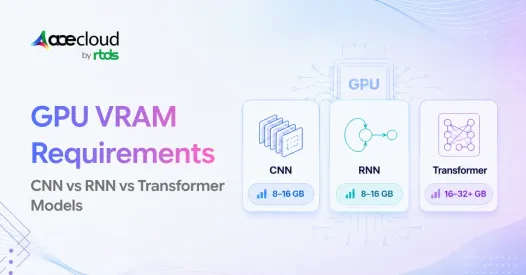
Most CNN and RNN projects run fine on 8 to 16 GB of video memory, or VRAM. Transformer workloads commonly need 16 to 32 GB or more. Small inference tasks fit in 4 to 8 GB, while high-resolution vision, long sequences, large language models, and full training can demand 48 GB, multiple GPUs, or data center accelerators. These are starting points, not guarantees. Model size, batch size, precision, input size, sequence length, and training versus inference all shift the number.
When determining deep learning model’s GPU requirements, it all comes down to the memory needed to store its data and the power needed to run its math.
- VRAM holds weights, activations, gradients, and optimizer states.
- Compute throughput drives training speed and inference latency.
- Memory bandwidth controls how fast data moves to the GPU cores.
- Precision support (FP16, BF16, INT8, INT4) cuts memory use and speeds things up.
Weight memory roughly equals parameter count multiplied by bytes per parameter. Training needs more memory than inference since it also holds gradients and optimizer states.
You should check our guides on why GPU memory matters and CUDA cores and Tensor Cores as these go deeper into the model-memory reference.
How Much GPU Memory Does a CNN Need?
CNNs are the workload most people underestimate, right up until they train on full resolution images.
A CNN usually needs 8 to 16 GB for standard image classification training, and 16 to 32 GB for detection, segmentation, or higher resolution images. Image size, batch size, feature map count, and depth all push that number up. Doubling both image dimensions creates four times as many pixels, and can push activation memory and compute up by roughly four times too.
- 4 to 8 GB. Small CNN inference and basic classification
- 8 to 16 GB. ResNet, MobileNet, or EfficientNet training
- 16 to 32 GB. Object detection and image segmentation
- 24 to 80 plus GB. Medical imaging, satellite imagery, video, and 3D CNNs
Mixed precision, smaller crops, gradient accumulation, and frozen backbones all bring these numbers down. For more information, you must refer to our guide on GPU acceleration for image processing and PyTorch’s Conv2d documentation.
How Much GPU Memory Does an RNN, LSTM, or GRU Need?
Most recurrent workloads train fine on 8 to 16 GB, though long sequences, wide hidden states, and bidirectional models push that to 16 to 32 GB. An RNN processes data one step at a time, an LSTM adds gates for longer term memory, and a GRU uses a simpler gated structure.
Sequence length, batch size, hidden state size, and layer count move the needle most. These models often need less VRAM than large Transformers, but may not fully use a high-end GPU anyway since steps process one after another.
- 2 to 4 GB. Small model inference
- 4 to 8 GB. Basic time series or text classification
- 8 to 16 GB. Multi-layer LSTM or GRU training
- 16 to 32 GB. Long or bidirectional sequences
Truncated backpropagation, packed sequences, and mixed precision all help.
Also read: Our guide on Cloud GPUs for AI and Machine Learning
How Much GPU Memory Does a Transformer Need?
Transformers generally need the most memory because they combine large parameter counts with attention activations, optimizer states, long context, and key value cache during inference. The KV cache stores attention keys and values from earlier tokens so the model skips recomputing the whole sequence for every new token. Dense self-attention also scales quadratically with sequence length, so doubling the context can roughly quadruple the attention workload.
- 1 to 3B parameters. Roughly 4 to 12 GB
- 7 to 8B parameters. Roughly 16 to 24 GB in FP16 or BF16
- Quantized 7 to 8B. Roughly 6 to 12 GB
- 13B parameters. Roughly 24 to 48 GB
- 70B parameters. High memory or multi-GPU hardware unless heavily quantized
Quick example: A 7B model needs about 14 GB for BF16 weights alone, since each parameter takes roughly two bytes. Add overhead and KV cache, and a 20 to 24 GB GPU is safer for unquantized inference. FlashAttention, gradient checkpointing, INT8 or INT4 quantization, LoRA, and sharding methods like FSDP help fit bigger models into smaller GPUs.
Also read: AceCloud’s guide on Choosing a GPU for AI inference
Which Model Architecture Needs the Most GPU Power?
Transformers usually need the most VRAM, CNNs get memory hungry at large resolutions, and RNNs are lighter but harder to parallelize.
| Architecture | Main memory driver | Typical starting VRAM | Main bottleneck |
|---|---|---|---|
| CNN | Image resolution and feature maps | 8 to 16 GB | Convolutions and activations |
| RNN or LSTM | Sequence length and hidden states | 8 to 16 GB | Sequential execution |
| Transformer | Parameters, attention, and KV cache | 16 to 32 GB | VRAM capacity and bandwidth |
Architecture alone does not decide this though. A high-resolution segmentation CNN can need more VRAM than a small Transformer. We often point people toward the 24 GB NVIDIA A30 as a solid mid range example, not a universal answer.
How Should You Choose a GPU for Deep Learning?
Once you know your architecture and rough workload, picking hardware gets simpler.
- 8 GB. Learning, lightweight inference, and small models
- 12 to 16 GB. General CNN and RNN training
- 24 to 32 GB. Detection, segmentation, 7B Transformers, and fine tuning
- 48 GB or more. High resolution vision and larger Transformer workloads
- Multiple GPUs. Full training of multi billion parameter Transformers
Prioritize VRAM capacity before peak speed, since a faster GPU cannot run a workload that does not fit in memory. Leave roughly 10 to 20 percent free for overhead and fragmentation. Bandwidth, precision support, and cloud versus owned hardware matter too, just further down the list.
There you have it. CNN requirements depend on image resolution, RNN requirements depend on sequence length, and Transformer requirements depend on model size and context. Work out the full picture of your workload before you commit to hardware.
Need more information? Book your free consultation with our GPU and LLM experts at AceCloud, and get all your questions answered.
Frequently Asked Questions
Not for small models or basic inference, but a GPU speeds up training a lot, especially for Transformers and high-resolution CNNs.
Yes, for learning, small CNNs, basic RNNs, and quantized Transformer inference. It gets tight with segmentation, large batches, or fine tuning.
It works for smaller Transformers and many quantized 7B models. Full precision 7B inference and training generally need more.
Yes. Larger batches store more inputs and activations at once. Reducing microbatch size is an easy fix for memory errors.
Yes. Longer sequences raise stored activations in RNNs and attention memory in Transformers.
VRAM decides whether the workload fits at all, while CUDA cores decide how fast it runs. Check capacity first.
Not automatically. Data parallel training puts a full model copy on each GPU. Sharding methods like FSDP split model states instead.
The framework may throw a memory error, offload to slower CPU memory, or fail to load. Batch size or precision usually need adjusting.
Mixed precision, smaller batches, gradient accumulation, checkpointing, quantization, shorter sequences, and methods like LoRA all help.
Yes. Training stores gradients and optimizer states on top of the weights. Inference can still get demanding with long contexts.
A local GPU suits steady workloads on fixed hardware. Cloud GPUs give more flexibility for occasional or temporary multi-GPU work.

