

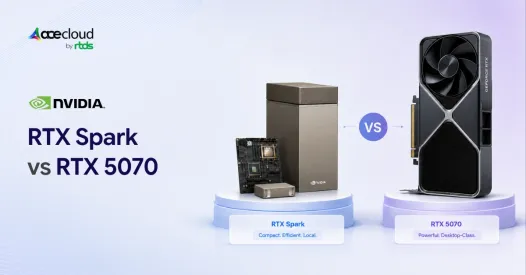
NVIDIA’s 2026 RTX Spark push has changed how developers think about local AI PCs. At the same time, the RTX 5070 gives users a capable Blackwell-generation GPU for gaming, creative work, and lighter AI tasks. Both are generating a lot of buzz right now.
But for AI teams, “Which GPU is better?” is the wrong question. The better question is which workloads belong on a local device, and which workloads need cloud GPU infrastructure to actually ship.
RTX Spark vs RTX 5070: The Short Answer
Before we get into the details, here is the practical answer if you are short on time.
RTX Spark is better for local AI agents, larger local model experiments, and private AI workflows. RTX 5070 is better for mainstream gaming, creator workloads, and smaller AI tasks that fit within its VRAM. But neither replaces cloud GPUs for production AI.
Choose RTX 5070 for affordable local experimentation. Choose RTX Spark for a premium AI PC with serious local model capacity. Choose cloud GPUs when your workload needs production inference, fine-tuning, shared team access, or flexible scaling.
Quick decision: Choose RTX 5070 for affordable local experimentation, RTX Spark for advanced local AI workflows, and AceCloud GPU Cloud when workloads need shared access, fine-tuning, production inference, or elastic scaling.
NOTE: Specs and pricing as of June 2026. GPU specs and availability can change.
Why RTX Spark vs RTX 5070 is Not a Normal GPU Comparison
Most GPU comparisons follow the same script. Compare CUDA cores, benchmark scores, and price-to-performance, and one GPU wins. The RTX Spark vs RTX 5070 comparison does not work that way, and treating it as a standard spec matchup will get you the wrong answer.
The RTX 5070 is a traditional discrete GeForce GPU built for local GPU performance across gaming, creative, and AI-accelerated workloads. RTX Spark, by contrast, is positioned more directly around AI PCs, unified memory, and local AI agents. NVIDIA’s RTX Spark page lists up to 1 PFLOP FP4 AI compute and up to 128 GB of unified memory for on-device AI agents. The RTX 5070 comes in at 12 GB GDDR7 and 988 AI TOPS.
These are different products solving different problems. The real comparison is workload fit, not raw specs.
RTX Spark is not a discrete GPU. It is a complete system-on-chip. CPU, GPU, and memory integrated on one package and is available only in laptops and compact desktops from OEM partners. You cannot install RTX Spark in your existing workstation or server. The comparison here is between local AI PC platforms and cloud GPU infrastructure, not between two GPUs you can swap into the same machine.
Why Does Memory Matter More Than Compute for AI Workloads?
Here is something that comes up constantly in AI infrastructure conversations. People focus on TOPS and compute numbers. But for most practical AI workloads, memory is the actual constraint.
Model size, context length, batch size, and fine-tuning jobs are all bounded by available memory. A fast GPU means nothing if the model does not fit. This is why the RTX Spark vs RTX 5070 gap is larger than the spec sheet suggests for AI use cases.
Here is how the memory story compares across the three options worth knowing about.
| Factor | RTX Spark | RTX 5070 | What it means |
|---|---|---|---|
| Product type | AI PC platform / superchip | Discrete GPU | Not a like-for-like comparison |
| Best fit | Local agents, larger local AI workflows | Gaming, creator work, smaller AI workloads | Different workload priorities |
| Memory | Up to 128 GB unified memory | 12 GB GDDR7 | Spark fits larger local models better |
| AI limitation | Bandwidth, price, local-only access | VRAM ceiling | Both have real tradeoffs |
| Cloud replacement? | No | No | Both are local compute options |
RTX Spark helps answer, “Can we fit this model locally?” RTX 5070 helps answer, “Can we run smaller AI workloads quickly on a local GPU?” For workloads that need more headroom, H200-class cloud GPUs offer 141 GB HBM3e and upto 4.8 TB/s bandwidth, which is a different category entirely. We have a deeper breakdown in our RTX Spark vs Cloud GPUs post if you want to go further on the local-vs-cloud angle specifically.
RTX Spark and RTX 5070 solve different local AI problems. RTX 5070 is a practical option for smaller experiments, creator workflows and gaming, while RTX Spark gives developers more local memory for advanced AI agents and larger model tests. When the question moves beyond local experimentation into team access, fine-tuning, production inference or scaling, our RTX Spark vs Cloud GPUs guide explains where cloud GPU infrastructure becomes the better fit.
Is RTX 5070 Good for AI Workloads?
The RTX 5070 is not a bad AI GPU. It is just a bounded one, and knowing those bounds is the whole game.
With 12 GB GDDR7 and 988 AI TOPS, RTX 5070 handles smaller local LLM inference reasonably well. Quantized models, image generation experiments, AI-assisted coding, creator AI workflows, and local testing before cloud deployment are all solid use cases. For developers who want an affordable GPU for experimentation before committing to larger infrastructure, RTX 5070 is a practical starting point.
The wall appears when workloads grow. Larger LLMs, long-context tasks, and production inference all push past what 12 GB can handle comfortably. Our guide to the best cloud GPUs for Qwen, Llama, and Mistral inference covers what those workloads actually need in terms of memory and throughput.
What is RTX Spark Best Used for?
RTX Spark is a more interesting product for AI teams, mainly because of the unified memory story.
With up to 128 GB of unified memory, RTX Spark can fit models locally that would never run on a typical discrete GPU. Local AI agents, larger model experiments, private AI workflows with sensitive data, long-context experimentation, and developer prototyping are all reasonable RTX Spark territory. The CUDA and NVIDIA ecosystem compatibility is a bonus for teams that already have tooling built around that stack.
One thing worth being clear about, though. Large unified memory does not automatically mean production readiness. RTX Spark does not solve multi-user access, elastic scaling, centralized deployment, or production uptime. It is a powerful local AI device, not an enterprise AI infrastructure replacement.
Can RTX Spark or RTX 5070 Replace Cloud GPUs?
Both RTX Spark and RTX 5070 share the same fundamental limitation. One machine serves one person.
Teams need shared compute. Larger workloads can exceed even generous local memory limits. Full fine-tuning of larger models can be slow or impractical locally, while LoRA or QLoRA-style fine-tuning may still be possible depending on model size, quantization, memory, and framework support. Production inference needs uptime and concurrency that a local device cannot reliably provide.
There is also the operational side that nobody talks about until they are dealing with it. Drivers, thermals, CUDA compatibility between framework updates, and hardware refresh cycles all add overhead. Gartner forecasts worldwide AI spending will reach $2.52 trillion in 2026, with AI infrastructure adding $401 billion in spending. That growth is not coming from teams running everything on a single workstation.
What are the Hidden Costs of Buying GPUs for AI Teams?
The GPU purchase price is the part everyone talks about. The hidden cost is everything else.
Upfront hardware cost is just the beginning. Add idle GPU time between jobs, procurement delays, hardware refresh cycles every two to three years, cooling and power requirements, driver compatibility management, and the fact that a local GPU workstation typically serves one person at a time. For a team of five engineers, that math gets uncomfortable fast.
IDC projects AI infrastructure spending will reach $487 billion in 2026, up roughly 53% year over year, and exceed $1 trillion by 2029. Teams treating AI compute as a strategic decision are shifting to cloud GPU pricing models that let them pay for compute they actually use. Slow data pipelines also make GPUs idle, which is worth reading about in our piece on cloud storage for AI/ML workloads.
The real cost of local AI hardware is not just the GPU price. It is the cost of keeping expensive compute useful, available, and scalable across a team.
Not sure whether buying GPUs or renting cloud GPUs makes more sense for your AI workload? Book a free AceCloud consultation and get a workload-specific GPU recommendation before you commit budget.
The Contrarian View: RTX Spark May Actually Increase Cloud GPU Demand
Here is a take worth sitting with. Most people assume that better local AI hardware reduces the need for cloud GPUs. We think the opposite is more likely.
If RTX Spark makes it easier for developers to build local AI agents and prototypes, it will create more experiments. And more experiments means more things that eventually need production deployment. RTX Spark does not kill cloud GPU demand. It generates more AI prototypes that eventually need cloud infrastructure to scale.
Local AI lowers the barrier to experimentation. Once those experiments become products, teams still need scalable inference, fine-tuning infrastructure, storage, networking, monitoring, and reliable uptime. The development-to-production handoff is where local hardware ends and cloud infrastructure begins.
Decision Framework: RTX 5070, RTX Spark, or AceCloud GPU Cloud?
If you want a clear decision framework, here is how we would map it across common scenarios.
| Scenario | Best fit | Why |
|---|---|---|
| Testing small models locally | RTX 5070 | Affordable local experimentation |
| Gaming, creator work, and some AI | RTX 5070 | Balanced mainstream GPU use |
| Local AI agents and larger local models | RTX Spark | Larger memory and AI PC focus |
| Private local AI workflows | RTX Spark | Better for advanced local AI use cases |
| Cost-efficient inference | AceCloud L4 / L40S | Better for smaller or quantized model serving |
| Fine-tuning at scale | AceCloud A100 / H100 | Larger memory and scalable infrastructure |
| Long-context or 70B+ model serving | AceCloud H200 | High memory and bandwidth for larger LLM workloads |
| Team needs shared GPU access | AceCloud GPU Cloud | Cloud solves multi-user access |
| Best overall workflow | Local + AceCloud | Prototype locally, scale in cloud |
Choose local GPUs when you need individual experimentation. Choose cloud GPUs for inference and fine-tuning when your AI workload becomes collaborative, repeatable, or production-facing.
Why AceCloud Fits the Production AI Stage
Buying a GPU solves one workstation problem. AceCloud GPU Cloud solves the team infrastructure problem.
AceCloud offers on-demand NVIDIA GPU instances including A30, L4, L40S, A100, H100, and H200, covering inference, fine-tuning, training, rendering, and data science across different budget tiers. The infrastructure is India-hosted with INR billing, which matters for teams managing compliance and cost predictability. Pay-as-you-go billing, pre-built AI frameworks, 24/7 human support, and ₹20,000 free credits for new accounts round it out. AceCloud pricing is listed in INR across GPU tiers so teams can model costs before they commit.
IDC reported that cloud and shared environments accounted for 84.1% of AI infrastructure spending in Q2 2025. Enterprise AI infrastructure is already heavily cloud-driven. The local device is the starting point, not the destination. For teams managing RAG pipelines or large datasets, cloud object storage also plugs naturally into this workflow in a way that local storage simply cannot.
Final Verdict: Local AI Starts the Journey, Cloud GPUs Scale It
RTX 5070 makes local AI experimentation accessible. RTX Spark makes advanced local AI workflows more realistic for developers who need larger local model capacity. But enterprise AI is not won on a single device.
The right strategy is hybrid. Use local hardware for experimentation, and use cloud GPUs for scale. RTX Spark and RTX 5070 help teams start building. AceCloud helps them deploy, scale, and operate AI workloads reliably when those experiments become products.
Sources and methodology: This comparison uses official NVIDIA specifications for RTX Spark, RTX 5070, and H200, along with Gartner and IDC infrastructure spending forecasts. AceCloud GPU recommendations are mapped by workload type, including local experimentation, LLM inference, fine-tuning, production deployment, and team-scale GPU access.
Frequently Asked Questions
RTX Spark is better for larger local AI workflows and AI agents because of its unified memory capacity. RTX 5070 is better for smaller AI workloads, creator use, and affordable local experimentation. For production AI workloads, AceCloud GPU Cloud covers what neither local option can.
RTX 5070 can run smaller or quantized LLMs, but larger models and long-context workloads will run into its 12 GB VRAM limit fairly quickly.
No. RTX Spark is useful for local AI workflows, but cloud GPUs are better for production inference, fine-tuning at scale, team access, and elastic compute.
Use cloud GPUs when your workload needs larger GPU options, shared team access, production uptime, scalability, or pay-as-you-go infrastructure without upfront hardware costs.
It depends on model size and throughput requirements. AceCloud L4 and L40S work well for smaller and quantized models. A100 and H100 handle larger fine-tuning and inference jobs. H200 is the right choice for long-context workloads and 70B+ model serving.

