
Quick Answer
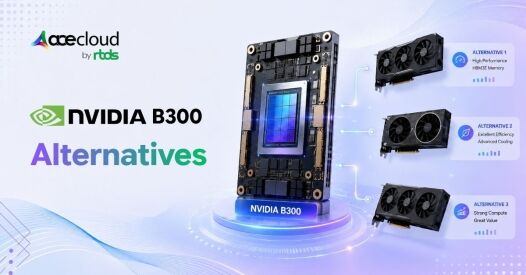
Yes, there are cheaper alternatives to NVIDIA B300. Most enterprises should evaluate the NVIDIA H200, H100, RTX PRO 6000 Blackwell, A100, or L40S before committing to B300-class infrastructure. H200 is the closest high-memory alternative, while H100 remains the most balanced choice for enterprise AI. The right option depends on model memory, throughput, latency, precision, scaling, and software compatibility.
An AI team preparing to deploy a large language model may assume the NVIDIA B300 is the safest choice. However, after evaluating model size, context length, inference volume, and expected utilization, they may discover that an H200, H100, or even RTX PRO 6000 can meet the same production requirements at a significantly lower cost.
That is the real issue this article addresses. The question is not whether another GPU can match every B300 specification. It is whether a cheaper alternative can complete the same business workload without unnecessary infrastructure overhead.
Here, we compare the most relevant alternatives by architecture, memory, workload fit, scalability, and cost.
What is NVIDIA B300 GPU?
The NVIDIA B300 is a Blackwell Ultra accelerator designed for frontier-model training, long-context reasoning, high-concurrency inference, mixture-of-experts models, and tightly interconnected multi-GPU environments.
According to NVIDIA’s official DGX B300 documentation, one system contains eight B300 GPUs with 288 GB of HBM3E memory each. That equals approximately 2.3 TB of aggregate GPU memory.
Key Specifications:
- FP8 training performance: 72 PFLOPS
- FP4 inference performance: 144 PFLOPS
- Aggregate NVLink bandwidth: 14.4 TB/s
- System power: Approximately 1100 W
- Rack footprint: 10U
- Best suited for: Frontier training, reasoning inference, large mixture-of-experts models, and high-concurrency serving
The 14.5 kW, 10U design also has implications beyond GPU cost. Organizations may need suitable rack power, cooling, networking, storage throughput, and data-center capacity.
B300 should therefore be treated as a specialized accelerator for exceptional workloads, not the default option for every AI project.
For a full breakdown of its architecture and platform design, see our dedicated guide to the NVIDIA HGX B300.
What are the Cheaper Alternatives for NVIDIA B300?
Well, there is no single drop-in replacement that matches the B300 in every category. The right alternative depends on which B300 capability the workload actually needs.
- H200 is the closest practical option for memory-intensive workloads.
- H100 is the strongest all-round enterprise choice.
- RTX PRO 6000 Blackwell is compelling for high-memory inference, development, simulation, and visual AI.
- A100 remains useful for mature training environments.
- L40S provides better economics for narrower inference workloads.
| Requirement | Our Recommendation |
|---|---|
| Maximum memory per GPU | B200 or AMD MI350X |
| High-memory NVIDIA cloud workload | H200 |
| Enterprise training and inference | H100 |
| High-memory development and visual AI | RTX PRO 6000 |
| Mature, cost-conscious training | A100 |
| Quantized or multimodal inference | L40S |
A lower-priced GPU is not automatically cheaper. When it requires several additional accelerators or substantially more processing time, the apparent savings may disappear.
How Do NVIDIA B300 Alternatives Compare?
The strongest B300 alternative depends on which capabilities matter most to the workload. AceCloud offers several NVIDIA GPUs including H200 NVL, H100 HGX, RTX PRO 6000 Blackwell, A100, and L40S for different training, inference, development, and visual computing requirements.
B200 is also a relevant comparison for organizations that want to remain on Blackwell while stepping down from B300’s 288 GB memory capacity. For teams open to a non-NVIDIA platform, AMD Instinct MI350X provides another high-memory option, with software compatibility and ROCm readiness becoming important parts of the decision.
The following comparison looks at where each GPU fits based on architecture, GPU memory, scalability, software ecosystem, workload requirements, and cost.
NVIDIA B200: The Closest Blackwell Step-Down
B200 is a more direct architectural alternative to B300 than H200. An eight-GPU DGX B200 provides 1,440 GB of aggregate HBM3E memory and 64 TB/s of aggregate memory bandwidth. This equals 180 GB and 8 TB/s per GPU.
It is suited to organizations that require Blackwell training and inference capabilities but do not need 288 GB per GPU.
B200 is still a premium data-center accelerator. Its availability, complete system configuration, cloud pricing, and total infrastructure cost should be confirmed before it is described as the cheaper option for a specific workload.
Our verdict: Choose B200 when Blackwell architecture is required, and 180 GB per GPU is sufficient.
For a detailed spec-by-spec breakdown, see our HGX B300 vs HGX B200 platform comparison.
NVIDIA H200 NVL: The Closest Practical High-Memory Alternative
NVIDIA H200 extends the Hopper architecture with 141 GB of HBM3E memory and 4.8 TB/s of bandwidth, making it suitable for workloads that struggle to fit on 80 GB GPUs. It can accommodate larger model weights, longer context windows, bigger KV caches, and more demanding fine-tuning tasks.
H200 NVL on AceCloud starts from ₹222,775 per month. This page will have more detailed information.
Key Specifications
- Architecture: NVIDIA Hopper
- GPU memory:141GB HBM3e
- Memory bandwidth: 4.8 TB/s
- Best suited for: Large-model inference, RAG, long-context LLMs, fine-tuning, and memory-intensive HPC
H200 can reduce the need for model parallelism, CPU offloading, or aggressive quantization. However, it still provides less than half the B300’s 288 GB per GPU and lacks Blackwell Ultra’s latest FP4 capabilities.
Our verdict: Choose H200 when memory is the main constraint, but 288 GB per GPU is unnecessary.
For a deeper cost breakdown against other inference-focused GPUs, see our NVIDIA H200 cost comparison for AI inference.
NVIDIA H100 HGX: The Best Overall Enterprise Alternative to B300
The H100 remains the most balanced option for enterprise AI. Its 80 GB of HBM3 memory, Transformer Engine, fourth-generation Tensor Cores, mature CUDA support, and NVLink-based scaling makes it suitable for production training, inference, fine-tuning, and HPC.
AceCloud offers H100 HGX from ₹180,000 per month, with one, two, four, and eight-GPU configurations.
Key Specifications
- Architecture: NVIDIA Hopper
- GPU memory:80 GB HBM3
- Scaling options: Up to eight GPUs
- Best suited for: Enterprise training, distributed AI, production inference, and HPC
The main limitation is memory. Models exceeding 80 GB may require quantization, offloading, tensor parallelism, or additional GPUs.
Our verdict: Choose H100 for the strongest balance of performance, software maturity, scalability, and cost.
NVIDIA RTX PRO 6000 Blackwell: The Strongest Lower-Cost Blackwell Option
The RTX PRO 6000 brings Blackwell architecture to AI development, inference, rendering, simulation, and professional visual computing. Its 96 GB of GDDR7 ECC memory gives it more capacity than a standard 80 GB H100, making it attractive for large single-GPU workloads.
AceCloud offers RTX PRO 6000 instances from ₹121,599 per month.
Key specifications
- Architecture: NVIDIA Blackwell
- GPU memory:96 GB GDDR7 ECC
- Best suited for: AI inference, development, simulation, rendering, visualization, and virtual workstations
Its 96 GB capacity makes it attractive for large single-GPU models and memory-intensive visual workloads. However, GDDR7 does not provide the same bandwidth profile as HBM3E, and the GPU is not intended to replace tightly interconnected HGX or DGX systems.
Our verdict: Choose RTX PRO 6000 when 96 GB is sufficient and the workload is inference-heavy, visual, simulation-based, or development-oriented.
See our dedicated breakdown of RTX PRO 6000 for LLM inference for throughput and memory benchmarks.
NVIDIA A100: The Sensible Mature Option
The A100 remains relevant simply because many enterprise AI environments are already optimized for the Ampere architecture. Its 80 GB of HBM2e memory supports training, fine-tuning, inference, data science, and HPC, while its mature CUDA ecosystem reduces migration and operational risk.
AceCloud offers A100 80 GB instances from ₹90,000 per month.
Key Specifications
- Architecture: NVIDIA Ampere
- GPU memory:80 GB HBM2e
- Best suited for: Mature training pipelines, fine-tuning, inference, data science, and HPC
Its main disadvantage is speed. Newer Hopper and Blackwell GPUs will generally complete demanding workloads faster and may offer better economics when time-to-result is critical.
Our verdict: Choose A100 when compatibility, predictable performance, and lower cost matter more than using the latest architecture.
NVIDIA L40S: A Better Choice for Focused Inference and Visual AI
The L40S is designed for generative AI inference, multimodal applications, rendering, simulation, video, and visual computing. Its 48 GB of GDDR6 memory can support quantized language models, computer vision pipelines, image generation, and professional graphics workloads.
AceCloud offers L40S instances from ₹83,000 per month.
Key specifications
- Architecture: NVIDIA Ada Lovelace
- GPU memory:48 GB GDDR6
- Best suited for: Quantized inference, multimodal AI, rendering, simulation, video, and visual computing
L40S is not a direct B300 substitute. Its memory and scaling profile place it in a different category. However, using B300 for a workload that runs efficiently on L40S would usually be difficult to justify.
Our verdict: Choose L40S for focused inference and visual workloads that do not require large HBM capacity.
AMD Instinct MI350X: The High-Memory Non-CUDA Alternative
AMD MI350X provides 288 GB of HBM3E memory and up to 8 TB/s of peak theoretical bandwidth. It is one of the closest B300 alternatives by memory capacity.
Its decisive trade-off is software compatibility. Organizations must evaluate ROCm support, framework maturity, migration effort, and internal engineering experience instead of treating MI350X as a drop-in CUDA replacement.
The economics may be attractive for teams already using AMD infrastructure or prepared to optimize for ROCm. Migration costs can offset hardware savings when existing pipelines depend heavily on CUDA-specific libraries.
Our verdict: Consider MI350X when 288 GB per GPU is important, and the organization is prepared to operate within the ROCm ecosystem.
Book a Free Consultation to compare these AceCloud GPUs against your model size, context length, throughput, latency, and budget.
Which GPU Should You Choose for Each AI Workload?
| Workloads | First Choice | Alternative |
|---|---|---|
| High-memory LLM inference | H200 | RTX PRO 6000 |
| Production model training | H100 | A100 |
| Fine-tuning and RAG | H200 or H100 | A100 or L40S |
| Quantized inference | L40S | RTX PRO 6000 when more memory is required |
| Rendering and visual AI | RTX PRO 6000 | L40S |
| Blackwell training with lower memory needs | B200 | H100 |
| AMD-compatible frontier workload | MI350X | None |
Model-fit Rule of Thumb: For rough inference sizing, weights require about 2 bytes/parameter at FP16/BF16, about 1 byte/parameter at 8-bit, and about 0.5 byte/parameter at 4-bit before quantization metadata, scales, KV cache, runtime buffers, framework overhead and safety headroom.
A 70-billion-parameter model therefore requires roughly:
- 140 GB for FP16 weights
- 70 GB for 8-bit weights
- 35 GB for 4-bit weights
These figures cover weights only. Actual inference memory is higher because KV cache, runtime buffers, framework overhead, batch size, context length, and operational headroom must also fit.
Training requires substantially more memory because gradients, optimizer states, activations, and temporary buffers must be stored alongside the model.
Can NVIDIA B300 Still Have a Lower Total Cost?
B300 may have a lower total cost when its higher memory and throughput allow fewer GPUs to complete a commercially valuable workload substantially faster.
It can be justified when:
- The model or KV cache exceeds H200 or B200 capacity
- Utilization remains consistently high
- Throughput directly affects revenue
- Several smaller GPUs can be consolidated into fewer B300 GPUs
- Training completion time has significant business value
- The workload benefits from Blackwell Ultra precision and interconnect capabilities
Test every candidate using the same model, precision, prompt distribution, context length, batch size, concurrency, and service-level target.
For inference, compare tokens per second, time to first token, P95/P99 latency, and cost per million tokens. For training, compare time to target quality, total GPU-hours, scaling efficiency, checkpoint/restart overhead, storage/network bottlenecks, convergence behavior, failure rate, and cost per successful run.
Should You Buy or Rent a B300 Alternative?
Renting is generally the safer starting point for evaluation, variable demand, or rapidly evolving workloads. It reduces upfront capital investment and allows teams to benchmark H200, H100, RTX PRO 6000, A100, or L40S before committing to one architecture.
Purchasing may make sense when utilization is consistently high, demand is predictable, and the organization already has suitable power, cooling, networking, security, and operational expertise.
For most enterprises, a representative cloud pilot is more defensible than selecting hardware from specifications alone.
Find the Right NVIDIA B300 Alternative with AceCloud
The NVIDIA B300 is justified only when its memory, throughput, and scaling capabilities create a measurable business advantage. For many enterprise workloads, H200, H100, RTX PRO 6000, A100, or L40S can meet production requirements at a lower infrastructure cost.
The right choice depends on model size, KV-cache demand, precision, latency, concurrency, and time to completion. AceCloud helps you evaluate these trade-offs using your actual training or inference workload, rather than selecting hardware from specifications alone.
Frequently Asked Questions
No. H200 is one of the best alternatives for memory-intensive workloads, but it provides 141 GB of HBM3E memory compared with the B300’s 288 GB per GPU.
Yes. An 80 GB A100 can support LLM training, fine-tuning, and inference. Larger models may require quantization, CPU offloading, or multiple GPUs.
H200 is our first choice for memory-intensive inference. H100 is better for balanced production deployments, while RTX PRO 6000 or L40S may offer better value for models that fit within their memory limits.
Yes, particularly in memory capacity. MI350X provides 288 GB of HBM3E and 8 TB/s of bandwidth. Businesses must still evaluate ROCm compatibility and migration effort.
Renting is usually the better starting point for evaluation, variable demand, and lower financial commitment. Purchasing is more appropriate for stable workloads with consistently high utilization.

