Quick Answer
As of October 2026, NVIDIA lists the 128GB DGX Spark at $6,950 (₹6,59,277) in its U.S. Marketplace and has announced the new 64GB configuration starting at $4,999 (₹4,74,205.14) through OEM partners from October 23. The 64GB model lowers the entry cost for local CUDA AI, while cloud GPUs remain better suited to bursty, changing, or production-scale workloads.
When AI teams are spending thousands of dollars on GPU instances for fine-tuning, inference, agents, and experimentation, NVIDIA DGX Spark creates a serious buy-versus-cloud decision. The new 64GB configuration starts at $4,999 (₹4,74,205.14) through NVIDIA’s manufacturer partners, while the 128GB model is listed at $6,950 (₹6,59,277) in NVIDIA’s U.S. Marketplace. Both combine Grace Blackwell compute, CUDA compatibility, local data processing, and NVIDIA’s AI software stack in a compact system.
But memory capacity alone does not determine value. Teams still need to consider throughput, model size, context length, software compatibility, utilization, and how often workloads need to scale beyond one system.
For AI developers, research teams, startups, and CTOs, the real question is not whether DGX Spark can run large models. It is whether owning dedicated local compute delivers better performance, control, and total cost than continuing to use cloud GPUs.
What is the NVIDIA DGX Spark Price in 2026?
NVIDIA’s U.S. Marketplace currently lists the 128GB DGX Spark at $6,950. That configuration includes 128GB of coherent unified memory, 4TB of self-encrypting NVMe M.2 storage, ConnectX-7 networking, and up to 1 PFLOP of FP4 AI performance.
For the newer 64GB configuration, NVIDIA announced that systems will be available from Acer, ASUS, Dell, Gigabyte, HP, and MSI beginning October 23, 2026, starting at $4,999. Unlike the 128GB configuration sold through NVIDIA’s Marketplace, the 64GB version is available exclusively through manufacturer partners, so final pricing can vary by vendor and configuration.
| Configuration | Official Price | Unified Memory | NVIDIA-Stated Model Capacity |
|---|---|---|---|
| DGX Spark 64GB | Starting at $4,999 (₹4,74,205.14) | 64GB | Up to 100B parameters |
| DGX Spark 128GB | $6,950 (₹6,59,277) | 128GB | Up to 200B parameters |
At headline pricing, the 64GB model lowers the entry cost by $1,951 (₹1,85,071.86) compared with the currently listed 128GB system. Put another way, the 128GB model costs about 39% more upfront while providing twice the unified memory.
That does not automatically make either configuration the better value. NVIDIA states that the 64GB system supports models up to 100B parameters, while the 128GB version supports models up to 200B. Teams that can comfortably keep their workloads within 64GB can avoid paying for unused memory, while workloads approaching that limit may justify the additional headroom of the 128GB version.
For buyers, MSRP is only the starting point. The more useful metric is cost per useful workload after factoring in utilization, power, administration, upgrade cycles, and any cloud capacity still required.
Is NVIDIA DGX Spark Worth It?
DGX Spark is worth considering when your team needs large-memory CUDA workloads locally and expects to use the system consistently. Its strongest advantages are:
- Large coherent memory
- CUDA compatibility
- Local model and data processing
- Dedicated compute availability
- NVIDIA’s integrated AI software ecosystem
NVIDIA positions DGX Spark for agentic AI, prototyping, fine-tuning, inference, data science, and edge application development. It is a stronger fit when local processing matters, compute demand is steady, and desktop GPU memory is the limiting factor.
It is less attractive when usage is intermittent, workloads frequently move between GPU classes, large distributed jobs are common, or production traffic needs to scale quickly.
For some teams, that naturally leads to a hybrid model: local hardware for predictable development and cloud GPUs for larger or temporary workloads.
Should You Choose DGX Spark 64GB or 128GB?
Memory capacity should be the first filter, but the new $4,999 (₹4,74,205.14) starting price makes workload fit even more important.
The 64GB DGX Spark starts $1,951 (₹1,85,071.86) below the currently listed $6,950 (₹6,59,277) price of the 128GB model. It supports models up to 100B parameters and is better suited to teams whose local agents, RAG systems, coding assistants, image-generation workflows, and quantized LLMs remain comfortably within a 64GB memory envelope.
The 128GB version supports up to 200B parameters, and NVIDIA also positions it for fine-tuning models up to 70B parameters. It makes more sense when teams need additional memory headroom for larger models, longer contexts, multi-model workflows, larger KV caches, or parameter-efficient fine-tuning.
But parameter count alone does not determine whether a model fits. Actual memory usage depends on:
Model weights + precision or quantization + KV cache + context length + runtime overhead + batching + concurrency
A quantized model may fit comfortably where the same model at higher precision would not. Longer contexts and multiple concurrent requests also increase memory pressure.
NVIDIA also supports multi-system scaling. Two 64GB DGX Spark systems can pool 128GB of memory through ConnectX-7 networking. NVIDIA reports that two clustered 64GB systems delivered up to 1.7× the performance of a single system in its Qwen3.8 27B test.
That creates another decision point: teams approaching the limits of one 64GB system should compare the economics of starting with 128GB against purchasing and operating multiple 64GB systems later.
What Do AI Developers Get for the DGX Spark Price?
The 128GB DGX Spark is built around NVIDIA’s GB10 Grace Blackwell Superchip.
| Specification | DGX Spark | Why it matters |
|---|---|---|
| Unified memory | 128GB LPDDR5X | Large-model and context capacity |
| Memory bandwidth | 273 GB/s | Important for model throughput |
| CPU | 20-core Arm | Host and development workloads |
| AI compute | Up to 1 PFLOP FP4 | Low-precision AI workloads |
| Storage | 4 TB NVME.M2 with self-encryption | Local models and datasets |
| Networking | ConnectX-7 | Multi-system scaling |
| Ethernet | 10 GbE | Network connectivity |
| GB10 SoC TDP | 140W | Power planning |
| OS | NVIDIA DGX OS | Integrated NVIDIA software environment |
NVIDIA specifies a 20-core Arm CPU with 10 Cortex-X925 and 10 Cortex-A725 cores, 273 GB/s memory bandwidth, ConnectX-7 at 200 Gbps, and a 140W GB10 TDP.
The advertised 1 PFLOP FP4 figure should be treated as a peak compute specification rather than an application-level performance guarantee. Tokens per second, fine-tuning time, image-generation latency, and serving throughput depend on model architecture, precision, runtime, batch size, context length, and optimization.
Does Arm64 Compatibility Matter?
Yes, particularly for teams moving an existing x86-based development environment. DGX Spark uses an ARM64 20-core CPU, and NVIDIA identifies the platform as ARMv9.2.
NVIDIA supports major AI software components, but package compatibility and minimum versions can vary. Teams using x86-only binaries, custom compiled dependencies, legacy libraries, or proprietary tools should validate compatibility before purchasing.
Is DGX Spark Fast Enough for Real AI Development?
For many local inference, fine-tuning, agentic AI, and image-generation workloads, yes. Its main performance trade-off is memory capacity versus memory bandwidth.
DGX Spark provides 273 GB/s of memory bandwidth. By comparison, NVIDIA specifies the GeForce RTX 5090 with 32GB GDDR7 and 1,792 GB/s of total memory bandwidth.
This means an RTX 5090 can be more attractive when a workload fits comfortably inside 32GB and throughput is the priority.
DGX Spark becomes more compelling when the model, context, KV cache, or full runtime footprint exceeds conventional desktop VRAM. The better question is therefore:
Can the system fit my workload while delivering the latency and throughput I need?
What Does DGX Spark Performance Look Like in Practice?
NVIDIA has published workload-specific DGX Spark benchmarks. At batch size 1 with a 2,048-token input and 128-token output, NVIDIA reported:
| Model | Token Generation |
|---|---|
| Qwen3 14B | 22.71 tokens/s |
| GPT-OSS-120B | 55.37 tokens/s |
| Llama 3.1 8B | 38.65 tokens/s |
For image generation, NVIDIA reported 23 1024×1024 images per minute using FLUX.1 12B Schnell at FP4.
These are workload-specific results, not universal expectations. Model versions, quantization, runtimes, context lengths, and software optimizations can materially change performance. For infrastructure planning, benchmark the exact stack you expect to run.
DGX Spark Total Cost of Ownership: Buy Local or Use Cloud GPUs?
The $4,999 starting price for the 64GB model and $6,950 price of the 128GB model do not by themselves tell you whether DGX Spark is cheaper than cloud GPUs. A simplified local ownership model is:
DGX Spark TCO = Hardware + electricity + administration + support + downtime + upgrades − residual value
Cloud TCO is closer to:
GPU usage + attached compute + storage + networking + support + idle resources
For illustration, if the hardware were actively used for 6,000 hours over three years, the purchase price alone would work out to roughly:
- DGX Spark 64GB: $4,999 (₹4,74,205.14) ÷ 6,000 = about $0.83 (₹78.73) per active hour
- DGX Spark 128GB: $6,950 (₹6,59,277) ÷ 6,000 = about $1.16 (₹110.04) per active hour
These figures exclude electricity, administration, maintenance, downtime, and other ownership costs. They also should not be directly compared with cloud GPU hourly rates because different accelerators can finish the same workload at very different speeds. The more useful metrics are:
- Cost per fine-tuning job
- Cost per million generated tokens
- Cost per image workload
- Cost per completed inference batch
Owned hardware becomes more attractive when utilization is high and predictable. Cloud becomes more attractive when usage is intermittent, accelerator requirements change frequently, or workloads need to scale from one GPU to several without purchasing permanent capacity.
How Does DGX Spark Compare with RTX PRO 6000, RTX 5090, Mac Studio and Cloud GPUs?
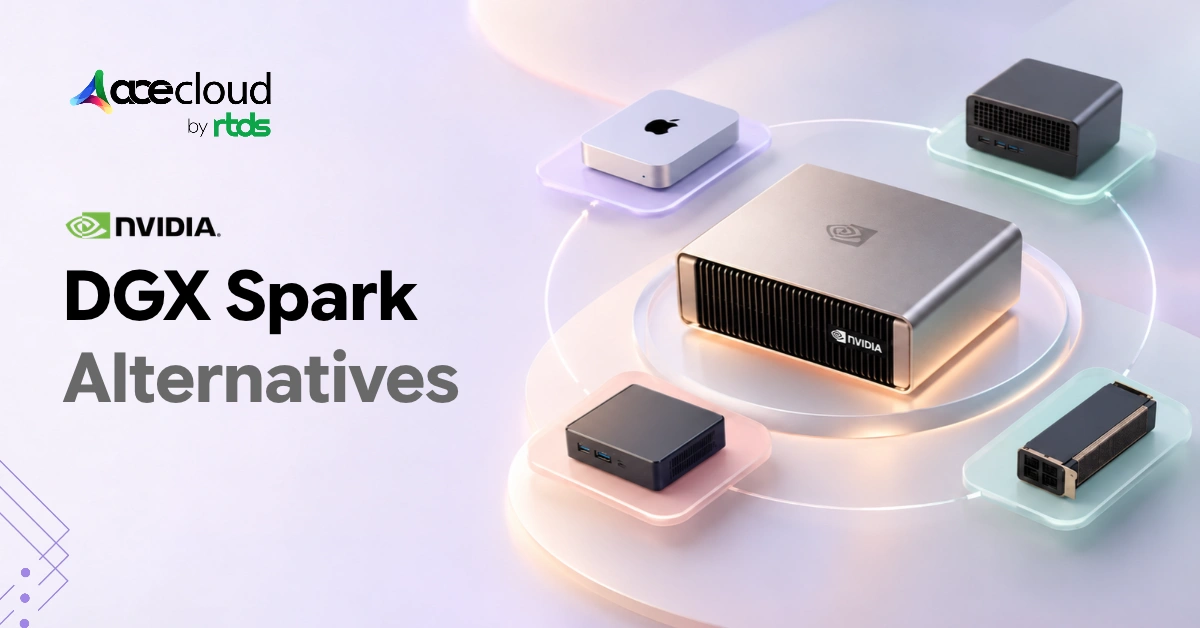
Each option solves a different infrastructure problem. The table below covers the platforms DGX Spark buyers compare most often. For a wider shortlist that includes workstations, mini PCs, and cloud options, see our guide to the 9 best NVIDIA DGX Spark alternatives in 2026.
| Platform | Memory | Bandwidth | Best Fit |
|---|---|---|---|
| RTX 5090 | 32GB | 1,792 GB/s | High-throughput workloads fitting in 32GB |
| DGX Spark | 64GB / 128GB | 273 GB/s | Large-memory local CUDA |
| RTX PRO 6000 Blackwell | 96GB | 1,792 GB/s | Professional CUDA workloads |
| Mac Studio M5 Ultra | Up to 512GB | 1.2 TB/s | Very large local-memory workloads |
| Cloud GPUs | Configurable | GPU-dependent | Elastic and production workloads |
The RTX PRO 6000 Blackwell Workstation Edition provides 96GB of GDDR7 ECC memory and 1,792 GB/s bandwidth, making it relevant for teams that want substantially more VRAM than the RTX 5090 while retaining high bandwidth and CUDA compatibility.
Apple’s M5 Ultra Mac Studio supports up to 512GB unified memory and 1.2 TB/s memory bandwidth, making it attractive for very large local-memory workloads. Its main trade-off for CUDA-focused teams is the different software ecosystem.
Cloud GPUs address a different problem by allowing teams to change accelerator classes and scale capacity as workload requirements evolve without committing to one hardware configuration for several years.
When Should You Buy DGX Spark?
DGX Spark is most compelling when:
- Your workloads exceed common desktop GPU memory limits
- CUDA compatibility is important
- Compute demand is steady
- Local processing offers meaningful operational or data-control benefits
- Developers need dedicated compute available continuously
It is less compelling when GPU use is highly intermittent, maximum throughput matters more than memory capacity, large distributed jobs are common, or production demand changes quickly.
Local processing also does not automatically mean secure. Teams still need access controls, patching, monitoring, backups, network security, and physical security.
Is NVIDIA DGX Spark Worth the Price in 2026?
For the right workload, yes. DGX Spark’s main value is the combination of large coherent unified memory, CUDA compatibility, local processing, compact hardware, high-speed networking, and NVIDIA’s AI software ecosystem.
That makes it particularly relevant for large-model experimentation, local agents, RAG, parameter-efficient fine-tuning, and private AI development.
Teams with bursty demand, rapidly changing accelerator requirements, or production workloads that need dynamic scaling should compare it with cloud GPUs before committing to fixed hardware.
The final decision should be based on model fit, utilization, throughput, compatibility, and cost per completed workload rather than purchase price alone.
If your team is comparing local AI hardware with scalable GPU infrastructure, Book a free consultation with AceCloud to evaluate the architecture and cost model that best fits your workload.
Frequently Asked Questions
As of October 2026, NVIDIA’s U.S. Marketplace lists the 128GB DGX Spark at $6,950. NVIDIA has also announced that the 64GB DGX Spark will be available through Acer, ASUS, Dell, Gigabyte, HP, and MSI from October 23, starting at $4,999. Because the 64GB version is sold through manufacturer partners, final pricing can vary by vendor and configuration.
Yes. A 70B model falls within NVIDIA’s stated capacity for both the 64GB and 128GB configurations. Actual memory requirements still depend on precision, quantization, context length, KV cache, and runtime overhead.
NVIDIA states that the 128GB DGX Spark can fine-tune models up to 70B parameters. The exact fine-tuning method and model memory requirements still matter.
Not universally. DGX Spark offers much more memory, while the RTX 5090 offers 32GB GDDR7 and 1,792 GB/s bandwidth. DGX Spark is stronger when capacity is the bottleneck; RTX 5090 can be attractive when a workload fits within 32GB and throughput matters more.
It can be when utilization is consistently high, and workloads fit the hardware well. Cloud GPUs can be more economical for intermittent, changing, or rapidly scaling workloads because teams avoid purchasing fixed capacity upfront. Compare cost per completed workload, not purchase price against hourly rental rate alone.