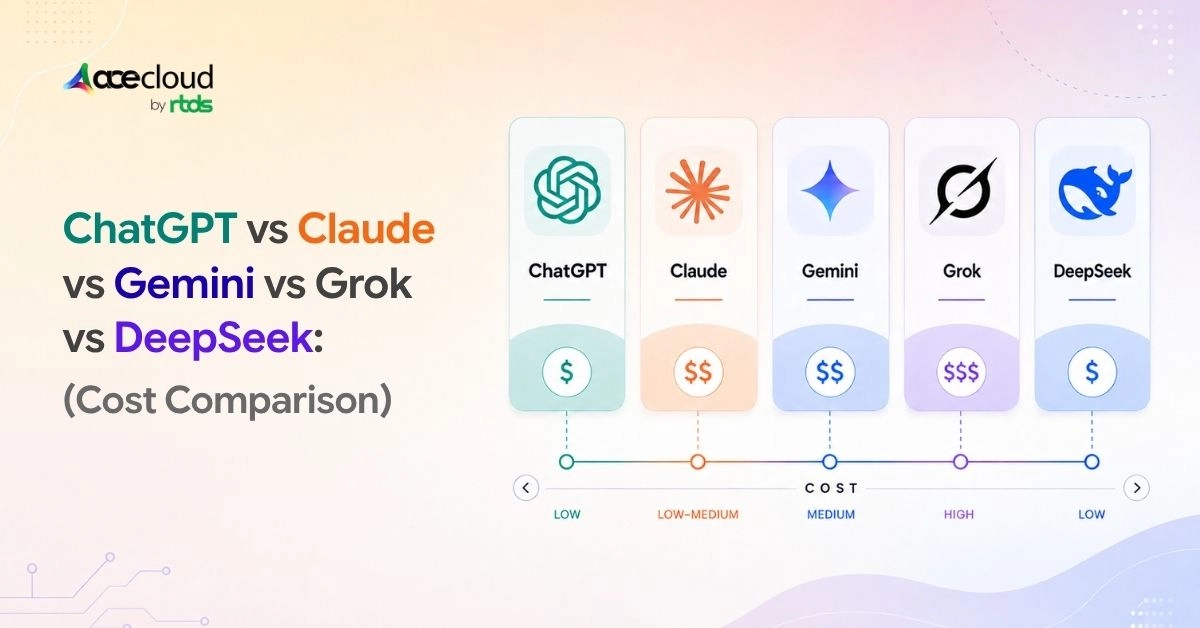
Consider this situation. You book a cab. Forty kilometres in, the provider changes its rates. Not just for the road ahead. The meter recalculates all forty at double, then carries on at a higher rate. Two models in our comparison behave much like that.
Grok 4.6 costs $2/$6 per million input/output tokens below 200K prompt tokens according to SpaceXAI’s official API pricing documentation. At 200K and above, the rates become $4/$12, while cached input doubles from $0.50 to $1. OpenAI applies a similar rule to GPT-5.6 Sol. Its standard $5/$30 input/output rates become $10/$45 when a request exceeds 272K input tokens, with the higher rates applying to the full request.
Claude Sonnet 5 and Gemini 3.7 Flash have no equivalent long-context price cliff in their published API pricing.
That distinction changes how these models should be compared. The context window tells you what fits. It does not tell you what using that context will cost.
Quick Answer: Which Model Should You Choose?
- Choose GPT-5.6 Sol for coding agent working across a difficult repository. OpenAI reports 72.7% on DeepSWE v1.1 and 88.8% on Terminal-Bench 2.1, giving Sol the strongest published long-horizon coding case among these five.
- Choose Gemini 3.7 Flash for processing PDFs, screenshots, audio, or video at scale. Google documents native text, image, video, audio, and PDF input, with a 1,048,576-token input limit.
- Choose Claude Sonnet 5 for analyzing a 300K to 800K-token document or knowledge corpus.Anthropic gives it a 1M-token context window, and long-context requests continue to use standard pricing rather than entering a higher token tier.
- Choose DeepSeek V4 Pro for running a model under your own infrastructure control. DeepSeek publishes V4 Pro at 1.6T total parameters, 49B activated parameters, and 1M context, with model weights available under the MIT license.
- Grok 4.6 belongs on the shortlist for cost-aware frontier agents, particularly while individual requests remain below its 200K pricing threshold.
What a Spec Comparison Cannot Tell You
A specification table can tell you that GPT-5.6 Sol has a 1.05M-token context window. It cannot tell you whether sending 800K tokens is economically sensible. OpenAI’s model documentation confirms the 1.05M context window alongside a 128K maximum output. The pricing rule matters more.
GPT-5.6 Sol costs $5 per million uncached input tokens, $0.50 for cached input, $6.25 for cache writes, and $30 for output at short context. Above 272K input tokens, those rates move to $10, $1, $12.50, and $45 respectively.
Grok 4.6 hits its threshold earlier. SpaceX AI publishes a 500K context window and short-context rates of $2 input, $0.50 cached input, and $6 output. At 200K or more, those rates become $4, $1, and $12. SpaceXAI explicitly states that the long-context rates apply to all tokens in the request once the threshold is reached. The important detail is that these are per-request thresholds.
An agent could consume 2M tokens across ten requests that each contain 180K tokens without crossing either threshold. Another workflow might consume fewer tokens overall but trigger higher pricing because one request carries 300K tokens.
Claude Sonnet 5 takes a different approach. Anthropic currently charges Claude Sonnet 5 at $2/M input and $10/M output through August 31, 2026; from September 1, 2026, published standard pricing becomes $3/M input and $15/M output. Anthropic explicitly notes that a 900K-token request receives the same per-token rate as a 9K-token request.
Google’s published pricing for Gemini 3.7 Flash similarly lists no separate long-context surcharge. This creates one of the most important distinctions in the comparison:
A model’s technical context ceiling and its economic context ceiling are not necessarily the same number. That is why context management is also cost management.
How do the Five Models Compare in the Top 6Specs?
Before calculating cost, it helps to reduce the specification sheet to the six dimensions that actually change a production decision.
| Factor | DeepSeek V4 Pro | Claude Sonnet 5 | GPT-5.6 Sol | Gemini 3.7 Flash | Grok 4.6 |
|---|---|---|---|---|---|
| Input / Output per 1M tokens | $1.32 / $3.96 peak | $2 / $10 | $5 / $30 | $0.75 / $3.75* | $2 / $6 |
| Long-context threshold | None published | None | >272K | None published | ≥200K |
| Context window | 1M | 1M | 1.05M | 1,048,576 | 500K |
| Published/leaderboard DeepSWE v1.1 | 62.7% | ~54% | 72.7% | 65.3% | 65.9% |
| Deployment | API + open weights | Proprietary API | Proprietary API | Proprietary API | Proprietary API |
| Input modalities | Text | Text, image | Text, image | Text, image, video, audio, PDF | Text, image |
Note: *Gemini 3.7 Flash introductory pricing applies through December 31, 2026.
Benchmarks here are directional, not absolute rankings. Reasoning effort, agent harnesses, tool access, prompt design, and evaluation setup can materially change the result. There is another variable that rate cards miss: token efficiency.
A model costing twice as much per million tokens can still be cheaper for a task if it uses substantially fewer reasoning and output tokens or finishes successfully in fewer attempts. So instead of asking which model has the lowest rate, we need to give all five the same job.
What Does the Same Coding Job Cost on Each Model?
Consider a coding agent working across a medium-to-large repository. The numbers below are not meant to represent every coding task. They make the billing mechanics visible using one fixed scenario.
Workload assumptions
- 10 model requests during one coding task
- 300K input-token positions per request
- 3M total input-token positions across the task
- 210K-token stable repository, instructions, and tool prefix
- 90K changing context per request
- Stable prefix cached after the first request
- 1.89M cached input tokens across subsequent requests
- 180K total output/reasoning tokens
- Standard synchronous API pricing
The important part is the 300K context per request. Every request, therefore, crosses GPT-5.6 Sol’s 272K threshold and Grok 4.6’s 200K threshold.
Using currently published rates, assumed 1-hour Claude cache writes, assumed Gemini cache storage for one hour, and long-context GPT/Grok pricing where triggered, the approximate cost becomes:
| Model | Approx. Cost for the Same Task |
|---|---|
| Gemini 3.7 Flash | ~$1.75 |
| DeepSeek V4 Pro, peak | ~$2.26 |
| Claude Sonnet 5 | ~$4.82 |
| Grok 4.6 | ~$8.49 |
| GPT-5.6 Sol | ~$21.62 |
| DeepSeek V4 Pro, off-peak | ~$1.13 |
These figures are calculated workload estimates, not vendor quotes. The result explains why $/million-token comparisons can mislead. GPT-5.6 Sol is not operating at $5/$30 in this scenario. Each request has crossed 272K, so the higher rate applies. Grok behaves similarly at 200K.
Disclaimer: Pricing and cost estimates in this section are based on publicly available vendor rates as of August 24, 2026 and the workload assumptions stated above. Model pricing, cache rates, thresholds, and promotional offers may change over time, so always verify the latest provider pricing before making deployment decisions.
Caching changes the Economics
Production agents repeatedly resend repository context, system instructions, schemas, conversation history, and tool definitions.
- DeepSeek currently charges V4 Pro $0.044 per million cache-hit input tokens during peak hours and $0.022 off-peak, versus $1.32/$0.66 for cache misses.
- Claude Sonnet 5 charges $0.20 per million cache reads, with five-minute cache writes at $2.50 and one-hour writes at $4 per million tokens.
- Google’s 2026 Gemini 3.7 Flash rate is $0.075 per million cached tokens, plus $0.50 per million cached tokens per hour for storage.
Two applications processing the same nominal number of tokens can therefore generate very different invoices depending on prompt structure and cache reuse.
For a deeper playbook on reducing spend through caching, batching, and prompt design, see our guide on AI token usage optimization.
Batch Processing is Another Lever
Offline workloads create different economics.
Anthropic’s Batch API gives a 50% discount on input and output tokens. Google likewise states that its Batch API offers a 50% cost reduction, and Gemini 3.7 Flash currently falls from $0.75/$3.75 standard pricing to $0.375/$1.875 in Batch mode. OpenAI also publishes lower Batch and Flex rates for GPT-5.6 Sol.
That makes asynchronous processing useful for extraction, classification, enrichment, and evaluation. It is less helpful for an interactive coding agent waiting for its next tool result.
Tools belong on the invoice too
Once the model becomes an agent, token pricing is only part of the bill. For example, SpaceXAI currently charges $5 per 1,000 Web Search calls and $5 per 1,000 Code Execution calls.
Retries can multiply both token and tool consumption. This is where agentic AI infrastructure matters. Routing, caching, memory, observability, fallback logic, and context management can influence production economics as much as the headline model rate. Most importantly, the table above still does not measure success.
If GPT-5.6 Sol completes the engineering task once while a cheaper model requires three attempts and developer intervention, $21 of inference can still be better economics than $6 of unsuccessful inference. The metric that matters is not dollars per million tokens. It is dollars per accepted completed task.
Three Things the Cost Model Still Misses
The calculation above normalizes the billing mechanics. It still does not tell you which model will feel fastest, satisfy your data requirements or know the facts your application needs.
1. Time to first token can matter more than decode speed
A model can generate hundreds of tokens per second after output begins and still feel slow if it spends several seconds processing input or reasoning before the first useful answer appears.
This matters most in interactive agents. A developer waiting for the next terminal action experiences time to first useful action, not a tokens-per-second benchmark.
Artificial Analysis therefore separates output speed from time to first token, time to first answer token and end-to-end response time. Production testing should do the same. Measure the complete request from send to accepted action, including reasoning and tool latency, rather than declaring a winner from decode throughput alone.
2. Data residency can change both architecture and price
The cheapest global endpoint may not be the endpoint your legal or security team approves.
Anthropic says regional and multi-region endpoints for newer Claude models carry a 10% premium, and first-party US-only inference uses a 1.1x pricing multiplier. OpenAI likewise applies a 10% uplift to eligible regional-processing endpoints for newer models.
A rate-card comparison that ignores where inference must happen can therefore understate the production bill before the first token is generated.
3. Release date is not knowledge freshness
A model released last week is not necessarily trained on information from last week.
OpenAI documents a February 16, 2026 knowledge cutoff for GPT-5.6 Sol. Other providers expose freshness and grounding differently across their current model documentation. For workloads involving current regulations, products, security advisories, prices or news, static model knowledge should not be treated as the source of truth.
The useful production question is whether your application can reliably ground the model through search, retrieval or your own trusted data source, and what that grounding adds to latency and cost.
When Do You Stop Renting Tokens and Self-Host DeepSeek V4 Pro?
DeepSeek V4 Pro creates a decision the other four do not. Its weights are available under the MIT license. That does not make it inexpensive to run.
DeepSeek publishes V4 Pro as a 1.6T-parameter MoE with 49B activated parameters and a 1M context window. By comparison, V4 Flash is 284B total with 13B activated parameters.
Current vLLM deployment guidance lists about 960GB minimum VRAM for the V4 Pro mixed-precision checkpoint. Its H200 guidance also notes that eight H200 GPUs leave KV-cache capacity tight at very long contexts, illustrating why theoretical 1M context and economically serving 1M context at production concurrency are different problems.
If you’re evaluating serving frameworks for a deployment like this, see our comparison of vLLM vs TensorRT-LLM vs TGI.
So ‘open weights’ and ‘easy to self-host’ are very different things. This matters when comparing open-source and proprietary LLMs. Proprietary APIs hide infrastructure inside the token rate. Self-hosting exposes GPU utilization, cluster design, storage, networking, observability, redundancy, and engineering cost.
For most teams, the hosted API will remain simpler. Self-hosting becomes more compelling with sustained utilization, custom weights, hard residency requirements, predictable large-scale demand, or latency requirements a shared API cannot guarantee.
If self-hosting becomes the right call, see our breakdown of best cloud GPUs for Qwen, Llama, and Mistral-class models for hardware sizing.
There is also a tier trap. DeepSeek says V4 Flash-Max can achieve comparable reasoning performance to V4 Pro when given a larger thinking budget, although Pro retains advantages on pure knowledge and the hardest agentic workloads.
Teams investigating private deployment should therefore evaluate open-source LLM options before assuming Pro is automatically the right model to host. Sometimes the better infrastructure decision is not finding cheaper GPUs for Pro. It is choosing a smaller model.
Which Model Fits These Real Production Jobs?
Abstract categories such as multimodal automation are not how teams buy AI. The decision becomes easier when the workload is concrete.
40,000 customer-support cases per month with PDFs, screenshots, voice notes and occasional video
Start with Gemini 3.7 Flash. It accepts all of those modalities through one model and its 2026 standard pricing is aggressive. The caveat is budgeting beyond December 31, because standard pricing doubles on January 1, 2027.
An autonomous coding agent modifying a large repository for hours at a time
Start with GPT-5.6 Sol. Its 72.7% DeepSWE v1.1 result and strong Terminal-Bench performance give it the best published coding case of these five. The caveat is context growth. Let repeated requests drift above 272K and the economics change quickly.
One 400K-token contract, policy or data-room analysis in a single pass
Start with Claude Sonnet 5. Its 1M window retains one base per-token rate, so a large prompt does not introduce the cliff seen with GPT or Grok. Validate the actual token count because Anthropic’s newer tokenizer behaves differently from earlier Claude generations.
A research or knowledge agent whose requests normally stay below 200K
Put Grok 4.6 on the shortlist. Its $2/$6 short-context pricing is materially below GPT-5.6 Sol, and SpaceXAI positions 4.6 around long-running agents and knowledge work. The caveat is architectural. If conversation growth repeatedly pushes requests past 200K, its token rates double.
For a fifth job, one where the model itself must run under your infrastructure boundary, the answer is different. That is where DeepSeek V4 belongs, with the Flash-versus-Pro sizing decision made before you buy the GPUs.
How to Test These Models on Your Own Workload
Published benchmarks should create your shortlist. Your own evaluation should choose the model. A useful test does not require thousands of prompts.
- Pick 20 representative tasks. Include routine work, difficult work, long-context cases and the tasks where failure would be expensive.
- Hold the environment constant. Keep the prompt, tools, retrieval data and success criteria stable. Use comparable reasoning settings where the APIs allow it, and record whenever they do not.
- Log the entire execution. Capture uncached input, cached input, cache writes, reasoning/output tokens, turns, retries, tool calls, time to first answer, total completion time and failures.
- Price what was actually consumed. Use provider usage records or your invoice rather than multiplying one headline $/MTok number by an estimated token count.
- Calculate cost per accepted completed task. If a model costs $1 per attempt but succeeds half the time, its useful cost is not $1. Include retries and human repair when they are part of the workflow.
Then compare quality, cost and latency together. A two-day controlled evaluation on representative work will usually tell your engineering team more about your deployment than another dozen leaderboard screenshots.
It also gives you something a benchmark cannot provide: the evidence needed to decide whether to use one model everywhere or build a routing layer that sends different jobs to different models. In production, that second architecture may be the real winner.
Test the Workload, Not Just the Model
The difficult part of frontier-model selection is no longer finding benchmark scores. It is measuring how context growth, caching, reasoning, retries, tools, latency, and infrastructure change the cost of completing your actual work.
AceCloud can help design that workload-level evaluation and map the results to the appropriate model-routing, cloud GPU, and deployment architecture.
Book a free consultation with AceCloud to compare these models for your workloads and identify the right AI deployment strategy.
Frequently Asked Questions
Among these five, DeepSeek V4 Pro currently has the lowest published off-peak rates at $0.66 per million cache-miss input tokens and $1.98 per million output tokens. Cache hits fall further to $0.022 per million input tokens. That does not automatically make it the cheapest model per completed task.
Google states that Gemini 3.7 Flash’s $0.75 input / $3.75 output per million tokens pricing runs through December 31, 2026. Starting January 1, 2027, the published rates become $1.50 input / $7.50 output.
Yes. DeepSeek V4 Pro’s repository and model weights are licensed under the MIT License. The bigger constraint is infrastructure. V4 Pro has 1.6T total parameters and 49B active parameters, while current vLLM deployment guidance lists about 960GB minimum VRAM.
Gemini 3.7 Flash is the only model in this five-model comparison whose documented model interface accepts text, images, video, audio, and PDFs together, with a 1,048,576-token input limit and 65,536-token output limit.