Quick Answer
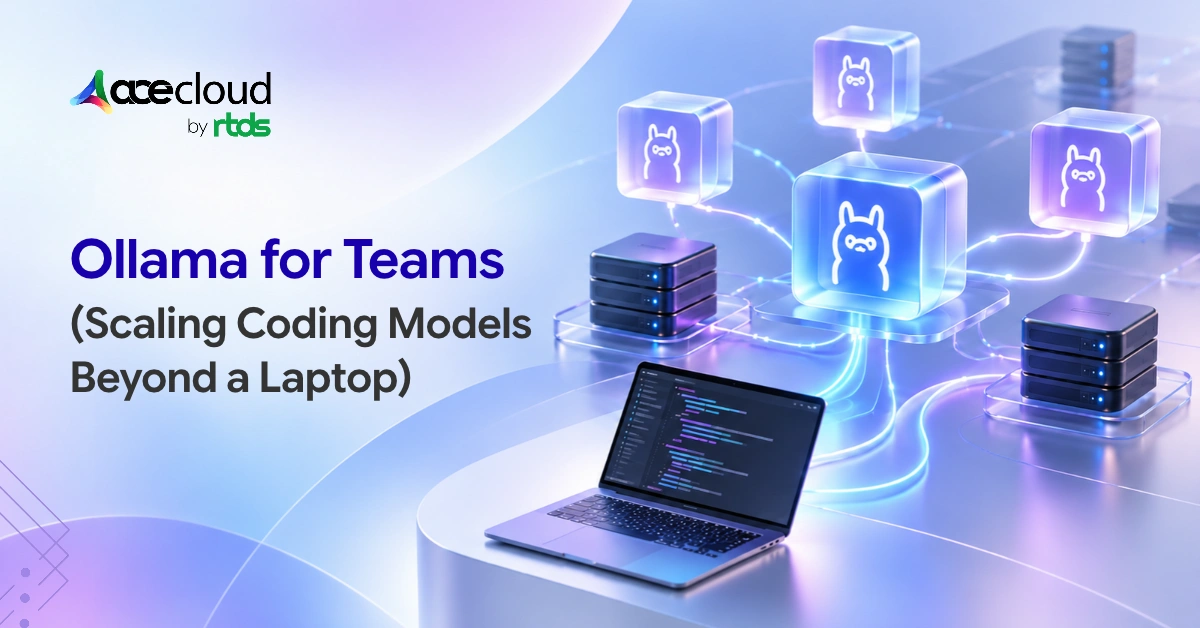
Ollama is a practical way to test and run coding models locally, but a laptop can become a bottleneck when several developers, coding agents, or CI systems use the same model. Team inference requires planning for concurrency, GPU memory, reliability, access control, observability, and serving capacity.
A developer gets a local coding model running on a laptop. It is fast enough, private enough, and surprisingly capable. A few prompts later, the team starts asking a more interesting question: “Can we all use this?”
That is usually where the simple setup starts getting complicated. What works beautifully for one developer can behave very differently when several engineers send requests at the same time, coding agents start making multiple model calls, and larger codebases push context and GPU memory further.
Suddenly, the challenge is not just getting a model to run. It is keeping that model available, responsive, secure, and predictable for everyone who depends on it.
This is where tools such as Ollama become part of a much bigger infrastructure question. Running a coding model locally is one thing. Running it as a shared service for an engineering team is another.
So, where does a laptop-based setup start to fall short, and what needs to change when local inference becomes team infrastructure?
Where Does Ollama Work Well for Developers?
Ollama removes much of the friction involved in testing local models. It provides a local server, a model library, an API, and GPU acceleration support across common hardware.
For an individual developer, that is often enough to answer the questions that matter first:
- Does this coding model work well with our codebase?
- Is the quality good enough for code completion, debugging, or documentation?
- How much context can the available hardware handle?
- Does the model work with the team’s preferred coding tools?
For one developer, these are practical and useful tests.
For a team, they are only the beginning.
The important distinction is not really Ollama versus another runtime. It is single-user inference versus shared inference.
What Changes When Several Developers Use the Same Model?
The moment a local model becomes a shared service, the workload changes.
One developer might send a request, wait for the response, and move on. Ten developers can send requests at roughly the same time. An internal coding assistant can generate several model calls for one task. A CI pipeline can add another source of traffic.
That changes what the infrastructure needs to handle.
| Requirement | One developer | Shared team service |
|---|---|---|
| Requests | Mostly sequential | Multiple users and applications |
| GPU memory | Sized around one workload | Shared across concurrent requests |
| Availability | Laptop being available may be enough | Service needs predictable uptime |
| Access | Local machine | Network access and permissions |
| Monitoring | “Is it working?” | Latency, errors, queueing, capacity |
| Model updates | Developer choice | Controlled versioning and rollout |
| Scaling | Upgrade the machine | Add or resize serving capacity |
Ollama supports concurrent processing when enough memory is available. If the machine cannot accommodate additional work, requests can be queued, and an overloaded server can return a 503.
Increasing parallel requests can also increase memory requirements because each request needs its own context. So a model that feels fast for one person can behave very differently when several developers start using it at the same time.
The first team challenge: GPU memory
Running a coding model is not simply a question of whether the model fits on the GPU.
Memory requirements depend on factors such as the model, quantization, context length, and the number of requests being processed concurrently. Longer contexts and parallel requests can increase the amount of memory required.
This matters for coding workloads because the requests themselves can become large.
A developer asking a model to explain one function is very different from an agent sending a large repository context, build logs, tool results, and previous conversation history.
| Coding workload | What the infrastructure has to handle |
|---|---|
| Code completion | Short, frequent requests |
| Debugging | Code, logs, and error output |
| Repository questions | Larger context windows |
| Coding agents | Multiple model calls for one task |
| Team usage | Several of these workloads at once |
The important question changes from “Can this model load?” to “Can this hardware handle our expected workload?”
The second team challenge: concurrency and latency
Teams do not use a coding model one request at a time.
Developers work in parallel. Internal tools may send requests in parallel. Coding agents can make multiple calls while planning, writing, testing, and reviewing code.
Ollama provides configuration options for parallel requests, loaded models, and queue size. Those controls are useful, but they do not create additional compute. They determine how the available resources are shared.
That leads to a simple rule: Concurrency is a capacity problem before it is a configuration problem.
If a GPU can comfortably serve one long-context request but struggles with four, increasing the concurrency setting does not remove the underlying constraint.
For a team, benchmarking should therefore include concurrent requests rather than measuring only single-request speed.
The third team challenge: turning a local model into a reliable service
Once developers depend on the model, “it runs on my laptop” is no longer a sufficient reliability strategy.
A shared service has to keep working when:
- a developer’s laptop is turned off
- the machine reboots
- GPU memory becomes saturated
- disk space runs low
- request volume increases
- a model needs to be updated
This is where dedicated GPU infrastructure becomes useful.
The model can run on a server that is available to the team instead of being tied to one developer’s workstation. Ollama can still be used in this kind of setup when its capabilities and serving behavior match the workload.
For larger or more demanding serving workloads, teams can also evaluate inference engines designed specifically for model serving.
The fourth team challenge: choosing the right inference server
At small scale, the runtime and the model may be all you need. As the workload grows, serving efficiency becomes much more important.
Tools such as vLLM are built specifically for serving models through APIs. Its feature set includes continuous batching, prefix caching, distributed inference, OpenAI-compatible APIs, metrics, and tracing integrations.
The question therefore changes from:
“Can this model run on our machine?”
to:
“How should this model serve our workload?”
That is a much more useful question once the model becomes a shared engineering service.
Ollama and a production-oriented inference stack
| Requirement | Ollama | Production-oriented inference stack |
|---|---|---|
| Local experimentation | Strong fit | Possible, but more setup |
| Quick model testing | Strong fit | More operational overhead |
| Shared API | Possible | Core use case |
| Concurrent workloads | Depends heavily on available resources | Designed around serving efficiency |
| Multiple GPUs | Supported in appropriate configurations | Common production use case |
| Advanced serving controls | More limited | Broader serving controls |
| Distributed inference | Not the typical laptop use case | Supported by systems such as vLLM |
| Observability | Basic operational visibility | Broader metrics and tracing options |
This is not a question of replacing Ollama as soon as a second developer joins.
It is about using a serving stack that matches the workload you actually have.
The fifth team challenge: security and access control
A local model and a shared model have very different security boundaries.
Ollama binds to localhost by default, and it can be configured to expose its service on a network. Once the endpoint is reachable by other machines, the team needs to think about who can access it and what else sits around the model.
A shared coding endpoint may need decisions around:
- authentication and authorization
- network access
- application permissions
- source-code handling
- logs and telemetry
- secrets
- isolation from other internal systems
Self-hosting the model does not automatically secure the service around it.
The API, host, network, storage, logs, and access controls still need to be managed.
The sixth team challenge: observability and capacity planning
A developer can usually tell when a local model feels slow. A platform team needs to know why it is slow.
Is the GPU full? Are requests waiting in a queue? Did latency increase because context sizes became larger? Is one team consuming most of the available capacity? Are requests failing?
These questions require more than a model UI.
For a shared coding service, useful measurements include:
| Metric | What it tells you |
|---|---|
| Time to first token | How responsive the service feels |
| Output tokens per second | Generation speed |
| Queue time | Whether demand is exceeding capacity |
| Error rate | Reliability of the service |
| GPU utilization | Whether compute is idle or saturated |
| VRAM usage | Whether the workload fits safely |
| Context length | How much code the model can process |
| Cost per task | Whether the setup is economically useful |
This is also why raw GPU pricing is not enough for a self-hosting decision. A cheaper GPU that stays underutilized or struggles with concurrent requests may cost more per completed developer task than a more capable setup.
When Should a Team Move Beyond a Laptop?
There is no fixed developer count where a laptop suddenly stops being appropriate.
The better signal is the workload.
A single developer can run a capable coding model locally. A small engineering team may also be perfectly comfortable using one dedicated GPU server for controlled internal use.
The need for a more production-oriented setup becomes clearer when several of these start happening:
- Multiple developers need the model at the same time.
- Requests regularly contain large code contexts.
- Coding agents make several calls for one task.
- Queueing starts affecting developer workflows.
- The model needs more VRAM than one workstation provides.
- The endpoint becomes a dependency for an internal product or CI system.
- The team needs usage metrics, tracing, or capacity planning.
- Model updates need controlled deployment.
At that point, the question is no longer whether Ollama can run the model. It is whether the whole serving setup is designed for the workload.
A Practical Path from Local Testing to Team Inference
Teams do not need to jump from a developer laptop straight to a large GPU cluster.
A more practical progression is to add infrastructure as the workload justifies it.
Stage 1: Test the model locally
Use Ollama and a local coding model to evaluate quality, context handling, developer-tool compatibility, and hardware requirements.
This is where local inference is at its most useful: fast experimentation without building a serving platform first.
Stage 2: Move to a dedicated GPU server
When several developers need a shared endpoint, move the model away from personal workstations.
Ollama can still be part of this setup if the workload is controlled and its serving behavior fits the requirements.
Stage 3: Introduce a dedicated inference server
When concurrency, latency, model size, or availability become important, evaluate a serving engine such as vLLM.
The focus at this stage shifts toward batching, request scheduling, metrics, tracing, and better use of GPU capacity.
Stage 4: Scale the serving infrastructure
Larger deployments may need multiple GPU nodes, model replicas, inference-aware routing, and more deliberate capacity management.
At this point, the model is no longer simply software running on a server. It has become a shared infrastructure service that needs its own operational design.
The Real Limitation isn’t Ollama
Ollama solves a real problem well: making local model inference accessible.
For developers, that simplicity is a feature. It makes testing open models, keeping code local, and connecting models to developer tools much easier.
But a team changes the requirements.
Once several people depend on the same coding model, the difficult parts become concurrency, GPU memory, networking, access control, observability, reliability, and cost per workload.
That is the point where self-hosted stops meaning “a model running on a machine we own” and starts meaning “an inference service we operate.” Ollama can be part of that journey.
The laptop proves that the model works. The serving infrastructure determines whether the team can depend on it.
AceCloud provides GPU infrastructure for teams that need to move beyond local experimentation and run AI workloads on dedicated cloud infrastructure. If your coding model is becoming a shared team service, Book a Free Consultation to discuss the right infrastructure for your workload.
Frequently Asked Questions
Yes. Ollama supports concurrent processing when enough memory is available. However, shared use increases resource requirements, and requests may be queued when the available hardware cannot accommodate additional work.
There is no fixed developer count. The need becomes clearer when multiple developers use the model at the same time, requests contain large code contexts, coding agents make several calls, queueing affects workflows, or the model becomes a dependency for an internal product or CI system.
Not by itself. Increasing parallel requests can increase memory requirements because each request needs its own context. Concurrency settings determine how available resources are shared; they do not create additional compute capacity.
Useful measurements include time to first token, output tokens per second, queue time, error rate, GPU utilization, VRAM usage, context length, and cost per task. These metrics help teams understand whether demand is exceeding available capacity.
It can be suitable when the workload is controlled and its serving behavior fits the requirements. As concurrency, latency, model size, availability, or serving efficiency become more important, teams can evaluate inference servers designed specifically for model serving.
Not immediately. A dedicated GPU server becomes useful when several developers need a shared endpoint or when a personal workstation is no longer sufficient for the model, context size, concurrency, availability, or operational requirements.

![Best Open-Weight Models for Vibe Coding [2026]](https://acecloud.ai/wp-content/uploads/2026/09/best-open-weight-models-vibe-coding.webp)