
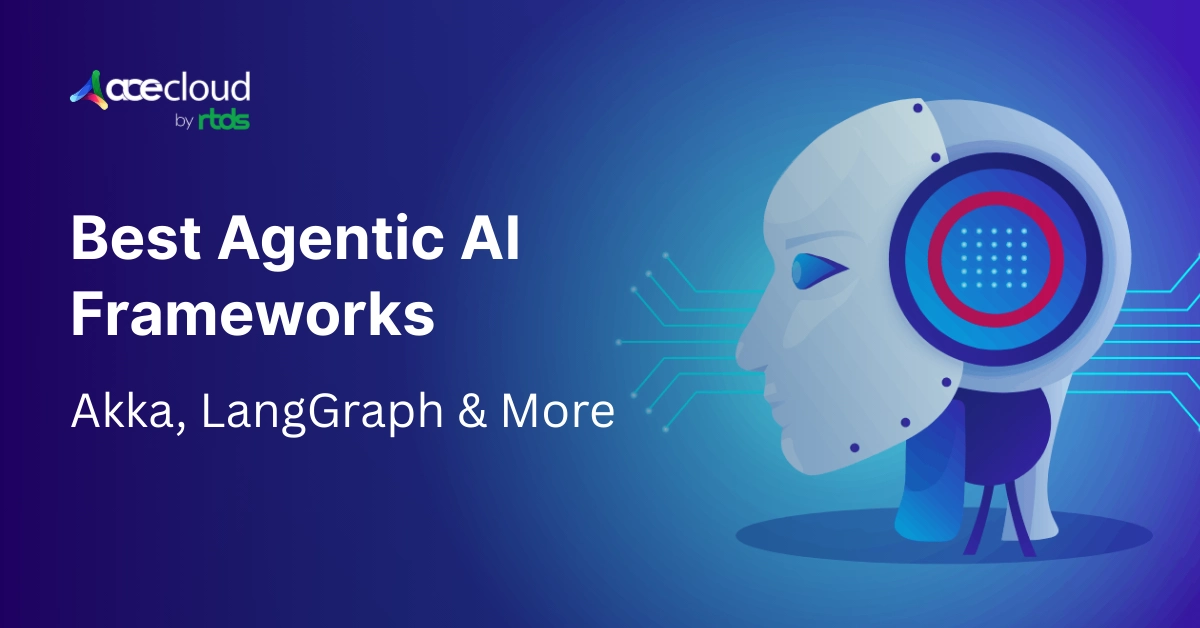
Agentic AI frameworks are becoming the control plane for enterprise automation, from fraud-monitoring agents to multi-agent supply chains that track inventory and forecast demand. IDC predicts that by 2027, G2000 agent use will increase tenfold, with token and API call loads rising a thousandfold.
For teams running SaaS platforms in hybrid clouds, the real challenge is production: sustaining high-throughput traffic with predictable latency, cost and governance.
Agentic systems are already improving incident response, employee productivity and customer support. It means your platform must handle concurrent inference, inter-agent communication and a memory architecture that can survive retries and partial failures.
This guide compares agentic AI frameworks that help you scale concurrent inference while keeping reliability and hybrid operability measurable.
1. Akka
Akka is an enterprise-grade agentic AI platform built to help you deliver production-ready agentic systems without stitching together a long list of separate tools.
It draws on roughly 15 years of distributed-systems experience and packages four tightly integrated capabilities in one SDK: orchestration, agents, memory and streaming. That integrated design is intended to support enterprise-scale performance while reducing integration overhead.
Best for: Enterprise teams that want an integrated, production-first platform with fewer moving parts.
Key Features
Memory: Supports short-term and long-term memory. Long-term memory is backed by durable storage and can persist semantic knowledge, skills and retrieved data across users, sessions, agents and systems.
Model support: Works with Anthropic, Gemini, Hugging Face and OpenAI models.
Reasoning: Supports chain-of-thought and ReAct-style reasoning patterns.
Orchestration and workflows: Includes a stateful workflow engine that can resume after stops or restarts without losing state. It also supports dynamic orchestration, where agents drive most steps inside a lightweight control framework.
Architecture: Supports single-agent and multi-agent workflows. Both vertical and horizontal patterns are straightforward to implement.
Security and compliance: Designed to meet multiple compliance standards.
Error handling: Provides session replay, human-in-the-loop support and built-in logging and monitoring.
Cost management: Includes a cloud spend dashboard with forecasting.
Infrastructure: Continuously replicates application data across configured regions.
Documentation and developer experience: Offers comprehensive documentation and agentic search for faster navigation. SDKs and composable components help teams become productive quickly, with documentation enhanced by an agentic AI assistant.
2. LangGraph
LangChain and LangGraph are complementary tools used to build agentic systems, with LangGraph often used when you want explicit workflow structure and state handling.
Best for: Teams that need durable, stateful workflows with clearer control over execution and recovery.
Key Features
Memory: Provides stateful graph execution and checkpointing; short-term and long-term memory are typically implemented using external stores (e.g., vector DBs, SQL/NoSQL) wired into the graph.
Model support: LangGraph is model-agnostic, which helps if you want flexibility across providers.
Reasoning: Supports chain-of-thought and ReAct-style reasoning patterns.
Orchestration and workflows: Supports function-driven and graph-driven workflow designs.
Architecture: Supports multi-agent designs, parallel agent execution and human-in-the-loop patterns.
Security and compliance: No formal compliance certifications are indicated.
Error handling: Provides guardrail tooling through native libraries. Its deterministic approach supports replay, and workflows can restart after errors.
Cost management: LangSmith supports token and usage tracking.
Infrastructure: Typically single-region by default, with self-hosting options.
Ease of development: Initial setup can be complex, but the tools are considered production-ready once deployed correctly.
3. CrewAI
CrewAI is geared toward role-based multi-agent setups and is often used when you want to move quickly from concept to a working pilot.
Best for: Fast multi-agent pilots where speed matters more than deep workflow durability.
Key Features
Memory: Supports both short-term and long-term memory.
Model and reasoning support: Works with many LLMs and supports multiple reasoning approaches.
Orchestration and workflows: Uses simpler, stateless orchestration through event-driven graphs.
Architecture: Optimized for role-based multi-agent “crews” handling a single user task. Large-scale horizontal patterns (thousands of concurrent agents, sharding, multi-tenant isolation) generally require additional orchestration and infrastructure around CrewAI.
Security: Audit and observability logs are available, with optional Portkey integration.
Error handling: Replay is available for certain tasks. Guardrails typically need to be implemented within the agents.
Cost management: Tracks token usage natively, with optional Portkey features for enhanced management.
Infrastructure: Can be self-hosted or run via CrewAI Enterprise offerings.
Ease of development: Faster to start, but less capable for advanced orchestration needs at large scale.
4. Microsoft AutoGen
Microsoft AutoGen is effective for rapid multi-agent experimentation and collaboration patterns but usually needs additional infrastructure work for production deployments.
Best for: Teams experimenting with multi-agent collaboration patterns that plan to add platform controls later.
Key Features
Memory: Not included by default. You typically add an external memory database for both short-term and long-term memory.
Model support and reasoning: Commonly used with OpenAI and Anthropic models. Chain-of-thought and ReAct-style patterns can be implemented through custom agents.
Orchestration and workflows: Provides a simple task-orchestration approach.
Architecture: Supports both horizontal and vertical multi-agent workflows.
Security: As an open-source library, it relies entirely on your hosting environment for IAM, network controls and data protection. You must design guardrails and approvals explicitly.
Error handling: Does not include audit logs or replay logs by default.
Cost management: No built-in token management.
Ease of development: Strong for prototyping, but you should plan for external components if you need production SLAs.
5. OpenAI Swarm and OpenAI Agents
OpenAI’s agent tooling is positioned as a lightweight, developer-friendly framework for building agentic systems, originating from the open-source Swarm work.
Best for: Teams that want a lightweight agent SDK with tracing and are comfortable adding external controls for strict production.
Key Features
Memory: Short-term memory is built in. Long-term memory typically requires an external store such as SQLite.
Model support and maturity: Primarily designed for OpenAI models and described as experimental in some contexts.
Orchestration and workflows: Supports orchestration through code and LLM-driven routing.
Architecture: Supports multi-agent designs.
Security: Guardrails are intended to monitor inputs and outputs to keep behavior within defined limits.
Error handling: Includes tracing and debugging features, with tooling that can visualize orchestration paths.
Cost management: No built-in token management.
Infrastructure: Hosted by OpenAI, with multi-region support not clearly positioned.
Ease of development: Offers a feature-rich SDK, but you should treat it as early-stage for strict production requirements.
6. LlamaIndex Workflows
LlamaIndex Workflows is a lightweight, event-driven, async-first workflow engine for orchestrating multi-step agentic applications (including agents, RAG flows, and document pipelines). It’s designed around Steps triggered by Events, with built-in support for streaming and typed state.
Best for: Teams that want explicit, code-centric control flow (events/steps), plus async + streaming, without committing to a heavier “platform” layer.
Key Features
Memory/state: Workflows use a Context object for state across steps, and you can reuse/restore context across runs. There’s also first-class checkpointing via a WorkflowCheckpointer pattern in examples.
Model support: Via LlamaIndex integrations, supports many providers (OpenAI, Anthropic, Google, Hugging Face, and more).
Reasoning: Works well for ReAct-style/tool-using agents (including examples of building a ReAct agent as a Workflow).
Orchestration and workflows: Event-driven steps, async-first execution, and built-in event streaming for progress/UX.
Architecture: Suitable for single-agent and multi-agent coordination patterns (Workflows docs/blog position it for “role-based multi-agent systems” as well).
Human-in-the-loop: Supports pausing/waiting for human input and resuming after receiving a response event.
Security and compliance: No formal compliance positioning by default (open-source library); typically handled via your surrounding platform controls.
Error handling: “Resume” is usually implemented via context persistence and/or checkpointing patterns rather than a fully managed platform replay layer.
Cost management: No native spend dashboard; you’ll typically pair with external tracing/observability and provider-side usage reporting.
Infrastructure: Runs wherever Python/TS runs; Workflows is available as standalone packages (Python + TypeScript).
Documentation and developer experience: Clear conceptual model (events/steps/context) with dedicated docs and examples; Workflows is also explicitly positioned as usable outside the broader LlamaIndex ecosystem.
7. Haystack (deepset)
Haystack is an open-source framework for building production-grade RAG, search, and agentic systems using modular components connected into pipelines. Its pipelines are directed multigraphs, enabling branching, parallel flows, and even loops.
Best for: Teams building RAG/search-heavy systems that want transparent, component-based pipelines (plus optional agent/tool orchestration) and strong debugging/tracing hooks.
Key Features
Memory/state:
- For chat history, Haystack supports chat message stores (e.g., in-memory chat history patterns in tutorials/cookbooks).
- For agents/tools, Haystack provides a structured State container to share messages/data and intermediate results during execution.
Model support: Integrations cover major providers (e.g., OpenAI, Anthropic, Hugging Face) and a broader ecosystem of integrations.
Reasoning: The Agent component is explicitly loop-based (tool-using), can validate/manage runtime state, and can stream outputs until exit conditions are met.
Orchestration and workflows:
- Pipelines are directed multigraphs that support branching, parallel paths, and loops.
- You can also expose entire pipelines as tools (e.g., PipelineTool) for agent/tool composition.
Architecture: Works for single-agent and multi-step systems; pipelines and agents can be composed (agent standalone or inside pipelines).
Security and compliance: No built-in compliance layer is typically claimed; teams usually rely on deployment controls + model/provider guardrails.
Error handling: Strong developer tooling for troubleshooting (inspect outputs, logging, tracing, monitoring integrations). Also, recent releases describe pipeline snapshots that capture the last successful step to help inspection/resume after failures.
Cost management: Not a native cost dashboard, but tracing/observability integrations (OpenTelemetry/OpenLLMetry, etc.) can help track behavior and (depending on the backend) token usage.
Infrastructure: Pipelines support serialization (save/load), and there’s an async pipeline engine for concurrency where the execution graph allows it.
Ease of development: Modular components and graph visualization/debugging patterns make systems easier to reason about once the component graph is set up.
What You Must Benchmark Before Going Live?
Before you ship an agent to production, validate it like any distributed system under real load. These benchmarks reveal whether it will stay fast, reliable and cost-controlled when traffic spikes and tools fail.
- Latency: p50, p95, p99 for end-to-end task completion, not just model response time
- Throughput: Max sustained requests per second and how performance changes under spikes
- Tool failure rate: Timeouts, 5xx rates, dependency slowness, retry success rate
- Retry amplification: How many extra tool calls and model calls retries generate
- Cost per successful task: Tokens, tool calls, GPU time and human review cost
- Human review rate: Percent of runs requiring escalation, approval or correction
- State integrity: Ability to resume from checkpoints without duplicating side effects
- Queue health: Backlog growth, dead-letter rate and time-to-drain after incidents
How to Choose an Agentic AI Framework?
Before you commit to an AI agent framework, you should start with your business goals and the workflows you want to automate. The right choice usually balances what your team can build and operate today with what you will need as requirements grow over time.
Here are the key areas to evaluate.
Complexity
Define the tasks you want an agent to handle and the level of decision-making involved. You should decide whether a single agent is enough or if you need a multi-agent system that coordinates across specialized roles.
If you expect multiple agents, map how agents will hand off work, share context and resolve conflicts. You should also identify where human review is still required for accuracy, safety, or compliance.
Data privacy and security
Privacy and security should be treated as baseline requirements, not optional features. Validate how the framework supports:
- Encryption in transit and at rest
- Least-privilege tool access (tool allowlists, scoped service accounts)
- Secrets management integration (vaults, rotation)
- PII masking or redaction and data retention policies
- Approval gates for sensitive actions (payments, production changes, deleting records)
- Clear data residency controls in regulated environments
Ease of use
Match the framework to your team’s skills and delivery timeline. Some frameworks make prototyping faster with templates and higher-level abstractions. Others expose lower-level controls that support deeper customization but require more engineering maturity.
If your team needs to move quickly with guardrails, choose a framework that reduces setup and supports repeatable patterns. If your team needs fine-grained workflow control, select one that supports custom state handling, routing logic and extensibility.
Seamless integration
You should assess how well the framework fits into your existing stack, including identity, logging, observability, data sources and deployment tooling. Integration strength affects how quickly you can move from proof of concept to production.
You also need a clear deployment model, including on-prem, cloud, or hybrid, and whether you expect a small rollout or a platform-wide deployment. These decisions influence networking, secrets management and operational boundaries.
Performance and scalability
Evaluate performance under realistic load, not only in a demo. You should measure latency for user-facing flows and validate how throughput behaves when request volume and tool-call fanout increase.
It is also important to test how performance changes under concurrency, because many agent workflows generate parallel tool calls and retries. Teams evaluating agentic ai development services should look at how well a framework supports production workflows, integration depth, observability, and long-term operational control.
Ready to Productionize Agentic AI in Your Hybrid Cloud?
Choosing the right agentic AI frameworks is only half the job. The real advantage comes from proving they can run under load with reliable tool execution, predictable latency and governance that holds up in hybrid environments. That’s easiest when the infrastructure layer is designed for fast, repeatable scaling.
AceCloud is built for GPU-first production workloads, offering on-demand NVIDIA GPU instances like H100, H200, A100, RTX Pro 6000 and L40S with pay-as-you-go pricing and a 99.99%* uptime SLA. For cost-sensitive scaling and load testing, AceCloud also offers spot instances and positions them at up to 60% lower cost compared to standard on-demand pricing for suitable workloads.
Explore AceCloud Cloud GPUs or book a demo to map your agent stack to the right GPU and deployment model, then validate throughput with real production traffic.
Frequently Asked Questions
Agentic AI is a system capable of autonomously planning and executing tasks using tools and memory, rather than only responding to prompts.
Hybrid cloud allows sensitive tools and data to stay on-prem while elastic compute and GPU inference burst to cloud, but it increases the need for strong networking, identity and data synchronization.
- Akka and LangGraph are often evaluated when you want production-aligned features like durable workflows, memory patterns and operational controls.
- CrewAI and AutoGen are common for multi-agent prototyping but typically need more platform components to reach strict SLAs.
- OpenAI’s agent tooling is lightweight and traceable, but you should plan external controls for enterprise-grade governance.
Memory architecture determines what the agent remembers across steps and sessions, enables checkpointing and resume, and helps debug failures via replayable state.
Pair orchestration with a runtime and inference layer that supports autoscaling and batching. In practice, teams often use a serving layer for parallelism and GPU efficiency, plus strict budgets and tool reliability controls to prevent runaway retries and spend.

![Best Open-Weight Models for Vibe Coding [2026]](https://acecloud.ai/wp-content/uploads/2026/09/best-open-weight-models-vibe-coding.webp)