
Your H200 compute just got 10% more affordable than ever before.
Get Startedright-arrow
Uday Dikshit's profile image

Uday Dikshit

Uday Dikshit is the platform engineering lead at AceCloud, working on the GPU side of the fleet. He qualifies new NVIDIA instances, runs benchmarks across the H200, H100, A100, L40S, and RTX Pro Blackwell lineup, and advises customers on the right GPU card for their workloads. He spends a fair amount of that time telling people the RTX Series they asked for is roughly three times the GPU they will ever touch.

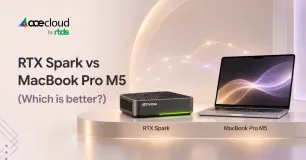
NVIDIA RTX Spark vs MacBook Pro M5: Which Is Better for AI?

Quick Answer Yes, NVIDIA RTX Spark can replace a MacBook Pro M5 for CUDA-based AI development and certain local LLM workloads. In 2026 benchmarks, RTX Spark outperformed M5 Pro in selected AI-agent tasks, while M5 Max led in CPU and graphics performance. Choose RTX Spark for NVIDIA-focused AI workflows, but MacBook Pro for longer battery […]

Have You Right-Sized Your Infrastructure Before Choosing B300 Over H200?

Quick Answer Before choosing NVIDIA B300 over H200, right-size your infrastructure based on workload requirements, GPU memory, concurrency, performance targets and costs. Benchmark both GPUs under realistic workloads. Choose H200 if it meets your requirements. Choose B300 when its additional memory, compute power or multi-GPU capabilities address measurable bottlenecks and justify the investment. GPU selection […]

9 Best NVIDIA DGX Spark Alternatives in 2026

Quick Answer The best NVIDIA DGX Spark alternative in 2026 depends on your workload. Choose AMD Ryzen AI Halo for high-memory local AI without CUDA, Framework Desktop for a developer-focused AMD system, Mac Studio M5 Ultra for massive unified-memory workloads, RTX Spark for Windows-native AI and creator workflows, RTX 5090 or RTX PRO 6000 for […]

NVIDIA DGX Spark Price in 2026: Cost, Specs and Is It Worth It?

Quick Answer As of October 2026, NVIDIA lists the 128GB DGX Spark at $6,950 (₹6,59,277) in its U.S. Marketplace and has announced the new 64GB configuration starting at $4,999 (₹4,74,205.14) through OEM partners from October 23. The 64GB model lowers the entry cost for local CUDA AI, while cloud GPUs remain better suited to bursty, […]

NVIDIA RTX Pro 4500 vs RTX Pro 6000: Which is Better for AI/ML Training?

Quick Answer RTX PRO 4500 and RTX PRO 6000 solve different AI training constraints. Choose RTX PRO 4500 when individual jobs fit within 32 GB and efficiency, density, or parallel experimentation matters. Choose RTX PRO 6000 when one job needs substantially more memory, higher memory bandwidth, or more single-GPU compute. Some AI teams can benefit […]

GPT-6 Astra vs GPT-6.1 Sol and Gemini 4 Argon: Benchmarks, Cost per Task, and Which to Use

Quick Answer In the GPT-6 Astra vs Gemini 4 Argon matchup, neither model wins outright, and GPT-6.1 Sol is often the better production default because it combines near-frontier capability with substantially lower API costs. GPT-6 Astra is better suited to difficult engineering, scientific, and computer-use tasks where higher task success can justify premium inference costs. […]

Self-Hosted Coding Models for Teams – What Ollama on a Laptop Can’t Do

Quick Answer Ollama is a practical way to test and run coding models locally, but a laptop can become a bottleneck when several developers, coding agents, or CI systems use the same model. Team inference requires planning for concurrency, GPU memory, reliability, access control, observability, and serving capacity. A developer gets a local coding model […]

Kimi K3 vs GPT-6 Astra: A Comprehensive Technical Comparison

Quick Answer Kimi K3 and GPT-6 Astra target different priorities. K3’s open-weight 2.8T-parameter MoE design favors deployment control, lower published Standard token pricing, architecture transparency, and strong long-context performance. Astra remains proprietary but leads several current independent general, terminal, and automation benchmarks while offering a broader managed tool ecosystem. Choosing the wrong frontier model can […]

AGI vs Generative AI vs Agentic AI: What Makes Artificial General Intelligence Different?

Quick Answer Artificial General Intelligence is an AI that can learn, reason, adapt, and solve problems across a broad range of intellectual tasks rather than being designed for one narrow purpose. An AGI would ideally be able to transfer knowledge between domains, learn unfamiliar skills, plan across multiple steps, use tools, and adjust when circumstances […]

Running MiniMax H3 on Your Own GPU: VRAM, Render Times and Cost per Minute

Quick Answer MiniMax H3 can run on a 24 GB GPU, but that proves feasibility, not production readiness. Practical performance depends on quantization, offloading, resolution, and inference optimization. L40S provides 48 GB VRAM, while RTX PRO 6000 Blackwell provides 96 GB. The key decision is not fit or speed, but which setup delivers acceptable video […]