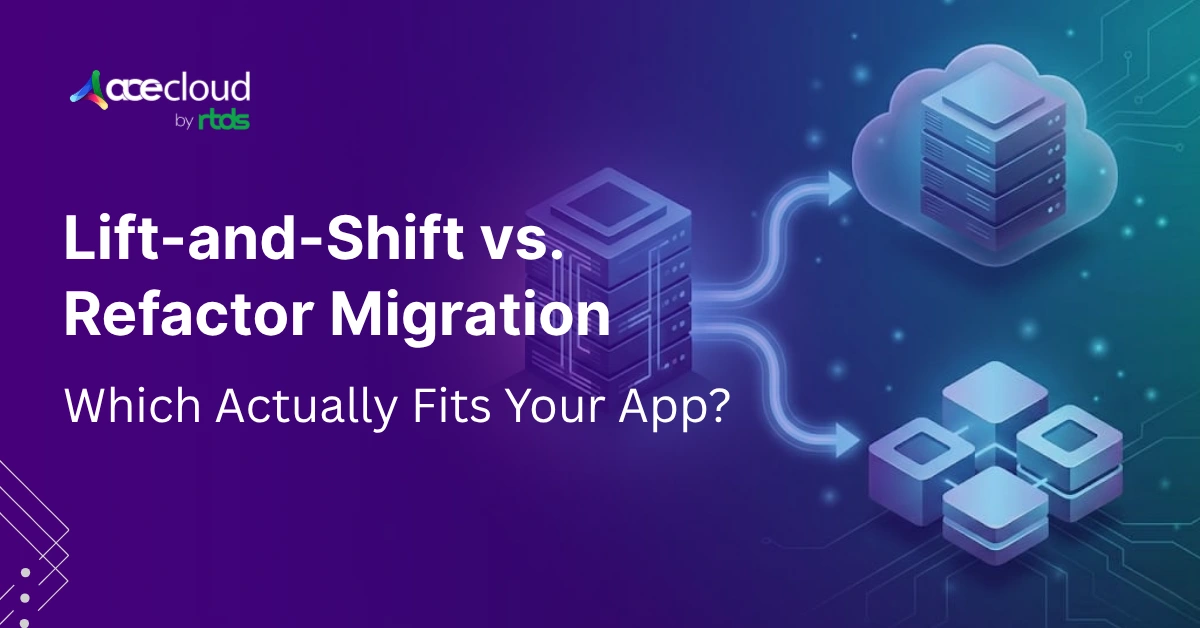
Choosing a cloud migration strategy is easier when you evaluate a specific application rather than debating cloud adoption in general. For most teams, the real question is lift-and-shift vs refactor and the right answer depends on what the application needs today and what the business expects from it tomorrow.
Lift-and-shift helps teams move quickly with minimal code or architectural changes, making it a practical choice when speed and lower disruption matter most. Refactoring takes more effort upfront, but it can unlock better scalability, resilience and long-term cloud efficiency.
This decision has real financial and operational consequences. Flexera’s 2026 State of the Cloud Report found that 85% of organizations say managing cloud spend remains their top cloud challenge.
Let’s explore when each strategy makes the most sense and how to evaluate the right path for each workload.
What is Lift-and-Shift?
Lift-and-shift, also called rehosting, migrates applications, data or systems from on-premises infrastructure to the cloud with little to no modification.
In the lift-and-shift vs. refactor decision, this path is often chosen when you need a faster migration and want to avoid major changes to the existing architecture.
It effectively moves the workload to a new hosting environment while preserving its core structure and behavior.
Benefits of Lift-and-Shift
- Faster migration timelines: You can move workloads largely as-is, which shortens planning, redesign and validation cycles.
- Lower initial investment: You should expect fewer engineering changes upfront, which typically reduces near-term costs.
- Lower change-related risk: You keep most of the existing architecture and interfaces, which can reduce migration-induced code regressions. However, infrastructure, performance, dependency and cloud-cost risks can still remain high if the workload is a poor fit for simple rehosting.
What is Refactoring?
Refactoring changes application code, architecture or both to improve cloud fit. In migration programs, this can range from targeted code and runtime changes to a broader re-architecture, but it should not be treated as synonymous with full re-architecting.
In a lift-and-shift vs refactor decision, refactoring targets long-term value by enabling cloud-native capabilities.
The scope can range from small, focused updates to a full redesign of the system.
Benefits of Refactoring
- Improved runtime efficiency: Refactoring aligns the application with cloud execution models, which can improve throughput, latency and resource utilization compared to lift-and-shift.
- Greater scalability and agility: You can adopt cloud-native patterns such as autoscaling, managed services, event-driven components or selective service decomposition where justified.
- Better long-term readiness: Refactoring positions the platform for emerging capabilities, including AI workloads and advanced analytics, without repeated foundational rewrites.
What is Replatforming?
Replatforming sits between lift-and-shift and refactoring. It moves an application to the cloud with limited optimization, without fully redesigning the system.
For example, a team may keep the application largely intact while shifting the database to a managed service, moving to containers, or adopting a more cloud-friendly runtime. This approach is useful when full refactoring is not feasible, but a pure rehost would leave too much inefficiency in place.
In many real-world migrations, replatforming becomes the middle-ground option for teams that need some modernization without taking on the cost, timeline and execution risk of a full refactor.
In practice, many organizations should not treat lift-and-shift vs refactor as a strict binary choice. For mixed application estates, replatforming is often the most realistic and financially sensible middle path.
Lift-and-Shift vs Replatform vs Refactor
Here is a practical comparison of lift-and-shift, replatforming, and refactoring for teams evaluating the right migration path.
| Factor | Lift-and-Shift | Replatform | Refactoring |
|---|---|---|---|
| Speed to cloud | Fastest | Moderate | Slowest |
| Upfront engineering effort | Low | Medium | High |
| Code changes | Minimal | Limited | Significant |
| Migration risk | Lower code risk | Balanced | Higher execution complexity |
| Cloud optimization | Low | Medium | High |
| Long-term cost efficiency | Moderate to low | Better | Highest potential |
| Scalability improvement | Limited | Moderate | Strong |
| Best fit | Time-sensitive legacy moves | Workloads needing selective modernization | Strategic apps needing long-term transformation |
Key takeaway:
- If the priority is speed, lift-and-shift often wins.
- If the priority is long-term cloud value, refactoring usually wins.
- If the answer sits between those two, replatforming is often the smarter route.
How to Choose Between Lift-and-Shift vs. Refactoring?
Choosing between lift-and-shift and refactoring should align with your business objectives, budget and delivery timeline. You can make a clearer decision by evaluating the factors below:
Timeline and urgency
If you have strict time constraints, lift-and-shift usually moves systems to the cloud faster because it requires minimal code changes. If the timeline allows deeper planning, refactoring can deliver more strategic value through modernization.
Budget constraints
Lift-and-shift often costs less at the start because it minimizes redesign work. However, it can create higher long-term spend if oversized infrastructure, inefficient storage patterns and legacy licensing models carry into the cloud unchanged.
Refactoring usually costs more upfront, but it may improve long-term economics by reducing waste, improving resource efficiency and simplifying operations.
Long-term business goals
If the application supports modernization, product velocity, customer experience or future innovation, refactoring usually deserves stronger consideration. If the near-term goal is business continuity with minimal disruption, lift-and-shift may be the better fit.
System complexity and dependencies
Applications with tightly coupled integrations, legacy middleware, hardcoded dependencies or shared databases can make full refactoring harder to execute safely. In these environments, a phased path often works better: rehost first, stabilize, then modernize selected components.
Performance and scalability requirements
If the application already struggles with latency, throughput, release speed or scaling limits, lift-and-shift may simply move the problem instead of solving it. Refactoring becomes more valuable when the workload needs elasticity, faster deployment cycles or stronger performance under changing demand.
Operational readiness and internal skills
Refactoring demands stronger engineering discipline across cloud architecture, DevOps, testing, observability, security and change management. Even when refactoring is strategically right, the team may not be ready to execute it well. In that case, lift-and-shift or replatforming can be the more realistic step.
Security, compliance and governance needs
Some workloads require stronger identity control, encryption design, policy enforcement, auditability or data residency alignment in the cloud. If the current architecture cannot support those needs cleanly, refactoring may become necessary rather than optional.
Downtime tolerance and migration risk
Lift-and-shift reduces code risk, but it still involves cutover risk, migration sequencing and rollback planning. Refactoring may create stronger long-term outcomes, but it also increases execution complexity. That means the safest path depends on the workload, not the theory.
Technical debt and cloud fit
If the application is brittle, expensive to scale, difficult to maintain or poorly aligned with cloud economics, a simple rehost may not create enough value. This is often the clearest signal that the business should consider refactoring or at least partial modernization.
A More Practical Decision Framework
The most reliable way to choose between lift-and-shift and refactor is to evaluate the application, not the trend. Before making a final decision, ask these five questions:
- How much code-change tolerance does the application have? If the answer is very little, rehosting may be safer.
- How business-critical is the workload? The more strategic the app, the more likely it is that long-term architecture matters.
- How much technical debt is embedded in the current design? If the app is brittle, expensive to scale, or hard to change, simply moving it may not create enough value.
- What does the business actually need? Migration speed or modernization benefit? Those are not the same objective.
- Does the team have the capability to execute a refactor? Good architecture plans fail when the platform, security, testing, and operational model are not ready.
Real-World Examples: Which Path FitsWhichWorkload?
The best migration strategy becomes clearer when you map each option to a real workload and business context.
Legacy internal ERP system
If the ERP system is stable, business-critical, heavily integrated and not expected to change much in the near term, lift-and-shift may be the safest path. The goal here is often continuity and lower migration disruption.
Customer-facing SaaS application with scaling issues
If a product already faces release bottlenecks, scaling limits or inconsistent performance, refactoring is often the better investment. Moving it as-is may shift infrastructure, but it will not fix architecture-level constraints.
Monolithic application with a tight migration deadline
If the team must exit a data center or complete a migration quickly, but the monolith still needs some improvement, replatforming is often the right compromise. Teams can move first, adopt managed services or containers selectively, then refactor high-value components later.
Analytics or AI-enabled application expected to grow
If the workload will support AI features, data-heavy processing or unpredictable usage growth, refactoring often creates more long-term value because cloud-native architecture matters more over time.
How Can You Assess Readiness Before Migration?
Before choosing a migration path, teams should complete a basic readiness assessment. This should include workload discovery, dependency mapping, rightsizing analysis and an understanding of licensing, storage and network behavior in the target cloud environment.
This step is especially important because a lift-and-shift migration can preserve inefficient sizing, expensive licensing and architecture choices that do not translate well to cloud economics. For refactoring, readiness assessment helps define scope boundaries, identify dependencies and avoid unnecessary redesign.
For senior infrastructure and architecture leaders, this is usually where the business case becomes more concrete.
What Does a Simple Decision Matrix Look Like?
A practical way to evaluate an application is to score it across a few core dimensions:
- business criticality
- migration urgency
- code-change tolerance
- technical debt
- compliance sensitivity
- scalability needs
- modernization upside
- team readiness
Interpretation:
- A workload with high urgency and low code-change tolerance is often a strong fit for lift-and-shift.
- A workload with high modernization upside, strong scalability needs and active development pressure is more likely to justify refactoring.
- When the answer is mixed, replatforming or phased modernization is often the better path.
Can Lift-and-Shift and Refactor Work Together on One Roadmap?
Yes, and for many organizations, that is the most practical answer.
A blended roadmap lets teams rehost stable or lower-priority applications for speed while reserving refactoring effort for customer-facing, performance-sensitive or innovation-critical workloads. That reduces migration bottlenecks without forcing every application into the same model.
This kind of phased strategy is especially useful in a hybrid cloud world, where not every workload has the same cost profile, reliability target or modernization value. It also helps explain why cloud strategies sometimes get revisited after the initial move.
Foundry’s 2025 survey found that 75% of decision-makers have moved or plan to move workloads back on-premises, primarily because of security, cost, reliability and compliance concerns.
That is not evidence that cloud failed. It is evidence that workload-level fit matters. A rushed migration strategy can create as many problems as it solves.
Choose the Right Migration Path with AceCloud
There is no universal winner in the lift-and-shift vs refactor decision. The right path depends on your application architecture, business priority, migration urgency, technical debt, compliance needs, and long-term cloud goals.
Some workloads need speed and stability. Others need modernization and stronger cloud economics. Many need a phased path that starts with rehosting or replatforming and evolves toward deeper optimization later. That is where AceCloud can help.
From cloud readiness assessments and workload discovery to migration planning, modernization strategy, and ongoing optimization, AceCloud helps teams decide which applications should be rehosted, replatformed, or refactored first.
If you want a clearer migration roadmap, explore AceCloud’s cloud migration solutions and get a workload-by-workload assessment tailored to your environment.
Frequently Asked Questions:
Lift-and-shift migration, also called rehosting, moves an application to the cloud with minimal code or architecture changes.
You should refactor when the application needs cloud-native scalability, resilience, faster releases or long-term efficiency gains.
Lift-and-shift is usually cheaper upfront. Over time, refactoring can reduce technical debt and operational overhead.
Refactoring adds complexity, delivery risk and more architectural change during the migration process.
Replatforming moves an application to the cloud with limited changes, such as adopting managed databases or container runtimes, when full refactoring is not feasible.
Lift-and-shift can increase cloud costs when the application is over-provisioned, has steady peak sizing, relies on expensive licensing or uses storage and I/O patterns that do not map efficiently to cloud services.
You should refactor a monolith before migrating only when there is a clear need for independent scaling, release isolation, resilience improvements, or major platform fit changes. Otherwise, rehosting or replatforming first is often safer, with selective decomposition later.
You can use a phased approach by rehosting or replatforming to meet deadlines first, then refactoring high-value components in later waves with clear boundaries and strong testing and observability.


![AWS S3 to Indian Alternative: Complete Migration Guide [2026]](https://acecloud.ai/wp-content/uploads/2026/06/s3-alternative.webp)