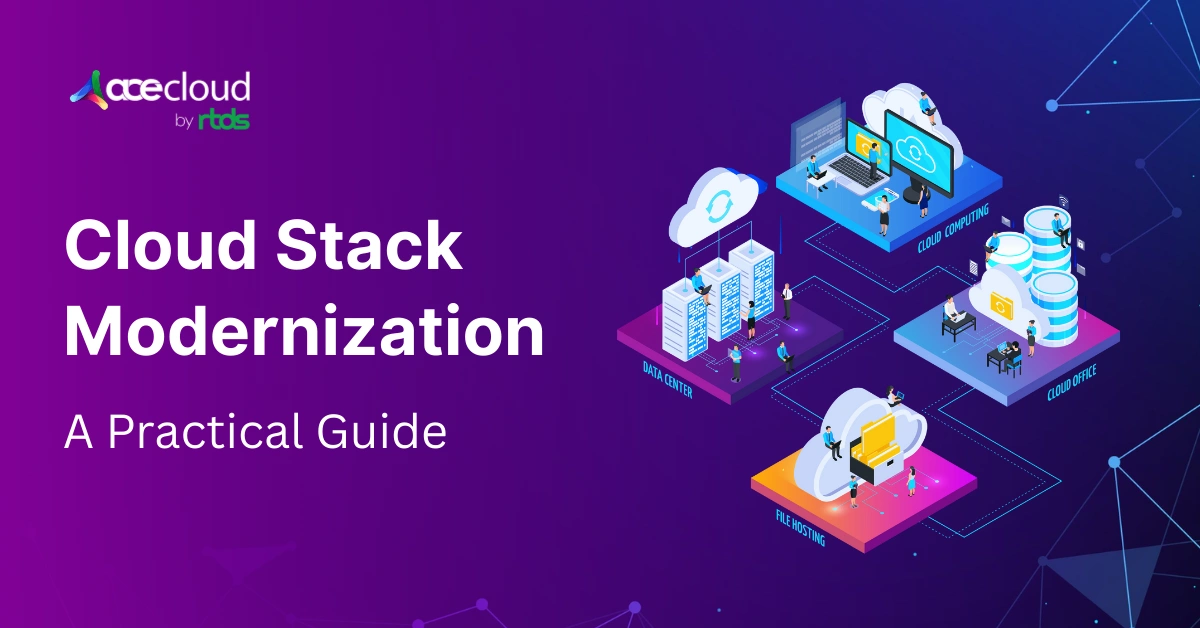
Cloud stack modernization has shifted from being a nice upgrade to something companies rely on to stay competitive. When teams upgrade their cloud environments, CTOs and DevOps groups can ship features faster and respond to change instead of chasing them. In many cases, it’s the difference between keeping up and falling behind.
As more workloads move to the cloud, the behind-the-scenes work becomes more complicated. Maintenance, updates and integrations become complex. This is where platforms like AceCloud help simplify and secure the shift. But before making that leap, CTOs need clarity on what actually changes and what it means for their teams.
Why Cloud Stack Modernization is No Longer Optional?
The cloud environment has undergone a massive expansion. To put it briefly, 94% of businesses are already utilizing cloud services.
However, a majority of entities still operate on their old cloud stacks, thus limiting their pace of innovation and agility. As a result, they are vulnerable to high operational costs and also security breaches.
Cloud stack modernization supports companies that want to scale efficiently while reducing overhead. It is not only about migration to the cloud but also about the revolution of the way cloud infrastructure is built, controlled, and expanded.
Companies that fail to modernize run the risk of being overtaken by competitors, who are capable of deploying at a faster rate.
What is Cloud Stack Modernization?
Cloud Stack Modernization is a way to upgrade your current cloud infrastructure and incorporate more modern, scalable, and flexible technologies. It enhances operational efficiency, reduce costs, and access to cutting-edge technologies such as AI and ML.
The primary objective is to cut technical debt, reduce manual processes, and use container orchestration tools like Kubernetes to scale.
Organizations should adopt cloud-native technologies such as Kubernetes, containers like Docker, microservices architectures, and serverless computing to ensure the cloud stack is future-ready. This will enable companies to easily deploy new features and handle huge traffic without worrying about infrastructure failure.
Key Drivers for Cloud Stack Modernization
What’s driving this shift? The key drivers of cloud stack modernization are clear:
Cost Efficiency:
According to a report by McKinsey, 80% of businesses that modernize their IT infrastructure see a reduction in operational costs. Legacy systems are expensive to maintain and often require manual interventions. Modern cloud solutions reduce overhead and streamline workflows, leading to long-term savings.
For example, a mid-sized SaaS company running legacy VMs may spend $50K/month in infrastructure, but by shifting to containerized workloads with autoscaling, those costs can drop by 30–40%.
With cloud solutions, you pay only for what you use. No more over-provisioning. You’re finally controlling your IT costs, shifting from hefty capital expenditures to flexible, pay-as-you-go models.
See how FinB slashed its cloud spend with targeted cost-optimization using AceCloud.Read the FinB cloud cost savings case study
Agility and Scalability:
Speed and flexibility are now survival traits. Whether it’s a new product launch or a sudden traffic spike, teams need systems that respond instantly. Modern platforms make it possible to deploy updates fast, scale applications on demand, and integrate with existing tools without long delays.
You can deploy applications quickly, scale them up when demand spikes, and seamlessly integrate them with your existing systems. It’s like having an elastic IT environment that stretches when needed. This kind of flexibility is a game-changer. You’re no longer stuck waiting for new hardware or software upgrades. Everything is done in real time.
Enhanced Security:
Security is critical for distributed systems. Often, breaches result in financial losses, endless litigation, and loss of trust. You can have the best technology, but if it’s not secure, it’s useless. Modern cloud stacks come with stronger security features. Think about advanced encryption, multi-factor authentication, and tight identity management.
AceCloud takes security to the next level, offering enterprise-grade protection with certifications like ISO/IEC 27001:2022, ISO/IEC 20000:2018, ISO/IEC 27017:2015 and ISO/IEC 27018:2019. With proactive threat monitoring, continuous updates, and compliance with global regulations
Innovation and Future-Proofing:
Innovation has become a moving target. Cloud-native platforms give companies the flexibility to experiment with AI, ML, IoT, and other emerging technologies without rebuilding everything from scratch. Modernization ensures the stack can support what’s coming next, not just what’s working today.
How to Approach Cloud Stack Modernization: A CTO’s Guide
Assess Your Current Stack
Before modernizing, examine your existing cloud stack. What components are outdated? Where are the bottlenecks? Is your current cloud environment supporting your company’s growth and innovation goals?
By assessing your current infrastructure, you can pinpoint areas which require immediate attention and where you can implement gradual improvements. You can optimize your cloud stack with minimal disruption, ensuring continuous business operations.
Adopt Cloud-Native Technologies
Start by adopting cloud-native technologies such as containerization, Kubernetes, and microservices. Modernized cloud platforms allow for a more modular, scalable application development and deployment approach. With GPU-powered virtual machines and high-performance compute instances, your teams can work faster, deploy more frequently, and manage complex applications more efficiently.
Automate Where Possible
Automation is one of the key benefits of cloud modernization. From infrastructure provisioning to software deployment, automation reduces manual errors and boosts efficiency. DevOps teams should consider leveraging Infrastructure as Code (IaC) and Continuous Integration/Continuous Deployment (CI/CD) pipelines to automate key processes and streamline development workflows.
Prioritize Security and Compliance
Security must be a priority when modernizing your cloud stack. Look for cloud solutions that offer built-in security tools like encryption, firewalls, and advanced access controls.
Optimize Costs with the Right Architecture
Cloud stack modernization is about upgrading technology and optimizing costs. Leverage cloud cost management tools to identify areas for reducing spending.
The Role of DevOps in Cloud Stack Modernization
The success of cloud stack modernization depends on DevOps teams. They are supposed to fill the gap between operations and development and ensure that applications can be deployed fast, reliably, and at scale.
DevOps teams are expected to automate the deployment pipeline, improve collaboration between developers and IT operations, and constantly optimize infrastructure in the context of cloud stack modernization. These teams simplify processes, improve collaboration, and manage cloud resources more effectively, enabling organizations to achieve business objectives sooner.
However, DevOps is not only about keeping the lights on. It is about making actual changes. DevOps teams are not simply deploying applications but minimizing manual errors, removing bottlenecks, and implementing updates at lightning speed.
Imagine a fully automated pipeline that lets teams deploy features or fixes effortlessly. They are harnessing all their potential and making their organization successful at a fast, reliable, and scalable pace.
Common Challenges CTOs Face During Cloud Stack Modernization
Like any massive change, cloud stack modernization is associated with challenges. These include:
- Integration of Legacy Systems: Many organizations have difficulties integrating new cloud infrastructure with legacy systems.
- Skills Gap: The new cloud technologies demand new skills that all team members do not possess.
- Cultural Resistance: Organizational change is usually met with resistance, particularly when it entails new working methods. CTOs should be the first to show the way by fostering a culture of innovation and collaboration so that adopting new cloud technologies proceeds without a hitch.
Conclusion
Cloud modernization isn’t a one-time effort. It’s a continuous evolution. Your cloud stack should keep up with technological changes. For CTOs and DevOps leaders, it is important to be ahead of the curve to achieve long-term success. Through modern cloud technologies, process automation, and a focus on security and scalability, organizations can be set to grow in a more competitive digital environment.
AceCloud is the ideal technical partner for modernizing your cloud infrastructure. From GPU-based virtual machines to managed services, it offers the tools, support, and expertise to modernize your cloud stack and achieve transformative benefits for your organization.

![AWS S3 to Indian Alternative: Complete Migration Guide [2026]](https://acecloud.ai/wp-content/uploads/2026/06/s3-alternative.webp)