
Quick Answer
Firewall as a Service is often cheaper for cloud-first, multi-location, and rapidly growing businesses because it can reduce firewall hardware, licensing, maintenance, staffing, and expansion costs. Self-managed firewalls may still cost less for centralized organizations that already own suitable appliances, have experienced security professionals, and expect limited network growth. The right decision depends on total cost of ownership, not the monthly subscription or firewall appliance price alone.
A business with three offices, 250 protected users, remote employees, and applications distributed across cloud and on-premises environments reaches a critical decision point.
Its existing firewalls are approaching renewal and have limited remaining useful life. VPN traffic is increasing, while the network security team is spending more time updating policies, reviewing IDS/IPS alerts, troubleshooting access, and preparing compliance evidence.
The business can purchase new next-generation firewall appliances, renew its threat-intelligence and support agreements, and continue managing the environment internally. Alternatively, it can move to Firewall as a Service and shift infrastructure maintenance, monitoring, and scaling to a cloud provider while retaining responsibility for policy ownership, access approvals, compliance, and incident handling.
This is not simply a choice between hardware and software. It is a financial decision involving capital expenditure, operational expenditure, staffing, licensing, depreciation, refresh cycles, energy costs, maintenance contracts, and business risk.
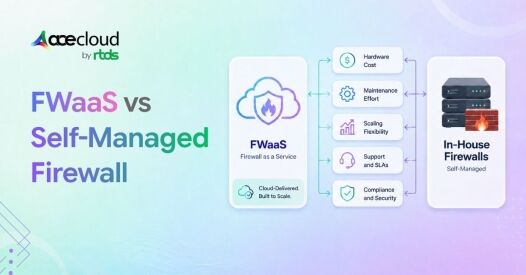
Comparing FWaaS vs Self-Managed Firewall – At a Glance
| Factor | Self-Managed Firewall | FWaaS |
|---|---|---|
| Infrastructure | Customer-owned or deployed | Provider-operated cloud infrastructure |
| Cost Model | CapEx plus recurring OpEx | Primarily recurring OpEx |
| Maintenance | Internal team or MSP | Primarily provider-managed |
| Scaling | Appliance or licence upgrade | Plan or resource adjustment |
| Policy Control | Direct customer control | Customer-controlled policies via centralized platform |
| Hardware Lifecycle | Customer responsibility | Provider responsibility |
| Staffing | Higher internal requirement | Reduced infrastructure workload |
| Security responsibility | Primarily customer-managed | Customer: policies & rules; Provider: platform & infrastructure |
Note: Maintenance remains important in both models. The Verizon 2026 Data Breach Investigations Report found that 31% of breaches started with software vulnerabilities, making patching, policy reviews, and vulnerability management important parts of firewall TCO.
Before breaking down costs, it helps to understand the structural differences between a cloud firewall and a traditional firewall.
How Should Firewall TCO Be Calculated?
A reliable firewall cost comparison should include every capital and operational expense incurred over at least three years.
A practical formula is:
Firewall TCO = Infrastructure + licensing or subscriptions + implementation + labor + monitoring + maintenance + scaling + transition costs
- Self-managed firewall CapEx may include appliances, redundant devices, installation, and data-centre preparation. Its OpEx may include licences, support, labour, energy, monitoring, backup connectivity, and upgrades.
- Firewall as a Service moves more spending into recurring OpEx, but migration, governance, integrations, log retention, premium support, and exit planning may still create additional costs.
What Does Managing Your Own Firewalls Cost?
Managing firewalls internally costs more than purchasing appliances because ownership creates continuing licensing, staffing, maintenance and infrastructure responsibilities.
Upfront costs can include:
- Primary and secondary NGFW appliances
- Branch-office hardware
- Installation and network redesign
- Initial firewall licensing
- Security-policy migration
- Testing and administrator training
- High-availability configuration and testing
Recurring expenses can include:
- Threat-prevention and IDS/IPS licences
- VPN and threat-intelligence subscriptions
- Central management tools
- SIEM integration and log storage
- Maintenance and support agreements
- Power, rack space, and backup connectivity
- Policy recertification
- Firmware testing and rollback planning
- Vendor-management and procurement time
- Emergency replacement equipment
How should internal labor be calculated?
Annual firewall labor cost = Fully burdened annual employee cost × percentage of time spent on firewall operations
Firewall work can include rule reviews, patching, alert investigation, VPN administration, certificate management, segmentation, troubleshooting, audit preparation, and after-hours incidents.
The 2025 ISC2 Cybersecurity Workforce Study found that 33% of organizations lacked the budget to staff security teams adequately, while 29% could not afford professionals with the required skills. It also found that 47% of respondents often felt overwhelmed by their workload.
What Does AceCloud FWaaS Cost Over Three Years?
AceCloud provides 12 configurations across BYOL, Fortinet UTP, and Fortinet Enterprise options. Monthly prices range from ₹1,304 for FW.1.2 BYOL to ₹69,500 for FTN.ENT.8.16.
The comparison uses FTN.UTP.4.8 at ₹40,710 per month.
₹40,710 × 36 months = ₹14,65,560
| Representative option | Monthly price | Calculated 36-month base total |
|---|---|---|
| FW.4.8 BYOL | ₹4,986 | ₹1,79,496 |
| FTN.UTP.4.8 | ₹40,710 | ₹14,65,560 |
| FTN.ENT.4.8 | ₹44,310 | ₹15,95,160 |
The 36-month amounts are mathematical projections based on published monthly rates, not separately quoted three-year contract prices.
BYOL requires a customer-supplied license and excludes security-service bundles and support, so its lower infrastructure price is not directly comparable with license-inclusive options.
How Do the Three-Year Costs Compare?
Under the financial assumptions, the base AceCloudFWaaS model costs ₹27,05,560 compared with ₹50,00,000 for self-management.
How were the labour figures calculated?
The model assumes a blended, fully burdened security and network staff cost of ₹15,00,000 per year.
- Self-managed firewall labour: ₹15,00,000 × 40% × 3 years = ₹18,00,000
- FWaaS governance labour: approximately ₹15,00,000 × 13.3% × 3 years = ₹6,00,000
These percentages are illustrative. They must be replaced with actual time allocations.
| Cost component | Self-managed firewall | AceCloud FWaaS |
|---|---|---|
| Hardware and high availability | ₹12,00,000 | ₹2,00,000 |
| Deployment or migration | ₹3,00,000 | ₹2,00,000 |
| Three-year license or subscription | ₹9,00,000 | ₹14,65,560 |
| Administration and governance | ₹18,00,000 | ₹6,00,000 |
| Logging, integrations, and monitoring | ₹3,60,000 | ₹2,40,000 |
| Energy, rack space, power consumption, and spares | ₹2,40,000 | ₹0 |
| Hardware refresh reserve | ₹2,00,000 | ₹0 |
| Estimated three-year TCO | ₹50,00,000 | ₹27,05,560 |
Estimated difference = ₹50,00,000 − ₹27,05,560 = 22,94,440
Illustrative TCO reduction = approximately 45.9%
Disclaimer: This comparison is illustrative and based on assumed staffing, infrastructure, licensing, migration, and operating costs. Actual TCO will vary by organization size, traffic, security requirements, existing hardware, taxes, support scope, and contract terms. Validate all figures before making a purchasing decision.
Which Hidden Costs Can Change the Result?
Hidden costs can include migration, extended logging, additional capacity, premium support, provider dependency, contract exit, and redundancy requirements.
The 2026 Unit 42 Global Incident Response Report found that:
- 87% of intrusions involved activity across two or more attack surfaces.
- 67% involved activity across three or more attack surfaces.
These results show why buyers should assess visibility, and integration requirements across endpoints, networks, cloud environments, SaaS applications, and identities.
The Uptime Institute Annual Outage Analysis 2026 reports that around one in ten respondents said their latest outage had serious or severe consequences.
This statistic does not predict the cost of a firewall outage. However, it supports evaluating availability requirements separately from the base subscription price.
When FWaaS Usually Wins
FWaaS is more likely to deliver a stronger ROI when an organization is distributed, cloud-focused, rapidly growing, or constrained by security staffing.
The business case becomes stronger when:
- Several offices require protection
- Remote users depend heavily on VPN or ZTNA
- Applications run across multiple cloud platforms
- Security policies change frequently
- Hardware is approaching replacement
- Internal specialists are difficult to hire
- Branch deployments require travel and installation
- Capacity requirements fluctuate
- The business is adopting SASE or Zero Trust
When Self-Managed Firewall Usually Wins
A self-managed firewall may cost less when the organization has recently purchased equipment, operates a stable network, and already has qualified staff with available capacity.
Self-managed may remain attractive when:
- Appliances are within their supported lifecycle
- Traffic is predictable
- Most users and applications are centralized
- The organization maintains a mature SOC
- Security policies require extensive customization
- Direct infrastructure control is mandatory
- Migration would provide limited immediate value
How Can You Calculate Your FWaaS Break-Even Point?
FWaaS reaches break-even when avoided ownership costs exceed the combined subscription, migration and continuing governance expenses.
Annual FWaaS savings = Annual self-managed cost − Annual FWaaS cost
Break-even period = FWaaS transition cost ÷ Annual FWaaS savings
Model at least:
- Three-year TCO
- Five-year TCO
- Low-growth scenario
- High-growth scenario
- Hardware-refresh scenario
- Subscription-renewal scenario
- Existing-licence scenario
- Higher-capacity scenario
A reliable ROI calculation should use actual invoices, payroll costs, maintenance agreements, energy expenses, and provider quotations.
Book a Free Consultation to calculate an organization-specific TCO and payback period.
What Should You Ask Before Choosing an FWaaS Provider?
Buyers like you should evaluate technical scope, service responsibility, pricing structure, and exit terms before selecting an FWaaS platform.
Ask:
- Which plan supports the required throughput and sessions?
- Are NGFW, IDS/IPS, and threat-intelligence capabilities included?
- Is high availability included?
- How long are logs retained?
- What monitoring does the provider perform?
- Are VPN, ZTNA, or SD-WAN integrations supported?
- How are security policies updated?
- Are migration services included?
- Which costs increase with usage?
- How are configurations and logs exported at contract end?
FWaaS can support security and compliance controls, but purchasing the service does not automatically make an organization compliant.
See our guide on understanding public cloud security for a deeper look at shared responsibility.
Ready to Lower Firewall Costs with AceCloud?
FWaaS can be the more economical choice when your business is facing hardware renewal, rising licensing costs, limited security staff, or multi-site growth. In this comparison, AceCloud FWaaS delivers a lower illustrative three-year TCO than self-managed firewalls, but the result depends on plan sizing, high availability, logging, migration, and internal labor costs.
The next step is not to compare appliance prices with subscription fees. It is to calculate your actual TCO, break-even point, and operational savings.
Book a Free Consultation with AceCloud to validate your requirements, compare real costs, and choose the right firewall configuration for your environment before making your decision.
Frequently Asked Questions
No. FWaaS is often more cost-effective for multi-location, cloud-first, and fast-growing businesses. Self-managed firewalls may cost less when suitable hardware, licences, and experienced security staff are already available.
AceCloud firewall pricing starts at ₹1,304 per month for BYOL infrastructure. Fortinet UTP plans start at ₹14,360 per month, while Fortinet Enterprise plans start at ₹15,640 per month. Pricing should be verified before purchase.
Hidden costs include administrator time, firewall licences, maintenance contracts, redundant appliances, power, rack space, monitoring, patching, compliance reporting, emergency upgrades, and hardware replacement.
Additional costs may include migration, high availability, premium support, advanced security capabilities, SIEM integrations, extended log retention, additional resources, taxes, and contract-exit work.
The break-even period depends on migration expenses, subscription pricing, existing hardware age, staffing costs, licensing fees, and future growth. Businesses should compare both three-year and five-year TCO scenarios.
BYOL has the lowest published infrastructure pricing, but the customer must provide an eligible firewall license. License renewals, support, and management costs must be added before comparing it with Fortinet UTP or Enterprise plans.
Self-management may be more economical when the organization operates from a small number of stable locations, owns recently purchased appliances, has predictable traffic, and employs skilled firewall administrators with available capacity.


