The recovery dashboard is green. Forty virtual machines restart within 25 minutes, and the provider reports that the recovery time objective has been met. But there is one problem. Customers still cannot place an order because the database is recovering, DNS has not changed, and the payment gateway cannot connect.
That gap captures the biggest risk when we evaluate DRaaS in India. We may buy an infrastructure recovery target while believing we have bought complete business recovery.
Disaster Recovery as a Service replicates applications and data to a secondary cloud environment so they can be recovered when primary infrastructure fails. The recovery point objective measures acceptable data loss. The recovery time objective measures acceptable downtime.
The most important question is not how quickly a provider can start a virtual machine. It is how quickly our customers, employees, or partners can use the affected business service again.
IBM placed the global average cost of a data breach at US$4.4 million in 2025. Although a breach differs from a conventional infrastructure outage, the finding shows why faster containment and trustworthy recovery matter when systems and data are disrupted.
The Four Levels of a DRaaS Promise
Not every DRaaS recovery claim is a guarantee. Its value depends on the wording, measurement method, covered workload, exclusions, and remedy.
| Claim level | Typical wording | What it tells us |
|---|---|---|
| Marketing claim | Near-zero downtime | An ambition that may not be defined |
| Technical capability | RPO as low as seconds | A result that may be possible under specific conditions |
| Contractual SLA | RTO shall not exceed 30 minutes | A binding target only when scope and measurement are clear |
| Demonstrated outcome | Application recovered in 27 minutes during a live drill | The strongest operational evidence |
AWS offers a useful example. Its Elastic Disaster Recovery documentation cites recovery point objectives of seconds and recovery time objectives of minutes. Its public DRS SLA commits to 99.9 percent monthly service availability, usually remedied through service credits.
Service availability is not the same as guaranteed application recovery. A platform can remain available while our application, database, network, or external integrations remain offline.
The cloud SLA evaluation checklist can help us review covered services, calculation methods, exclusions, credits, and escalation paths.
A meaningful recovery claim identifies the workload, clock, acceptance test, exclusions, and consequence of failure.
The RTO Clock Can Hide the Real Outage
An RTO has limited value until we know exactly what starts the clock and what event stops it.
| Recovery measurement | Clock starts | Clock stops |
|---|---|---|
| Platform RTO | Failover request is submitted | Recovery task completes |
| Infrastructure RTO | Disaster is formally declared | Servers and networks become available |
| Application RTO | Disaster is declared | The application passes technical checks |
| Business-service RTO | Users lose the service | An agreed business transaction succeeds |
Microsoft states that Azure Site Recovery measures RTO from failover initiation until the target virtual machine runs. Manual actions and scripts are excluded, and credits depend on sufficient capacity being available in the recovery region.
The database may still be recovering after the virtual machine starts. DNS may still need to change. Identity services or external APIs may remain unavailable.
Our provider may recover servers in 25 minutes while customers wait two hours. Both figures can be technically correct, which is not especially reassuring at 2 a.m.
For critical workloads, the useful RTO ends when the agreed business service works, not when a server merely powers on.
Does our recovery plan measure business recovery or infrastructure startup? We can book a free consultation with AceCloud to map workload dependencies and define realistic RPO and RTO requirements.
What the Provider May Not Own?
A fully managed DRaaS service may still exclude the dependencies that determine whether an application works.
Common gaps include database consistency, identity services, DNS, routing, certificates, application startup order, third-party APIs, transaction validation, reconciliation, and failback.
A provider may own replication, cloud infrastructure, monitoring, and basic orchestration. We may still own disaster declaration, database integrity, external connections, security validation, and business acceptance.
AceCloud’s managed database options can form part of the database availability and recovery design. A Virtual Private Cloud can help recreate network boundaries and routing. Separately controlled identity access can support safer administration when production credentials are unavailable or compromised.
We get more value from a named list of systems, tasks, and acceptance checks than from a broad end-to-end label.
Three Hidden Risks That Change the Value of DRaaS
The real value of DRaaS depends on capacity, data integrity, and the ability to return safely to normal operations.
Recovery Capacity May Not Be Waiting
Rapid recovery requires available compute, storage performance, network throughput, quotas, and software licences.
AWS DRS uses EC2 On-Demand capacity by default and warns that capacity may be unavailable during extreme conditions. AWS also notes that the first boot of a recovered Windows machine can take up to 45 minutes.
Microsoft recommends capacity reservations when recovery-resource availability is critical.
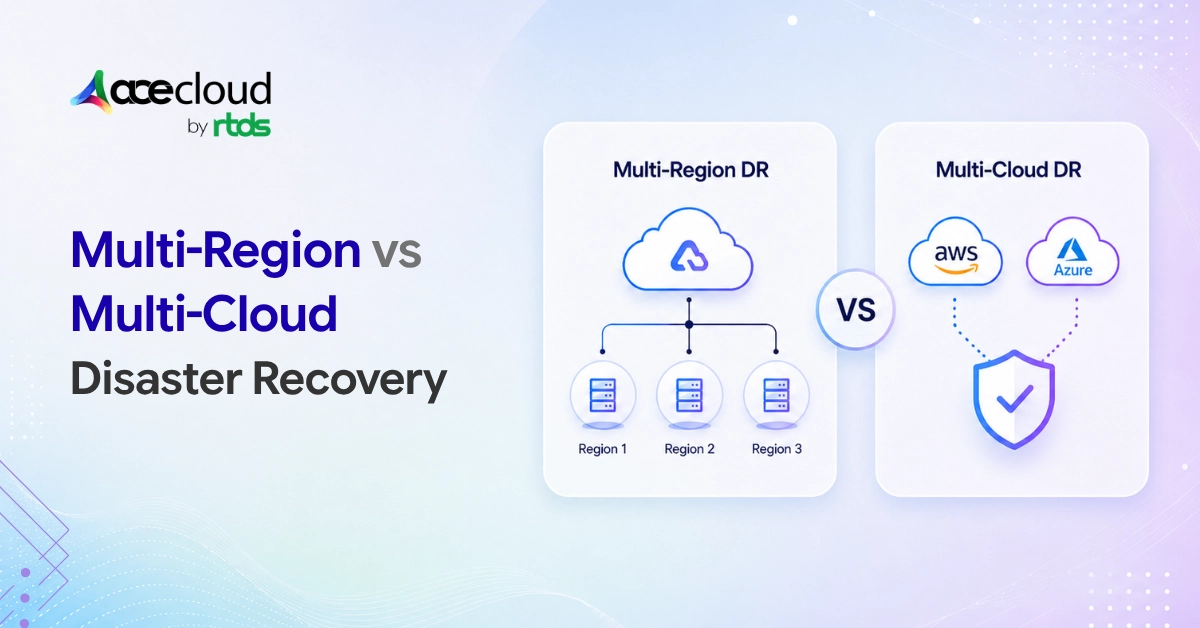
A cross-region disaster recovery design can reduce dependence on one location, but capacity, routing, and replication policies still need testing.
An RTO of minutes is difficult to trust when the required infrastructure has not been reserved or validated under realistic load.
Replication Can Copy the Problem
Continuous replication can reproduce ransomware encryption, accidental deletion, damaged configuration, or database corruption in the recovery environment.
Verizon reports that ransomware appeared in 48 percent of breaches in its 2026 Data Breach Investigations Report.
Traditional disaster recovery restores availability. Cyber recovery restores a known-clean, isolated, and trustworthy environment.
We usually need several recovery points, isolated credentials, tested restoration, and protected backups such as a cloud volume-backup service.
Replication helps us recover from infrastructure failure. It does not automatically prove that the replicated data is safe to restore.
Failback Can Be the Expensive Sequel
Failover receives most of the attention. Failback is where the engineering effort and cloud bill often return for an encore.
Moving back to the primary environment may involve reverse replication, transaction reconciliation, extended cloud use, repeated testing, and another maintenance window.
True DRaaS cost equals steady-state protection plus drills plus recovery operation plus extended DR hosting plus failback.
What DRaaS in India Means for Compliance?
Hosting recovery infrastructure in India does not automatically settle every compliance, security, or data-location question.
We still need to know where replicas, backups, security logs, encryption keys, service metadata, monitoring data, and remote support access reside.
CERT-In requires covered entities to report specified cyber incidents within six hours of noticing them. ICT logs must be retained securely for 180 days within Indian jurisdiction.
For organizations covered by SEBI’s Cybersecurity and Cyber Resilience Framework, the framework calls for disaster declaration within 30 minutes, a two-hour RTO, a 15-minute RPO, and live recovery drills. These requirements do not apply to every Indian business.
A useful provider relationship gives us timely access to synchronised logs, recovery evidence, named incident contacts, and forensic records.
AceCloud’s DPDP compliance checklist covers data flows, processor responsibilities, and audit evidence. The IaaS contract checklist covers recovery scope, data location, support timelines, and incident obligations.
Regulatory accountability remains with us even when recovery operations are outsourced.
The Five-Question DRaaS Reality Test
Five questions can reveal most of the hidden gaps in a DRaaS proposal.
- What exact event starts the RTO clock?
- What technical or business outcome stops it?
- Does the SLA include applications, databases, identity, networks, and external dependencies?
- Is recovery capacity reserved and tested at production scale?
- What remedy applies when the business service misses its target?
A recovery exercise using a real application tells us more than a demonstration virtual machine.
In practice, recovery language is useful only when it is connected to a number, a test method, and a clear consequence when the commitment is missed.
Why Proof Matters More Than Recovery Adjectives?
DRaaS India can improve resilience when the provider is accountable for a clearly defined business outcome.
RPOs of seconds and RTOs of minutes mean little when capacity, dependencies, validation, and failback remain outside the contract.
The strongest evidence is a recent drill showing that an agreed business transaction recovered within the contracted period using the people, processes, and infrastructure that would be available during a real incident.
Frequently Asked Questions
Backup as a Service preserves recoverable data. DRaaS also provides recovery infrastructure, replication, and orchestration. Most organisations need both because backup data alone cannot restart a complete business application.
High availability keeps services running through local component failures. DRaaS restores systems after a wider site, region, or infrastructure disruption.
No. DRaaS focuses on technology recovery. Business continuity also covers employees, suppliers, communications, facilities, customer support, and temporary operating procedures.
Sometimes. Recovery agents or backup-based methods may support physical systems, but old operating systems, hardware dependencies, licences, and specialised peripherals can complicate recovery.
Yes, but virtual-machine protection is not enough. Recovery may also require cluster definitions, container registries, persistent volumes, deployment manifests, secrets, and external managed services.
Not automatically. Infrastructure-focused DRaaS may not protect data stored inside third-party SaaS platforms. Separate SaaS backup, retention, and recovery services may be required.
Hot DR is immediately available. Warm DR needs some provisioning. Cold DR relies more heavily on rebuilding and restoration. Faster readiness generally costs more.
A small virtual environment may take weeks. A complex application estate can take months because of networking, security reviews, dependency mapping, data movement, and recovery testing.
The recovery design needs geographic separation, alternative regions, limited shared dependencies, and clear data-export options. Provider concentration risk should also be considered.
Switching may require data movement, new replication agents, rebuilt runbooks, format conversion, and repeated recovery testing. Exit terms are easier to negotiate before signing.