
Quick Answer
For most organizations, multi-region DR reduces total risk more effectively because it is easier to operate, secure, automate, and test. Multi-cloud DR offers stronger protection against provider-wide failure, but it reduces overall risk only when the second environment can operate independently and has been proven through regular recovery exercises.
The real question is not how many clouds or regions we can place on an architecture diagram. It is which design gives us the best chance of recovering applications, data, and business services within the time our organization can tolerate. A well-designed cloud disaster recovery solution balances infrastructure separation with the practical ability to recover.
That distinction matters. A second cloud may give us a separate infrastructure provider, but it can also give us another identity model, another networking design, another set of security policies, and another environment that quietly becomes outdated. A second cloud is useful only when it is a working recovery platform rather than an expensive museum of last quarter’s configuration.
What is the Difference Between Multi-Region and Multi-Cloud DR?
The terms sound similar, but they protect us from different levels of failure.
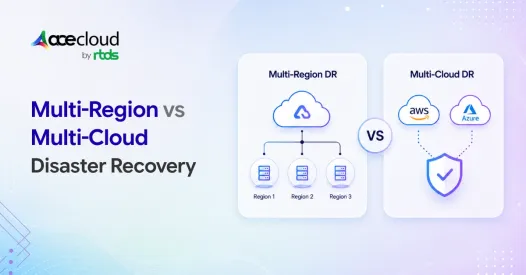
Multi-region disaster recovery replicates or operates workloads across geographically separate regions belonging to the same cloud provider. We may use backup and restore, a pilot light, warm standby, active-passive, or active-active architecture.
Because both environments use the same provider, we can often rely on native replication, consistent identity and access management, common APIs, and familiar monitoring. Our guide to single-region and multi-region DR models explores those options in more detail.
Multi-cloud disaster recovery maintains a recoverable application or data environment with a second cloud provider. The second cloud may hold backups, a pilot light, warm standby, or a complete active deployment.
That provider separation can reduce concentration risk and support portability or regulatory requirements. It also means we need to maintain networking, security, automation, monitoring, data replication, and operational expertise across two ecosystems. Our guide to multi-cloud strategy covers the broader tradeoffs.
How Do Multi-Region and Multi-Cloud DR Compare?
The difference becomes clearer when we compare the risks and operating demands side by side.
| Evaluation factor | Multi-region DR | Multi-cloud DR |
|---|---|---|
| Regional outage protection | Strong | Strong |
| Provider-wide outage protection | Limited | Stronger |
| Failover automation | Usually simpler | Usually more complex |
| Data replication | Often native | Often cross-platform |
| Identity and security | One provider model | Multiple provider models |
| RTO and RPO | Easier to optimize | Harder to standardize |
| Configuration drift | Lower | Higher |
| Skills required | One cloud ecosystem | Multiple cloud ecosystems |
| Cost | Usually lower | Usually higher |
| Provider concentration | Remains | Reduced |
| Recovery testing | Easier to repeat | More resource intensive |
Multi-cloud gives us greater infrastructure independence. Multi-region usually gives us a higher probability that recovery will happen as designed.
Before we choose either architecture, we need realistic RTO and RPO targets for each workload. A recovery time objective tells us how quickly a service must return. A recovery point objective tells us how much data loss, measured in time, we can accept.
Which Failures Does Each Strategy Protect Against?
We get better DR decisions when we begin with a failure scenario rather than a preferred technology.
Can multi-region DR survive an Availability Zone failure?
A well-designed multi-AZ application should normally handle a single Availability Zone or data center failure without invoking regional DR.
AWS describes its Regions as separate geographic locations containing multiple physically separated Availability Zones. This architecture lets us design applications that fail over between zones before a wider regional recovery process becomes necessary.
Using a second provider for one failed zone would usually be more recovery machinery than the problem requires.
What happens during a regional cloud outage?
A regional outage is where multi-region DR fits naturally.
Within one provider, we can often use native database replication, object replication, traffic management, infrastructure templates, and regional failover services. That common operating model can shorten recovery time and reduce the number of manual changes needed during an incident.
A multi-region disaster recovery platform can also help us orchestrate application startup order, DNS changes, and failback instead of treating recovery as a collection of unrelated server restarts.
What happens if an entire cloud provider becomes unavailable?
Multi-cloud DR provides the strongest isolation from a provider-level incident, but only when the recovery environment is genuinely independent.
Cloud regions are important failure boundaries, yet some provider services include global or shared control-plane components. AWS documents that the IAM control plane for its standard commercial partition is located in one region while regional data planes perform local authorization. This separation improves resilience, but it also shows why we cannot assume that every provider dependency is fully regional.
We also need independent access to DNS, secrets, monitoring, deployment artifacts, and recovery credentials. Two clouds that depend on the same unavailable identity provider or CI pipeline are less independent than the architecture diagram suggests.
Does either strategy protect against ransomware or data corruption?
Neither live-replication model protects us by itself.
Replication can copy accidental deletion, corrupted data, malicious changes, or ransomware encryption into another region or cloud. CISA recommends maintaining offline encrypted backups and regularly testing their availability and integrity because ransomware actors often try to delete or encrypt accessible backups.
We still need immutable backups, multiple recovery points, separate credentials, point-in-time recovery, and tested restoration procedures.
Does geographic diversity protect against a defective release?
No. If we deploy the same faulty application version everywhere, we can break every region and provider with impressive efficiency.
Release isolation still matters. Canary deployments, staged promotion, known-good artifacts, rollback procedures, and independent deployment gates protect us from software failures that geographic diversity cannot solve.
Why Does Multi-Region Reduce More Operational Risk?
Multi-region DR is generally easier to keep healthy because both environments share the same operating model.
We can use common identity controls, infrastructure code, monitoring, security policies, APIs, and replication tools. Our teams work in a familiar environment, and recovery tests are easier to repeat.
DR environments age quietly. Certificates expire, firewall policies drift, quotas change, and a dependency added six months ago never makes it into the recovery runbook. None of this is dramatic until the day we need the environment.
A simpler recovery platform is more likely to remain patched, synchronized, documented, and tested.
The safest DR architecture is not necessarily the one with the most providers. It is the one we can recover successfully and repeatedly.
This is why multi-region DR often gives us the best balance of resilience, speed, and operational confidence.
When Does Multi-Cloud DR Reduce More Risk?
Multi-cloud DR becomes the better choice when provider-wide unavailability is an unacceptable business scenario.
We usually see the strongest case for multi-cloud with Tier 0 workloads, safety-critical systems, regulated platforms, or services where an extended provider outage would cause severe financial or reputational harm.
Architecture needs real independence. We need portable applications, reliable cross-cloud replication, enough standby capacity, separate credentials, independent network and DNS paths, and teams capable of operating both providers.
A design such as cross-cloud disaster recovery between AWS and AceCloud can create provider separation for selected workloads. The benefit comes from tested independence, not simply from storing a copy somewhere else.
Multi-cloud DR also needs realistic failback planning. Returning data and traffic to the primary provider can be just as complex as failing over. Disaster recovery has a habit of saving its awkward questions for the return journey.
How Do We Choose Between the Two?
We make a better decision when we connect architecture to business impact rather than treating cloud diversity as a goal by itself.
Multi-region DR usually fits when regional outages are the main concern, low RTO and RPO matter, and our team primarily operates one cloud.
Multi-cloud DR usually fits when a full provider outage is unacceptable, provider concentration is a documented enterprise risk, and we can fund and test two independent environments.
Our decision also depends on whether the recovery target is a server, an application, or a complete business service.
A virtual machine can be running while the database, DNS, payment gateway, or identity service remains unavailable. Our guide on how to evaluate DRaaS beyond the headline SLA explores why infrastructure startup and business recovery are not always the same event.
What is the Most Practical DR Architecture for Most Enterprises?
For most environments, a layered design gives us broader protection without forcing every workload into a two-cloud operating model.
We can use multi-AZ production for local infrastructure failures, multi-region replication for regional outages, immutable backups for cyber and data recovery, and cross-cloud recovery for the small group of workloads that genuinely require provider independence.
This model recognizes that not every application has the same value, recovery objective, or risk tolerance. It also keeps our most complex controls focused on the workloads that can justify them.
Choose Wisely with AceCloud Disaster Recovery
For most organizations, multi-region DR is the lower-risk default. It is simpler to operate, easier to test, and more likely to recover within expected timelines.
Multi-cloud DR is a targeted control for workloads that require provider independence. The second environment must be independently operable, properly secured, adequately sized, and regularly tested.
At AceCloud, we encourage our customers not to collect more clouds. Our goal is to recover the business. Need expert guidance? Book your free consultation with our cloud disaster recovery experts and get all your questions answered.
Frequently Asked Questions
No. Multi-region DR uses geographically separate regions from one provider. Multi-cloud DR uses recovery environments from different providers.
No. Multi-cloud improves provider independence, but it can increase configuration, security, networking, data consistency, and recovery execution risks.
Multi-region usually supports a faster and more predictable RTO because we can use native replication, consistent tooling, and established failover services within one provider.
Only partially. Multiple regions can still depend on shared global services, identity platforms, networks, monitoring systems, or control-plane components.
Yes. Replication supports availability, but immutable and isolated backups give us clean recovery points when data is deleted, corrupted, or encrypted.
Not automatically. We may still depend on provider-specific databases, APIs, identity systems, observability tools, or deployment services. Real portability requires deliberate architecture and regular testing.

