
Your H200 compute just got 10% more affordable than ever before.
Get Startedright-arrow
Jason Karlin's profile image

Jason Karlin

Industry veteran with over 10 years of experience architecting and managing GPU-powered cloud solutions.
Specializes in enabling scalable AI/ML and HPC workloads for enterprise and research applications.
Former lead solutions architect for top-tier cloud providers and startups in the AI infrastructure space.

When is the RTX Pro 6000 Worth Over the RTX 5090 – An Honest Breakdown

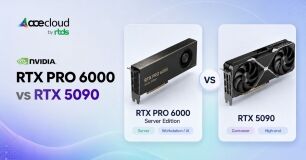
Quick Answer The RTX Pro 6000 is worth the premium when the full workload memory footprint exceeds 32GB, or when the deployment needs ECC memory, MIG/vGPU, validated server integration, rack density, enterprise drivers/support, or controlled multi-tenant GPU allocation. For gaming, local creation and single-user AI work that fits comfortably within 32GB, the RTX 5090 can offer better […]

NVIDIA Vera vs AMD EPYC vs Intel Xeon: Which CPU Fits Agentic AI?

Quick Answer NVIDIA Vera is likely to be the strongest host CPU for agentic AI systems built around Rubin GPUs because it combines high memory bandwidth with a coherent NVLink-C2C connection. AMD EPYC and Intel Xeon remain stronger alternatives when x86 compatibility, conventional memory capacity, mixed-vendor accelerator support, or general-purpose infrastructure matter more. Key takeaways: […]

How Much GPU Infrastructure Does NVIDIA Omniverse Really Need?

Quick Answer NVIDIA Omniverse requires an RTX-class GPU with RT Cores. The minimum is an RTX 4080 with 16GB VRAM for individual work. A 48GB L40S or RTX 6000 Ada is recommended for industrial scenes. Production digital twins need 4 to 8 GPU OVX-class nodes. A100, H100 and H200 should not be positioned for Omniverse RTX Renderer […]

RTX 5070 vs RTX 5080 vs RTX 5090 – Which GPU Should You Buy

The NVIDIA GeForce RTX 5070, RTX 5080, and RTX 5090 use the Blackwell architecture, GDDR7 memory, DLSS 4, Multi Frame Generation, fourth-generation ray-tracing cores, and fifth-generation Tensor Cores. However, they target very different users. Your choice should depend on gaming resolution, workload, VRAM requirements, power consumption, and total system cost, not just specifications alone. Quick […]

RTX Spark vs RTX 5070: Local AI PC or Cloud GPU for Enterprise AI?

NVIDIA’s 2026 RTX Spark push has changed how developers think about local AI PCs. At the same time, the RTX 5070 gives users a capable Blackwell-generation GPU for gaming, creative work, and lighter AI tasks. Both are generating a lot of buzz right now. But for AI teams, “Which GPU is better?” is the wrong […]

On-Demand vs Reserved vs Spot GPU Pricing in India: Which Costs Less?

A GPU priced at ₹125 per hour looks easy to budget. We multiply the rate by the expected runtime and assume we know what the workload will cost. Then the bill arrives with idle commitments, checkpoint storage, interrupted jobs, network charges, and a few notebooks that someone forgot to stop before the weekend. The real […]

Managed Cloud vs. Hyperscaler for Mid-Market EdTech: Which Operating Model Wins

It is 9 a.m. on enrollment day. Learner traffic triples within minutes, a school customer asks for security documentation, finance flags another cloud cost increase, and engineering is mid-sprint on an AI tutoring release. Quick Answer: For most mid-market EdTech companies, the strongest default is a customer-controlled cloud environment paired with selectively managed operations. The […]

Prefill-Decode Disaggregation on NVIDIA B200: Does It Lower Cost per Token?

Prefill and decode are two integral phases of LLM inference. While prefill is a compute-bound matrix operation, decode is a more memory-bandwidth-bound operation. Prefill processes your input tokens in a single parallel pass, while decode generates output tokens one at a time. These opposite compute profiles can be attributed to the way in which tokens […]