OpenAI has just rolled out ChatGPT 5.2, a fresh flagship update that’s quickly becoming one of the most searched AI topics right now. Recent reporting suggests OpenAI moved fast amid pressure from Google’s Gemini 3 Pro, but beyond the headlines, the real story is practical: ChatGPT 5.2 focuses on smoother “knowledge work” (coding, long documents, and deliverables like spreadsheets and presentations), while Gemini 3 Pro is built to shine on massive-context and multimodal workflows.
In this guide, we’ll cover the latest ChatGPT 5.2 model, what’s actually new, and a ChatGPT 5.2 vs Gemini 3 Pro comparison so you can pick the right model for your use case.
ChatGPT 5.2
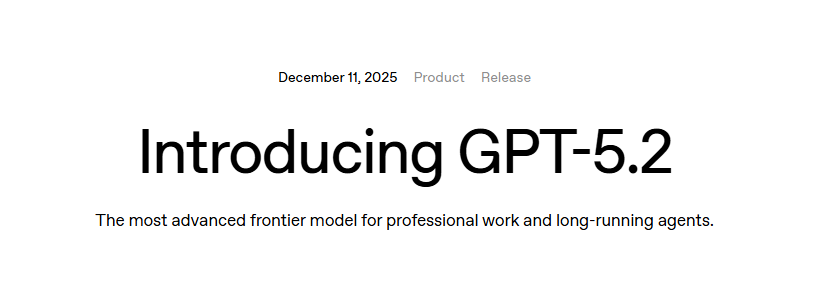
ChatGPT 5.2 refers to the new GPT-5.2 model series rolling out inside ChatGPT, launched December 11, 2025.
OpenAI is shipping 3 variants:

- ChatGPT-5.2 Instant (fast, “workhorse” model)
- ChatGPT-5.2 Thinking (deeper work: coding, long docs, planning)
- ChatGPT-5.2 Pro (highest-quality answers where accuracy is worth the wait)
What’s new in GPT-5.2
OpenAI positions GPT-5.2 as better at:
- Spreadsheets & presentations
- Coding
- Long-context understanding
- Tool use + complex multi-step projects
- More structured day-to-day outputs
OpenAI also highlights safety improvements in sensitive conversations and an age-prediction approach being rolled out in some places.
Availability (ChatGPT)
OpenAI says GPT-5.2 begins rolling out in ChatGPT, starting with paid plans (Plus, Pro, Go, Business, Enterprise) and is deployed gradually. GPT-5.1 remains available to paid users for three months under “legacy models.”
ChatGPT 5.2 vs Gemini 3 Pro: side-by-side comparison
| Category | ChatGPT 5.2 | Gemini 3 Pro |
|---|---|---|
| Best at | “Professional knowledge work” deliverables, coding + tools, structured outputs in ChatGPT | Massive context + multimodal reasoning + Google ecosystem distribution |
| Variants | Instant / Thinking / Pro | Pro (preview) + related preview models; Deep Think is separate mode |
| Context window | OpenAI reports strong long-context eval results up to 256k in its long-context benchmarks | 1M input / 64k output (official spec) |
| Reasoning controls | Pro supports a “reasoning” parameter; Thinking/Pro support higher reasoning effort (incl. xhigh) | thinking_level control (defaults to high) |
| API pricing (headline) | gpt-5.2: $1.75 in / $14 out per 1M tokens | gemini-3-pro-preview: $2/$12 (<200k) or $4/$18 (>200k) per 1M |
| Rollout | Starts with paid ChatGPT plans | Available across Gemini app + Search AI Mode + AI Studio + Vertex AI |
Performance & benchmarks:
GPT-5.2
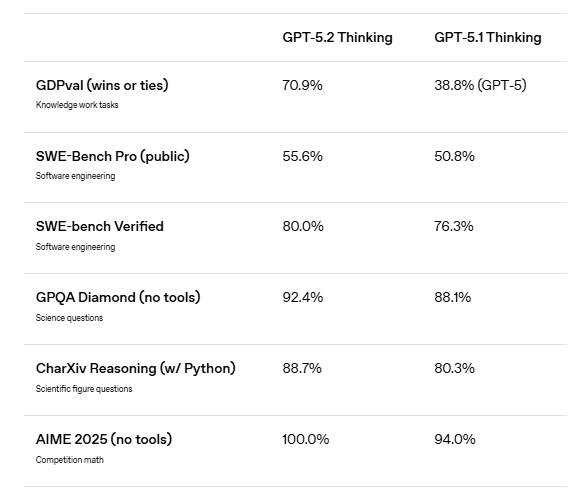

OpenAI’s release post reports strong gains on professional and reasoning benchmarks, including:
- GDPval (wins or ties): 70.9% (professional knowledge work tasks)
- SWE-bench Verified: 80.0%
- GPQA Diamond (no tools): 92.4%
- ARC-AGI-2 (Verified): 52.9% (Thinking), 54.2% (Pro)
OpenAI also notes benchmark runs used high reasoning effort settings and that results come from a research environment.
Gemini 3 Pro
Google’s Gemini 3 announcement claims Gemini 3 Pro is state-of-the-art across multiple benchmarks, highlights strong leaderboard positioning, and also introduces Gemini 3 Deep Think as a higher-reasoning mode with improved results on some evaluations.
The 6 differences that matter most in real workflows
1) Context: 256k-class reliability vs 1M-class capacity
- Gemini 3 Pro’s headline advantage is simple: you can stuff more into the prompt (up to 1M input tokens).
- GPT-5.2 emphasizes long-context performance in its own evals up to 256k and positions itself as better at “long contexts” and file work in ChatGPT.
2) Deliverables: spreadsheets + presentations as a first-class goal (OpenAI)
Reuters and OpenAI both spotlight GPT-5.2’s strength in spreadsheets, presentations, and multi-step professional tasks, which is exactly the output most “vs” posts don’t teach readers how to evaluate.
3) Reasoning control knobs are different
- OpenAI: reasoning parameter (Pro) + “reasoning effort” including xhigh for Thinking/Pro.
- Google:
thinking_levelto cap depth (lowvshigh).
Translation: Both let you pay for “thinking,” but the ergonomics differ. Developers should choose the one that matches their latency/cost constraints.
4) Ecosystem advantage: ChatGPT workflows vs Google distribution
Gemini 3 is shipped across Google products, including Search AI Mode, Gemini app, AI Studio, and Vertex AI.
GPT-5.2’s advantage is how it performs inside ChatGPT for daily professional work (and its tight integration into ChatGPT’s tool/workflow concept).
5) Pricing
- GPT-5.2: $1.75 input / $14 output per 1M tokens (cached input discounted)
- Gemini 3 Pro: $2/$12 under 200k prompt size, then $4/$18 over 200k
Practical cost note:
If your prompts often exceed 200k tokens, Gemini’s per-token rate jumps tiers.
6) “Code red” is mostly about speed + focus – not automatically “better for you”
Coverage agrees GPT-5.2 is a strategic response to Gemini 3 momentum, but that doesn’t mean GPT-5.2 is always the better model for every workload.
How to choose the best model
Choose ChatGPT 5.2 if you do a lot of:
- Spreadsheet modeling, planning docs, presentations, stakeholder-ready writing
- Coding + debugging where you want highly structured explanations and strong tool use
- Multi-step “do the whole project” prompts inside ChatGPT
Choose Gemini 3 Pro if you do a lot of:
- Massive document / repo ingestion (very large context)
- Multimodal research + deep integration with Google surfaces (Search AI Mode, AI Studio, Vertex)
- Applications where you want a simple “depth switch” (
thinking_level) for cost/latency control
Frequently Asked Questions
GPT-5.2 is positioned as “best for everyday professional use” and OpenAI reports strong gains on professional + reasoning benchmarks. Gemini 3 Pro’s biggest practical edge is context size (1M tokens) and broad Google ecosystem deployment.
Gemini 3 Pro is the “bring everything” model (1M context), while ChatGPT 5.2 is the “ship finished work” model (professional deliverables + tool workflows).
Yes, Google labels it as a preview model in the Gemini 3 series rollout.