

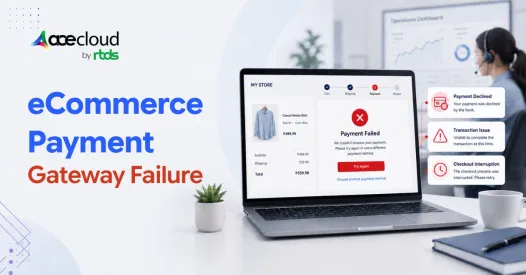
Your eCommerce flash sale ads worked. Traffic is surging. Carts are filling. But out of nowhere, payments start failing, quietly.
No big error banner. No site crash. Just customers retrying, abandoning, and occasionally getting charged without receiving a confirmation. Your team finds out hours later when cart abandonment looks suspicious or support tickets pile up.
That is what ecommerce payment failure in India actually looks like. Not a dramatic outage. A silent revenue leak that masquerades as a conversion problem.
Quick Answer:
Payment gateway failure during a big sale happens when customers cannot complete payments, or when successful payments fail to become confirmed orders. It can be caused by gateway outages, bank or UPI failures, slow APIs, webhook errors, fraud-rule false declines, or overloaded checkout infrastructure. Cloud solutions reduce the risk by enabling autoscaling, monitoring, queue-based processing, payment failover, and reconciliation.
Key takeaways:
- Checkout failure during peak sales is often silent and shows up as abandoned carts, pending orders, or missed confirmations.
- Big sales expose weak payment architecture because traffic, APIs, fraud checks, and webhooks all spike together.
- One gateway creates a single point of failure on your highest-revenue day.
- Cloud helps when it enables autoscaling, real-time monitoring, and failover, not just by hosting the same fragile checkout on better servers.
According to Adobe’s holiday shopping report, U.S. online holiday spending hit a record $257.8 billion in 2025. Indian ecommerce face platform faces the same sale-day pressure, with UPI, cards, wallets, net banking, EMI, and BNPL all adding complexity to checkout resilience. If your store is not ready to move from legacy hosting to managed cloud before a big campaign, checkout failure is not a risk. It is a schedule.
Why Do Payment Gateways Fail During Big Sales?
Most merchants test their payment setup against a normal Tuesday. A big sale is not a normal Tuesday. It compresses months of demand into hours, and everything that had breathing room suddenly does not.
According to Stripe’s BFCM 2025 newsroom report, Stripe processed over 578 million transactions and more than $40 billion in payment volume during Black Friday through Cyber Monday 2025, peaking at 152,000 transactions per minute. Adyen’s BFCM 2025 report puts their volume at $43 billion during the same window, peaking at 199,000 transactions per minute.
Those platforms prepare specifically for that load. Most merchants prepare their marketing campaigns.
Getting auto scaling and load balancing right before a sale is what decides whether your campaign revenue actually lands.
The failure points are also not just at the gateway. A payment travels through a chain: checkout, gateway, processor, acquirer (the merchant’s bank-side institution), card network or UPI rail, issuing bank (the customer’s bank), fraud tool, webhook, order system, inventory, confirmation email. Any link can break independently. The gateway can be fully operational while a webhook silently stops updating orders, or a fraud rule starts blocking legitimate customers because transaction velocity looks unusual during the sale.
Payment resilience is only one part of preparing an online store for peak traffic. Your application servers, database, cache, inventory services, CDN, APIs and disaster recovery setup must also remain stable when demand spikes. Use our eCommerce Flash Sale Readiness Checklist to assess the broader infrastructure risks that can affect checkout before your next major campaign.
Is One Payment Gateway Enough for a Big Sale?
We understand the appeal. One provider, one dashboard, one support contact. But a single PSP (payment service provider) means every payment route runs through one dependency. If that provider has latency or an outage, there is no fallback.
According to BR-DGE data cited by Access PaySuite, only 32% of enterprise merchants have automated payment failover, and 71% route most payment volume through a single PSP.
Most merchants go into their biggest sales with no backup plan. Thinking through recovery time and recovery point objectives before the sale is how you avoid a very expensive fire drill during it.
How Do Cloud Solutions Reduce Payment Gateway Failure?
Cloud does not magically prevent checkout failure. It helps you detect, absorb, route around, and recover from failures faster.
Here is what a cloud-ready payment setup looks like compared to a fragile one.
| Fragile payment setup | Cloud-ready payment setup |
|---|---|
| One gateway | Primary plus backup PSP |
| Manual monitoring | Real-time payment health alerts |
| Direct webhook processing | Queue-based webhook processing |
| Basic retries | Idempotent retries with deduplication |
| Single region | Multi-AZ or multi-region resilience |
| Manual reconciliation | Automated order-payment matching |
Kubernetes autoscaling handles checkout scaling without anyone manually provisioning servers mid-sale. Multi-region disaster recovery reduces the blast radius when one region has issues. Queue-based webhook processing means payment events do not get lost when downstream systems are under load.
Cloud only works here when used to build an actual resilience system. It does not fix bad integration, broken webhooks, or missing idempotency keys. Those are architecture problems. Hosting them on better infrastructure just makes them slightly faster to fail.
For Indian Merchants, Resilience Means More Than Cards
Sale-day checkout failure in India is more complex than in card-dominant markets. UPI, wallets, net banking, EMI, and BNPL all run on different rails with different failure modes. Bank downtime and issuer routing issues can affect each one differently on the same day.
According to a PIB release on UPI’s first decade, UPI processed more than 24,162 crore transactions worth over ₹314 lakh crore in FY2025-26. For May 2026 specifically, The Economic Times reports 23.2 billion transactions worth ₹29.90 lakh crore. That volume runs through rails that also experience peak-load moments.
For Indian sale events, payment resilience means payment-method coverage, bank-rail reliability, and fallback routing, not just keeping one gateway online.
What Payment Metrics Should You Monitor During a Big Sale?
During a big sale, do not monitor only server uptime. The metrics that actually matter are payment success rate, authorisation rate, gateway error rate, payment latency, decline rate, webhook delay, pending order volume, retry volume, duplicate payment attempts, refund requests, and payment-related support tickets.
The most important metric is not whether the website is online. It is whether customers who want to pay are becoming confirmed orders. If payment success drops while traffic stays high, you are not dealing with a traffic problem. You are dealing with revenue leakage.
What to Test Before Your Next Big Sale
Before the campaign goes live, answer these questions in a test environment.
- Can checkout handle five to ten times normal traffic?
- Does the backup gateway activate automatically if the primary times out?
- Are duplicate payments blocked?
- Do paid orders always move from pending to confirmed when webhook volume spikes?
- Are alerts triggered when the authorisation rate drops?
- Is there a sale-day incident owner with the context and authority to act quickly?
Here is one formula worth running before every campaign.
Revenue at risk per minute = average order value × failed payment attempts per minuteIf AOV is ₹2,000 and 80 attempts fail per minute, that is ₹1.6 lakh per minute at risk. That number tends to make infrastructure conversations move faster.
Assess autoscaling, load balancing, webhook processing, payment failover, monitoring, reconciliation and disaster recovery with AceCloud experts before campaign traffic reaches your checkout.
Final Takeaway
Your next big sale does not need only a payment gateway. It needs a payment resilience layer that can scale under pressure, detect silent failures, route payments through backups, prevent duplicate charges, and keep payments, orders, inventory, and confirmations in sync.
Marketing brings the traffic. Payment resilience converts it into revenue. If your next campaign depends on checkout reliability, start by assessing whether your current infrastructure can scale, fail over, and recover without losing payment data.
Frequently Asked Questions
Payment gateway failure during peak sales is usually caused by traffic spikes, gateway or processor outages, bank or issuer downtime, UPI or card-network disruptions, slow APIs, webhook failures, weak retry logic, fraud-rule false declines, or single-gateway dependency. Indian ecommerce checkout failure often happens not because one thing breaks but because multiple parts of the payment chain are under pressure at the same time.
Cloud solutions reduce payment failure risk by autoscaling checkout systems, monitoring payment health in real time, supporting queue-based processing, enabling multi-region availability, routing payments through backup providers, and helping reconcile orders after failures.
No. A single gateway creates a single point of failure. A resilient setup needs backup payment routes, multiple payment methods, automated failover, safe retries, and real-time monitoring. For Indian ecommerce, where UPI rail reliability and bank routing add extra variables, this matters even more.

