
India now has over 73 crore ABHA accounts and 49 crore linked health records under the Ayushman Bharat Digital Mission, and the systems supporting this scale are expected to do far more than before.
Patient data now flows across hospitals, labs, and applications. Audit expectations are tightening, and clinical systems have very little tolerance for downtime. In this environment, infrastructure decisions are no longer just technical, they directly impact reliability, compliance, and patient care.
For healthcare CIOs evaluating private cloud, the conversation often narrows to a single question: dedicated or multi-tenant. It’s the wrong framing. Both models can support healthcare workloads. The more useful question is which model fits which workload and how to combine them without introducing operational complexity.
This blog walks through how Indian healthcare enterprises can map workloads to the right private cloud model, the technical and regulatory factors that should drive that mapping, and where a hybrid approach makes the most sense.
What is the difference between dedicated and multi-tenant private cloud in healthcare
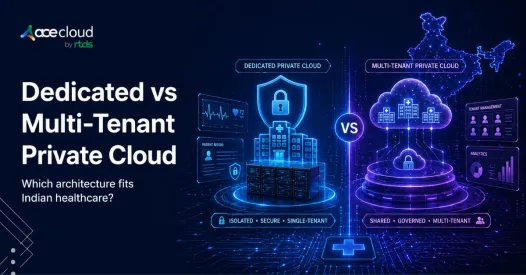
At its core, the difference comes down to control and how isolation is implemented in practice. A dedicated private cloud allocates compute, storage, and network resources to a single organization. This gives healthcare teams the flexibility to design custom network architectures, enforce granular segmentation, and align access controls with internal roles. It also allows fine-tuning of performance whether that’s storage IOPS, database throughput, or latency, which becomes critical for systems supporting real-time clinical workflows.
A multi-tenant private cloud, on the other hand, runs on shared infrastructure. Isolation is still enforced through virtualization, identity controls, and network policies, but the environment is governed through standardized, provider-defined configurations rather than full ownership. That distinction matters more than it first appears.
In practical terms, the difference isn’t about whether isolation exists. It’s about how much control you retain over enforcing, validating, and adapting it over time. Dedicated environments tend to offer more predictable performance and reduce cross-tenant contention, while multi-tenant setups simplify scaling, updates, and operational consistency. This becomes more relevant when applied to healthcare systems, where no two workloads behave the same way.
What technical and regulatory factors actually influence this decision
In healthcare environments, architecture decisions are shaped by both regulatory expectations and how systems behave under real conditions. Looking at tenancy alone is rarely enough; each workload needs to be evaluated across multiple dimensions:
1. Data residency and storage architecture
Patient data, logs, and backups often need to remain within Indian jurisdiction. In practice, this means combining high-performance storage for active workloads with object storage and lifecycle policies for archival and compliance.
2. Disaster recovery topology
Replication strategies, failover mechanisms, and recovery timelines (RPO/RTO) must be clearly defined. The infrastructure should support recovery without introducing inconsistencies.
3. Network segmentation and traffic control
Clinical systems generate significant internal traffic between EMR, PACS, and integration layers. Fine-grained segmentation helps enforce boundaries and reduce lateral movement risks.
4. Identity and access control complexity
Healthcare environments involve multiple user roles: clinicians, administrators, and external partners. Access models must reflect this complexity while maintaining audit visibility.
5. Workload behavior (stateful vs stateless)
Some systems, like EMR databases, require stability and persistence. Others, such as APIs and patient applications, benefit from elasticity.
6. Latency and performance sensitivity
Imaging systems, VDI, and real-time dashboards depend on consistent performance, particularly during peak hours.
7. Auditability and observability
Complete visibility across logs, metrics, and traces is essential. Integration with SIEM tools supports faster detection and audit readiness.
8. Control versus abstraction
Dedicated environments offer deeper control. Multi-tenant environments simplify operations through standardization.
Taken together, these factors show that cloud architecture in healthcare is not a binary choice; it’s a layered decision that often evolves over time. For teams working through these variables, turning them into a clear architecture plan isn’t always straightforward. AceCloud works with healthcare organizations to translate these requirements into practical, workload-aligned infrastructure decisions.
How to choose between (or combine) the two models
Once workloads are evaluated against these factors, the direction usually becomes clearer. Dedicated private cloud is better suited for systems that require strict isolation, predictable performance, and deeper control, especially core clinical workloads like EMR, PACS, and hospital information systems.
Multi-tenant private cloud works well for scalable, standardized workloads such as patient-facing applications, APIs, and non-production environments. In practice, most healthcare organizations don’t choose one over the other. They adopt a hybrid approach, placing critical systems in dedicated environments while using multi-tenant platforms for flexibility and scale. There’s no perfect split here; it depends heavily on how workloads evolve over time. A practical starting point is to classify workloads based on sensitivity, performance needs, and compliance requirements before making infrastructure decisions.
Where dedicated private cloud becomes necessary
This becomes easier to understand when mapped to real workloads. Dedicated private cloud is typically required when systems demand tight control over performance, access, and integration. Core clinical applications such as HIS, EMR, PACS, and LIS fall into this category. These systems handle sensitive data and rely on stable interactions across multiple components, which makes clear boundaries and auditability essential. The need becomes more pronounced in integration-heavy environments. Many healthcare systems still operate with legacy applications and tightly coupled workflows.
Dedicated infrastructure allows teams greater flexibility to customize routing, firewall policies, and service communication, something that becomes critical in integrating heavy healthcare environments. This is particularly relevant for performance-sensitive workloads such as imaging systems and virtual desktop environments, where consistent latency and throughput are essential. While no setup can eliminate performance risks entirely, isolated environments reduce cross-tenant contention and improve predictability under load. Storage requirements add another layer of complexity, as imaging workloads often need high-throughput storage for active use along with scalable archival storage for compliance. With dedicated setups, organizations have more control over how storage is tiered, managed, and retained over time.
For teams operating in such environments, working with a cloud provider familiar with healthcare-specific requirements can reduce both operational complexity and compliance risk.
When multi-tenant private cloud is the better fit
At the same time, not every workload needs this level of control. Multi-tenant private cloud is better suited for workloads that are modular, scalable, and less dependent on deep infrastructure customization. Patient-facing applications, appointment systems, teleconsultation platforms, and mobile apps fit naturally into this category. These systems need to scale quickly and support frequent updates. Development, testing, and analytics workloads also align well with multi-tenant environments. They are dynamic by nature and benefit from elastic scaling without the overhead of dedicated infrastructure.
From an engineering perspective, multi-tenant environments pair well with containerized architectures. Platforms like Kubernetes enable standardized deployments and automated scaling, which helps reduce operational overhead across teams. However, this model depends on strong governance. Isolation mechanisms, access controls, encryption practices, and observability must be validated carefully to meet compliance requirements. In such scenarios, platforms that combine standardized infrastructure with built-in governance can simplify operations. AceCloud’s managed Kubernetes environments are designed to support these needs for healthcare teams running scalable applications alongside regulated systems.
Map your EMR, PACS, HIS, patient apps and Kubernetes workloads to the right dedicated, multi-tenant or hybrid private cloud model with AceCloud.
Dedicated vs multi-tenant private cloud: a technical comparison
While both models can support healthcare workloads, their differences become clearer when viewed across key technical dimensions.
| Evaluation Area | Dedicated Private Cloud | Dedicated Use Case | Multi-Tenant Private Cloud | Multi-Tenant Use Case |
|---|---|---|---|---|
| Infrastructure control | Full control over resources | EMR, PACS, HIS | Managed through provider abstractions | Patient apps, portals |
| Isolation model | Infrastructure-level isolation | Sensitive patient data | Logical isolation | Shared applications |
| Network design | Custom segmentation and routing | Integration-heavy systems | Standardized policies | API-driven services |
| Performance | Predictable and stable | Imaging, VDI | Variable under shared load | Frontend applications |
| Storage | Custom tiering and retention | PACS archives | Standardized storage | App data |
| Compliance | Easier audit boundaries | Regulated systems | Requires validation | General workloads |
| Scalability | Planned scaling | Stable systems | Elastic scaling | Bursty workloads |
| Operations | Higher control | Core systems | Lower overhead | Dev/test |
Dedicated environments provide control and predictability, while multi-tenant environments offer flexibility and efficiency. Most healthcare architectures end up using both, whether planned that way or not.
How healthcare enterprises should approach this decision
At this point, the decision is less about choosing a model and more about how thoughtfully workloads are mapped to the right environment. A practical approach is to evaluate each workload individually, looking at factors such as data sensitivity, performance expectations, integration dependencies, and compliance requirements. Systems that are tightly coupled, latency-sensitive, or audit-heavy typically benefit from dedicated environments. In contrast, applications that are modular, scalable, and less sensitive can run efficiently on multi-tenant platforms. Most healthcare environments end up with a mix of both. What matters is not the split itself, but whether it’s intentional. A structured, workload-first approach helps avoid over-engineering critical systems while still allowing flexibility where it’s actually needed.
Dedicated and multi-tenant private cloud architectures serve different roles within a healthcare enterprise. The right approach is rarely about choosing one, it’s about applying each where it makes the most sense. As healthcare systems become more interconnected and regulatory expectations continue to evolve, organizations need infrastructure that is secure, auditable, and resilient without becoming unnecessarily complex.
If you’re planning to modernize your healthcare infrastructure, AceCloud works with healthcare organizations to design workload-aligned private cloud architectures that balance compliance, performance, and cost. AceCloud supports this transition by offering managed private cloud and Kubernetes environments designed for healthcare workloads, helping organizations scale while maintaining control over critical systems.
Frequently Asked Questions
Dedicated private cloud offers greater control and predictability for clinical systems, while multi-tenant private cloud provides scalability and cost efficiency for applications. Most hospitals use a hybrid approach based on workload needs.
Yes, if strong isolation, encryption, and access controls are in place. Security depends more on implementation than the model itself.
Not always. Compliance depends on data governance and auditability, though dedicated environments can simplify control for sensitive workloads.
EMR, PACS, HIS, and integration-heavy systems that require high control, performance stability, and audit clarity.
Patient applications, APIs, analytics, and non-production environments that need scalability and flexibility.
Evaluate each workload based on sensitivity, performance, and compliance needs. A hybrid, workload-based approach is usually the most effective.

