Quick Answer
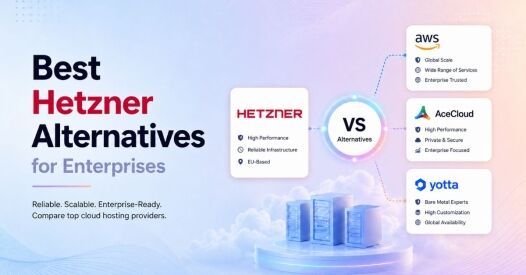
AceCloud is a strong Hetzner alternative for enterprises that need India-hosted NVIDIA H100 or H200 GPUs, managed Kubernetes, VMware private cloud, disaster recovery and INR pricing. DigitalOcean is a closer match for simple developer infrastructure. OVHcloud and Scaleway suit European cloud requirements, while AWS, Azure and Google Cloud make more sense when managed-service depth matters more than raw infrastructure cost.
Hetzner is usually where engineering teams go after deciding their cloud bill is too high. That makes this comparison different.
If your workload is a fleet of Linux VMs in Europe, uses significant bandwidth and your engineers are comfortable managing the software stack, replacing Hetzner may increase cost without improving the architecture.
The case for moving starts when the requirement changes: users are in India, Kubernetes operations consume too much engineering time, H100 or H200 capacity becomes necessary, recovery objectives become contractual or the application needs services Hetzner does not provide.
This guide focuses on those breaking points: where Hetzner still wins and where paying another provider more actually buys something valuable.
Research note: Pricing, locations and product capabilities were reviewed against official provider documentation in August 2026. Cloud pricing and capacity change frequently, so validate production configurations before committing.
Hetzner Alternatives at a Glance
| Provider | What You Gain Over Hetzner | India Infrastructure | Best For |
|---|---|---|---|
| AceCloud | India hosting, datacenter GPUs, managed cloud and DR | Yes | Indian enterprise and AI workloads |
| DigitalOcean | Managed Kubernetes and developer platform services | Yes | SaaS and product engineering teams |
| OVHcloud | Broader bare metal and private cloud | Yes | European and dedicated infrastructure |
| Vultr | Wider global footprint | Yes | Distributed applications |
| Scaleway | European cloud-native and AI infrastructure | No | Sovereign European cloud and AI |
| Akamai Cloud | Low egress and integrated delivery | Yes | Media, APIs and high-traffic applications |
| AWS | Extensive managed-service ecosystem | Yes | Complex global enterprises |
| Microsoft Azure | Microsoft integration and hybrid cloud | Yes | Microsoft-heavy enterprises |
| Google Cloud | Kubernetes, analytics and managed AI | Yes | Data and AI platforms |
| Oracle Cloud Infrastructure | Oracle stack and network economics | Yes | Databases and enterprise applications |
When Does Hetzner Stop Being Cheap?
Hetzner’s low infrastructure prices are real. So are its bandwidth advantages.
Following the June 15, 2026 price adjustment, a European CX23 Cloud Server is €5.49 per month excluding VAT. Hetzner also continues to provide competitive dedicated-server pricing and substantial traffic allowances.
The mistake is assuming a low server price automatically produces the lowest enterprise TCO.
Several requirements can change that calculation quickly.
Your Workload Needs India
Hetzner Cloud currently has six locations: Falkenstein, Nuremberg and Helsinki in Europe, Ashburn and Hillsboro in the United States and Singapore in Asia-Pacific. There is no Indian cloud location.
Singapore is the logical Hetzner option for many Indian workloads, but it should not be compared using European pricing or latency assumptions.
Hetzner’s June 2026 adjustment increased several Singapore cloud rates significantly. For example, a CPX12 moved from €7.99 to €15.49 per month for affected new orders and rescales.
For an application primarily serving Indian users, an in-country deployment may justify a higher VM price through lower latency, local data placement and simpler commercial terms.
Kubernetes Is Becoming a Job
Hetzner provides good Kubernetes building blocks: cloud servers, dedicated servers, private networking, load balancers, storage and APIs.
The difference appears when the enterprise no longer wants its platform team spending time operating Kubernetes infrastructure itself.
Once engineers are responsible for cluster upgrades, control-plane resilience, networking, observability, backup integration and lifecycle management, the cheapest worker nodes do not necessarily produce the cheapest platform.
For teams that deliberately want infrastructure control, this is not a Hetzner weakness.
For teams trying to reduce platform operations, it is a reason to evaluate managed Kubernetes elsewhere.
You Need H100 or H200 Capacity
Hetzner has expanded its accelerated-compute portfolio.
Its current dedicated GPU lineup includes the GEX44 with an NVIDIA RTX 4000 SFF Ada and GEX131 configurations using the NVIDIA RTX PRO 6000 Blackwell Max-Q Workstation Edition. GEX131 configurations support up to 768 GB of system RAM.
That is useful infrastructure for inference, visualization, rendering and dedicated GPU workloads.
It is not the same purchasing model as provisioning NVIDIA H100 or H200 cloud instances, scaling to multiple GPUs and attaching those resources to a managed Kubernetes environment.
If that is the requirement, comparing GPU names alone misses the architectural difference.
Backups Are No Longer Enough
Hetzner Cloud gives each server seven automated daily backup slots. However, attached Volumes are not included in server backups or snapshots.
There is another consideration in Singapore: because Hetzner currently uses one data center there, backups remain in the same data center as the source server.
That may be entirely sufficient for many applications.
It is different from enterprise disaster recovery built around cross-region replication, application startup order, defined RPOs and RTOs, failover orchestration and recovery testing.
The Application Needs More Than Servers
Hetzner is intentionally infrastructure-focused.
That is part of its appeal.
The model becomes less attractive when the enterprise wants the cloud provider to operate more of the stack:
- Kubernetes
- Managed databases
- AI platforms
- Enterprise analytics
- Disaster recovery
- Hybrid infrastructure
- Application-level services
At that point, the correct comparison is not simply Hetzner VM price versus another provider’s VM price.
It is infrastructure cost plus the engineering required to operate everything above it.
1. AceCloud: Managed Cloud for India

AceCloud is not the alternative to choose because you want to save another euro on a European VM. Hetzner is better positioned for that job.
The comparison becomes relevant when the workload moves closer to enterprise requirements: applications need to run in India, AI teams need H100 or H200 capacity, Kubernetes operations should be managed or a VMware estate needs a supported cloud destination.
AceCloud combines cloud compute, NVIDIA GPUs, managed Kubernetes, VMware private cloud, storage, networking and disaster recovery.
The real difference from Hetzner is therefore not simply infrastructure. It is how much of that infrastructure the enterprise still needs to operate itself.
Why AceCloud Stands Out
India-hosted H100 and H200 infrastructure: AceCloud’s H100 HGX offering supports one-, two-, four- and eight-GPU configurations. A single H100 includes 80 GB of GPU memory.
H200 NVL provides 141 GB of GPU memory per accelerator and is available in multiple compute configurations.
Managed GPU Kubernetes: GPU clusters can run within AceCloud Managed Kubernetes with managed control-plane operations, autoscaling and GPU Operator support.
Private cloud: VMware infrastructure can be delivered as hosted or managed private cloud for workloads requiring dedicated resources and greater isolation.
Disaster recovery: AceCloud publishes DR architectures with RPOs down to five minutes and RTOs from 15 minutes for supported workloads.
Where Hetzner Wins
Hetzner remains stronger for inexpensive European compute, included bandwidth and self-managed dedicated servers.
An experienced infrastructure team running CI workers, stateless services, internal platforms or self-managed databases may gain little from paying another provider to manage infrastructure it already operates efficiently.
Hetzner also has a broader geographic footprint than AceCloud.
Pricing
AceCloud publishes India GPU pricing directly in INR.
A single NVIDIA H100 HGX currently starts at ₹180,000 per month.
A 1× H200 NVL starts at ₹381.46 per hour or ₹222,775 per month, with six- and twelve-month discounts available.
Best for: Indian enterprises, AI companies, production Kubernetes environments, VMware migrations and businesses that need managed disaster recovery.
2. DigitalOcean: Simple, but More Managed

DigitalOcean is the alternative to examine when the engineering team says:
“We like Hetzner. We just don’t want to manage everything ourselves.”
Both providers are easier to navigate than a hyperscaler. DigitalOcean simply moves further up the application stack through Managed Kubernetes, managed databases and App Platform.
That makes it less infrastructure-pure than Hetzner, but more convenient for application teams.
Why DigitalOcean Stands Out
DigitalOcean Kubernetes removes control-plane management, while managed databases reduce routine database administration.
Its GPU portfolio is also much broader for AI workloads. Current on-demand options include NVIDIA H100, H200 and B300 alongside AMD accelerators. DigitalOcean currently prices H100 at $3.39/GPU/hour, while reserved H200 pricing starts at $3.40/GPU/hour.
The provider also offers per-second Droplet billing, which can work well for development and short-lived environments.
Where Hetzner Wins
Raw European compute economics and dedicated-server depth remain Hetzner advantages.
DigitalOcean’s GPU availability is also highly regional. Its current GPU fleet spans seven data centers, so the existence of a Bangalore region does not mean every accelerator is available there.
If the workload is mostly Linux VMs and the team already manages databases and Kubernetes effectively, DigitalOcean may add convenience rather than a compelling migration case.
Pricing
DigitalOcean uses predictable pay-as-you-go rates and monthly caps for standard cloud infrastructure.
GPU Droplets are priced separately by accelerator, with on-demand and reserved options.
Best for: SaaS businesses and development teams that want Hetzner-like simplicity with more of the platform managed.
3. OVHcloud: European Infrastructure at Scale

OVHcloud is closer to Hetzner philosophically than AWS or Azure.
Both companies are deeply rooted in European infrastructure and give engineering teams significant control.
The difference is breadth.
OVHcloud extends further into OpenStack Public Cloud, Managed Kubernetes, dedicated infrastructure and Hosted Private Cloud. That makes it a logical option for enterprises that like Hetzner’s infrastructure-first model but have outgrown its boundaries.
Why OVHcloud Stands Out
The primary advantage is infrastructure range.
Enterprises can combine Public Cloud with Managed Kubernetes, bare metal and private-cloud environments under one provider.
OVHcloud also has infrastructure in Mumbai, making it more relevant than Hetzner for organizations that need both European and Indian deployment options.
Where Hetzner Wins
Hetzner remains simpler and can be significantly cheaper for ordinary European VMs and dedicated servers.
OVHcloud’s product portfolio and network economics also vary by region, which adds more planning than Hetzner’s focused model.
For an application that simply needs inexpensive servers with generous European traffic allowances, moving to OVHcloud may solve nothing.
Pricing
OVHcloud uses region-specific pricing across Public Cloud and dedicated infrastructure.
Indian services are priced separately from European deployments, so comparisons should always use the intended workload location rather than a global headline price.
Best for: European enterprises that need dedicated infrastructure, OpenStack, managed Kubernetes or private cloud beyond what Hetzner provides.
4. Vultr: More Global Reach

Hetzner is concentrated by design. Vultr competes on distribution.
That distinction matters when users or infrastructure need to sit close to multiple markets.
Vultr combines standard and optimized cloud compute, managed Kubernetes, bare metal and GPU infrastructure across a much wider global footprint, including multiple Indian locations.
For an application already built around ordinary VMs or Kubernetes, the architectural transition can remain relatively straightforward.
Why Vultr Stands Out
Location choice is the obvious advantage.
It also gives customers a first-party managed Kubernetes option, so a team can keep an infrastructure-focused model without operating the control plane itself.
Bare-metal and GPU products provide another path for workloads that outgrow general-purpose virtual machines.
Where Hetzner Wins
Hetzner remains difficult to beat for European infrastructure economics.
Vultr’s wider footprint also does not imply identical products everywhere. A specific GPU, bare-metal server or managed service may only be available in selected regions.
That regional validation is critical before migration.
Pricing
Vultr uses hourly billing with monthly caps across many compute products.
This keeps the commercial model closer to Hetzner than hyperscaler pricing does, although actual rates depend on location and product.
Best for: Distributed applications, managed Kubernetes and teams that need more deployment locations without moving to a hyperscaler.
5. Scaleway: European Sovereign AI

Scaleway is not interesting because it sells European VMs. Hetzner already does that extremely well.
The reason it belongs in this comparison is that Scaleway has moved further into cloud-native services and AI while maintaining European ownership.
It sits between Hetzner’s infrastructure model and hyperscaler platform complexity.
That can appeal to enterprises that want European sovereignty without managing every component themselves.
Why Scaleway Stands Out
Managed Kubernetes and broader platform services reduce infrastructure work.
Its GPU portfolio is another differentiator. Scaleway offers accelerators across multiple performance tiers, including NVIDIA L4 and H100 systems.
For European organizations building AI workloads but avoiding U.S. hyperscalers, that combination is meaningful.
Where Hetzner Wins
Hetzner remains simpler for basic compute and much stronger in conventional dedicated-server economics.
Scaleway also lacks an Indian region.
Its product availability varies between European availability zones, so GPU and platform services must be checked at the exact location level.
Pricing
Scaleway uses pay-as-you-go infrastructure pricing, with accelerator rates varying significantly by GPU generation and region.
This is generally a better fit for elastic AI workloads than buying a dedicated GPU server that remains allocated continuously.
Best for: European enterprises seeking sovereign cloud infrastructure with managed Kubernetes and serious AI capacity.
6. Akamai Cloud: Built for Heavy Traffic

If bandwidth was one of the reasons you chose Hetzner, this comparison deserves extra attention.
Moving a bandwidth-heavy application from Hetzner to a hyperscaler can turn network transfer into one of the largest lines on the bill.
Akamai Cloud approaches infrastructure from the opposite direction: compute is connected to a global content-delivery and application-security network.
That makes it relevant when traffic itself is part of the workload economics.
Why Akamai Cloud Stands Out
Akamai’s Asia-Pacific cloud is available in locations including Mumbai and Chennai.
Its published Asia-Pacific egress overage is $0.005 per GB.
The same platform offers Kubernetes, storage, databases and GPU instances. Current Asia-Pacific pricing lists a single RTX PRO 6000 Blackwell Server Edition GPU with 96 GB of VRAM at $3.00 per hour.
That makes Akamai particularly relevant for workloads where delivery and compute need to be considered together.
Where Hetzner Wins
Hetzner’s included European bandwidth remains extremely attractive for self-managed workloads that do not need CDN or application-security integration.
Its dedicated-server portfolio is also deeper.
Akamai becomes the stronger alternative when traffic delivery is itself a business problem.
Pricing
Akamai uses regional cloud pricing.
For Asia-Pacific, current infrastructure pricing includes $0.005/GB egress overage, with transfer allowances depending on the selected compute plan.
Best for: Media, streaming, APIs, ecommerce, software distribution and bandwidth-heavy applications.
7. AWS: Managed Services at Scale
Comparing an AWS EC2 instance with a Hetzner VM and declaring a winner based on price misses the point.
AWS will rarely win that comparison.
What AWS can do is replace entire systems your engineering team currently deploys and operates.
That is where paying materially more can become rational.
Why AWS Stands Out
AWS provides managed infrastructure across databases, containers, serverless computing, analytics, event processing, security and AI.
An application can use services such as EKS, RDS, Aurora, Lambda, DynamoDB, Redshift, Bedrock and SageMaker instead of deploying equivalents itself.
Its global footprint and mature governance ecosystem also make it better suited to multinational enterprises.
Where Hetzner Wins
Hetzner wins on simplicity, raw infrastructure economics and portability.
A Linux VM on Hetzner is easy to understand and relatively easy to move.
An AWS architecture combining NAT Gateways, RDS, Lambda, DynamoDB and several managed services can become considerably harder to price and migrate.
If your team already operates the stack efficiently, AWS may solve a problem you do not have.
Pricing
EC2 supports On-Demand, Savings Plans and Spot Instances.
AWS advertises discounts of up to 72% with applicable Savings Plans and up to 90% for interruptible Spot capacity compared with On-Demand rates.
Best for: Global enterprises and complex applications that genuinely benefit from extensive managed services.
8. Microsoft Azure: The Microsoft Enterprise Cloud

Azure is rarely the provider a Linux engineering team chooses because it beats Hetzner on VM price.
The calculation changes when Microsoft already sits at the center of corporate IT.
If identity runs through Entra ID, critical systems use Windows Server and SQL Server and Microsoft licensing already represents a meaningful cost, Azure can consolidate infrastructure with technologies the enterprise already operates.
That can matter more than the VM price difference.
Why Azure Stands Out
Microsoft integration is the core advantage.
Azure combines cloud infrastructure with identity, Windows, SQL Server, Microsoft 365 integration and hybrid management.
For Microsoft-heavy enterprises, that can reduce governance and licensing fragmentation.
Azure also provides Indian regions, addressing a geographic requirement Hetzner cannot currently meet.
Where Hetzner Wins
Hetzner remains much simpler for conventional Linux infrastructure.
Azure adds more pricing dimensions, licensing decisions and platform dependencies.
An open-source SaaS application built around Linux, PostgreSQL and containers may gain little from those capabilities.
Pricing
Azure provides pay-as-you-go pricing and commitment discounts.
Its current Savings Plan for Compute advertises savings of up to 65% compared with eligible pay-as-you-go compute.
Best for: Microsoft-centric enterprises, Windows and SQL Server workloads and hybrid Microsoft environments.
9. Google Cloud: Data, Kubernetes and AI

A company can migrate its Hetzner VMs to Compute Engine.
That alone is rarely a compelling business case.
Google Cloud becomes more interesting when the application is becoming a data, Kubernetes or AI platform rather than simply a collection of servers.
That is where GKE, BigQuery and Vertex AI change the operating model.
Why Google Cloud Stands Out
GKE provides managed Kubernetes infrastructure.
BigQuery removes much of the infrastructure associated with large analytical workloads, while Vertex AI gives machine-learning teams a managed environment for model development and deployment.
For enterprises where data and AI are core to the product, these capabilities can be more important than raw VM cost.
Where Hetzner Wins
Google Cloud introduces significantly more complexity for ordinary infrastructure.
Its strongest services also create tighter platform dependencies.
A self-managed Kubernetes and PostgreSQL architecture on Hetzner remains easier to move than a system deeply dependent on BigQuery or other Google-specific services.
Pricing
Compute Engine offers one- and three-year commitments.
Google currently publishes committed-use discounts of up to 55% for most machine families and up to 70% for selected memory-optimized resources.
Commitments reduce pricing but do not automatically reserve zonal capacity; reservations must be handled separately where guaranteed capacity is required.
Best for: Kubernetes platforms, analytics, data engineering and enterprise AI applications.
10. Oracle Cloud Infrastructure: Oracle Workloads and Lower Egress
OCI belongs in a Hetzner comparison for a reason that is often overlooked: network economics.
An organization accustomed to Hetzner’s generous European traffic allowances can experience significant bill shock when moving bandwidth-heavy applications to some hyperscalers.
OCI has historically positioned network pricing more aggressively while also providing a much deeper enterprise database stack.
That makes it particularly relevant when the workload combines enterprise applications, databases and significant outbound traffic.
Why OCI Stands Out
Oracle Database, Exadata and Oracle enterprise applications are the obvious differentiators.
OCI also offers virtual machines, bare metal, Kubernetes and other infrastructure services.
For Oracle-heavy organizations, putting database infrastructure and cloud support within the same ecosystem can simplify commercial and operational relationships.
Where Hetzner Wins
For ordinary Linux VMs and open-source databases in Europe, OCI may add complexity without solving a significant problem.
Hetzner remains easier to understand and can still be significantly cheaper for straightforward infrastructure.
OCI’s value is strongest when Oracle technology or enterprise platform requirements already exist.
Pricing
OCI uses consumption-based pricing alongside enterprise commitment models.
Its network economics should be compared carefully with Hetzner’s included traffic rather than evaluated only through compute rates.
Best for: Oracle databases, ERP applications, enterprise infrastructure and workloads where network costs materially affect TCO.
Which Alternative Fits Your Workload?
Do not select the provider first and find a justification afterward.
Start with the constraint.
| Your Constraint | Better Fit | Why |
|---|---|---|
| Need cloud infrastructure in India | AceCloud | India-hosted infrastructure and INR pricing |
| Need H100 or H200 GPUs in India | AceCloud | Datacenter GPUs and multi-GPU options |
| Need managed GPU Kubernetes | AceCloud | Managed control plane plus GPU clusters |
| Need VMware private cloud | AceCloud / OVHcloud | Dedicated private infrastructure |
| Need enterprise disaster recovery | AceCloud | Managed replication and recovery objectives |
| Want Hetzner simplicity with more managed services | DigitalOcean | Developer-focused managed platform |
| Need deeper European infrastructure | OVHcloud | Bare metal, OpenStack and private cloud |
| Need more geographic locations | Vultr | Wider independent-cloud footprint |
| Need European sovereign AI | Scaleway | European ownership with cloud GPUs |
| Bandwidth dominates TCO | Akamai Cloud | Low egress and delivery integration |
| Need a large managed-service ecosystem | AWS | Extensive platform services |
| Microsoft defines the enterprise stack | Azure | Identity, licensing and hybrid integration |
| Building a data or AI platform | Google Cloud | GKE, analytics and managed AI |
| Oracle applications drive the architecture | OCI | Native database and enterprise stack |
When Is Leaving Hetzner Worth It?
Start with the capability Hetzner no longer provides.
If European compute is inexpensive, stable and your platform team operates it efficiently, moving providers may simply increase your bill. A migration makes sense when the new provider materially changes the operating model: lower latency in India, managed Kubernetes, datacenter GPU access, private cloud, disaster recovery or application services your engineers would otherwise build themselves.
Compare the Real Geography
Do not compare a €5 European Hetzner VM with an Indian provider and conclude the Indian option is expensive.
Compare Singapore with Mumbai or Noida when the application serves Indian users.
Geography affects latency, bandwidth, data-location requirements and pricing.
Price the Engineering Work
Include more than vCPU and RAM.
Ask how many engineering hours go into Kubernetes upgrades, databases, backups, monitoring, security and incident recovery.
A managed platform can have higher infrastructure rates and still lower TCO if it removes meaningful operational work.
Protect Your Bandwidth Advantage
This is particularly important for Hetzner users.
If the application currently consumes large amounts of included European traffic, model the target provider’s outbound transfer cost before moving.
A cheaper database or managed Kubernetes service can easily be offset by a significantly higher network bill.
Test What You Are Paying For
If the alternative costs more, prove why.
Do not run only CPU benchmarks. Test GPU provisioning, Kubernetes operations, backup restoration, support quality or failover.
A higher bill should buy lower risk, lower operational effort or a capability the business can measure.
Stay or Move?
Stay with Hetzner when the workload is primarily European compute, dedicated servers or bandwidth-heavy infrastructure and your engineering team is comfortable operating the software stack.
Move only when another provider solves a measurable limitation.
DigitalOcean reduces operational work without introducing hyperscaler-scale complexity. OVHcloud offers deeper European infrastructure. Vultr adds geographic reach. Scaleway brings more cloud-native AI capability. Akamai Cloud deserves attention when network delivery dominates TCO.
AWS, Azure and Google Cloud make sense when the business genuinely needs their platform services.
For enterprises operating in India, AceCloud addresses a different set of requirements: India-hosted NVIDIA H100 and H200 GPUs, managed GPU Kubernetes, VMware private cloud, disaster recovery and INR pricing.
Book a free consultation with AceCloud to compare your Hetzner architecture against your India, AI and managed-infrastructure requirements and determine whether migrating actually improves the business case.
Frequently Asked Questions
It depends on what Hetzner no longer solves. DigitalOcean is strong for teams that want similar simplicity with more managed services. OVHcloud fits European infrastructure and private-cloud requirements. For Indian enterprises that need H100 or H200 GPUs, managed Kubernetes, VMware private cloud or disaster recovery, AceCloud is a stronger fit.
Yes.
Hetzner remains highly competitive for European compute, dedicated servers and bandwidth-heavy workloads.
Its June 15, 2026 pricing adjustment changed several configurations, so current rates should be used rather than older comparison articles.
The strongest reasons are usually capability-related rather than price-related.
Examples include the lack of an Indian cloud region, requirements for managed Kubernetes, H100 or H200 GPUs, deeper managed services or more comprehensive disaster recovery.
A company running straightforward European infrastructure may have no strong reason to leave.
No.
Hetzner Cloud currently operates in Germany, Finland, the United States and Singapore.
Organizations requiring in-country Indian hosting need another provider.
Hetzner provides the servers, networking, load balancers and storage required to run Kubernetes, but it does not currently provide a native managed Kubernetes service comparable with EKS, GKE or DigitalOcean Kubernetes.
Teams therefore need to operate Kubernetes themselves or use third-party management.
Hetzner’s current documented GPU server portfolio includes RTX 4000 SFF Ada and RTX PRO 6000 Blackwell Max-Q configurations. Its official GPU-server matrix does not currently list NVIDIA H100 or H200 cloud instances.
For India-hosted AI, AceCloud offers H100 and H200 infrastructure along with GPU-enabled Managed Kubernetes.
DigitalOcean provides H100, H200 and other GPU instances in selected regions, while Google Cloud and AWS offer broader global AI ecosystems.
DigitalOcean is stronger when managed Kubernetes, managed databases and application-platform services remove work the engineering team does not want to own.
Hetzner is generally stronger for inexpensive European compute, dedicated servers and included bandwidth.
Neither is universally better.
AceCloud is a strong option when the requirement includes India-hosted cloud compute, H100 or H200 GPUs, managed Kubernetes, private cloud or disaster recovery.
AWS, Azure, Google Cloud, OCI, OVHcloud, Vultr and Akamai also operate infrastructure relevant to Indian workloads, but they solve different problems.
Often, no.
A company can keep inexpensive European web servers, CI infrastructure or batch processing on Hetzner while running India-facing workloads, GPUs or specialized managed services elsewhere.
Multi-cloud works best when every provider has a clear responsibility. Moving the same undifferentiated workload across multiple clouds usually adds complexity rather than resilience.

