
Quick Answer
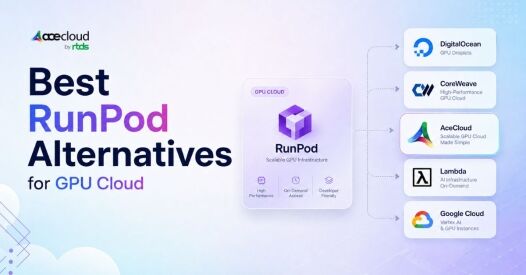
AceCloud is a strong RunPod alternative for Indian businesses that need GPUs inside a managed production cloud with Kubernetes and INR pricing. CoreWeave and Lambda are strong alternatives for large distributed training environments, Modal to serverless GPU applications, Vast.ai to price-sensitive workloads, DigitalOcean to SaaS infrastructure, and Google Cloud to enterprise data and AI platforms.
RunPod solves the first GPU problem well: getting an accelerator quickly without signing a large cloud contract or navigating a hyperscaler.
An H100 can be running in minutes. Pods are billed by the second. Serverless can scale inference workers down when traffic disappears. RunPod now also operates an India region focused on H100 capacity.
For many ML teams, there is no obvious reason to leave.
Alternatives become relevant when the GPU stops being the whole architecture. A training cluster may need InfiniBand. Production inference may need Kubernetes. A SaaS product needs databases, networking, and storage around the model. An enterprise may need INR billing, capacity guarantees, or infrastructure support.
Those requirements, not another provider’s headline H100 rate, separate the seven options below.
Research note: GPU prices, availability, and platform capabilities were reviewed against official provider documentation in August 2026. GPU inventory changes quickly, so verify the exact accelerator, region, and configuration before reserving production capacity.
RunPod Alternatives at a Glance
| Provider | Choose It When | Best For |
|---|---|---|
| AceCloud | You need India-hosted GPUs inside a managed cloud stack | Indian enterprise AI and production Kubernetes |
| CoreWeave | Kubernetes and large GPU fleets are the infrastructure | Large AI training and inference platforms |
| Lambda | You want dedicated InfiniBand clusters with managed Kubernetes or Slurm | Distributed model training |
| Modal | You want GPUs provisioned from code without managing servers | Serverless inference and AI applications |
| Vast.ai | Cost matters more than uniform infrastructure | Experiments and fault-tolerant batch workloads |
| DigitalOcean | GPUs are one part of a SaaS application stack | Product and engineering teams |
| Google Cloud | AI must connect to enterprise data and Kubernetes | Data-heavy enterprise AI platforms |
Key Takeaways
- Do not leave RunPod just to find cheaper GPUs. It’s per-second Pods, broad accelerator catalog, Serverless options and zero Pod ingress or egress fees already make it competitive for development and variable AI workloads.
- Choose based on what surrounds the GPU. AceCloud fits India-hosted production Kubernetes, CoreWeave large Kubernetes GPU fleets, Lambda distributed training and Modal serverless application workloads.
- Training and inference do not need the same provider. A reserved InfiniBand cluster can make sense for training while serverless capacity handles traffic-driven inference.
- GPU-hour price is not total cost. Utilization, storage, networking, interconnect, CPU, RAM, and idle capacity can outweigh a small difference in accelerator rates.
- RunPod may still be the right answer. If you need fast GPU access, short experiments or burst inference while the rest of the application already runs elsewhere, migrating can add work without fixing a real problem.
When Should You Stay with RunPod?
Before comparing alternatives, establish whether you actually need one.
RunPod’s current Pod catalog covers B300, B200, H200, H100, A100, L40S, L4, RTX PRO 6000, RTX 5090, RTX 4090, and several other accelerator classes. Current Secure Cloud pricing lists H100 PCIe at $2.89/hour, H100 SXM at $2.99/hour, H200 at $4.39/hour, A100 PCIe at $1.39/hour and L40S at $0.99/hour.
Pods are billed by the second. RunPod also states that it does not charge Pod data ingress or egress fees.
That combination works well for model experimentation, fine-tuning, rendering, batch jobs and other workloads where a developer needs direct access to a GPU without building a larger cloud environment first.
Serverless is Now a Serious Part of the Platform
RunPod Serverless uses Flex workers for traffic that can scale to zero and Active workers for steady workloads.
Its current public pricing lists H100 Serverless at $4.55/hour, H200 at $5.93/hour, A100 at $2.72/hour and the L40/L40S/RTX 6000 Ada tier at $1.75/hour, billed according to worker runtime.
This suits inference services with changing request volume because the team does not need to keep a full GPU instance running continuously.
Enterprise RunPod Has Changed
RunPod now offers reserved baseline capacity, usage-based burst above the commitment, post-paid consolidated billing, contractual SLAs and priority support through enterprise agreements. It reports 31 regions and has completed SOC 2 Type II, with HIPAA and GDPR support documented through its enterprise and compliance resources.
Reserved clusters can scale from smaller deployments to dedicated environments of 10,000+ GPUs.
That makes the old description of RunPod as a developer-only GPU marketplace inaccurate.
India is No Longer a Missing Region
RunPod opened AP-IN-1 on July 18, 2026. The site launched with more than 1 MW of power capacity and a focus on NVIDIA H100 80 GB HBM3 systems.
Indian buyers therefore should not choose an alternative merely because they assume RunPod cannot host workloads locally.
The question is whether H100 availability alone covers the rest of the production environment.
1. AceCloud: Managed GPU Cloud in India

RunPod now has H100 capacity in India, so geography alone does not make AceCloud the stronger option.
AceCloud becomes relevant when the GPU is part of a broader Indian production stack.
Its GPU platform supports multi-GPU workloads and GPU worker nodes inside managed Kubernetes. The current AceCloud GPU catalog includes H100, H200, A100, L40S and other NVIDIA accelerators, with pricing available in INR.
For a business running an AI application rather than an isolated training job, that operating model is the main difference.
Managed Kubernetes is the Stronger Argument
AceCloud manages Kubernetes control-plane components including etcd, kube-apiserver and scheduler operations. The service includes automated patching, controlled upgrades, failover, and a published 99.99%* uptime commitment for production workloads.
GPU clusters add managed upgrades, monitoring, autoscaling, network policies, and direct access to 24/7 support.
This is useful when the engineering team wants Kubernetes to remain its standard orchestration layer without owning every control-plane operation.
H100 and H200 Pricing is Local
AceCloud currently lists a 1× H100 HGX 80 GB configuration with 26 vCPUs and 250 GB RAM at ₹180,000 per month. Two-, four- and eight-GPU configurations are also published.
A 1× H200 NVL with 141 GB GPU memory starts at ₹381.46 per hour or ₹222,775 per month, with lower effective monthly rates on six- and twelve-month plans.
For Indian finance teams, INR-denominated pricing removes exchange-rate movement from the infrastructure budget.
Where RunPod Still Wins
RunPod has a much larger global accelerator catalog and a cleaner model for short-lived GPU jobs.
A developer who needs an RTX 4090 for an experiment, an L4 for a small inference workload and an H100 for a later training job can source all three through the same RunPod workflow.
Its Serverless platform is also more mature as a GPU-specific scale-to-zero product.
Best for: Indian enterprises and AI companies that need H100/H200 infrastructure inside managed Kubernetes and a broader production cloud.
2. CoreWeave: Kubernetes for Large GPU Fleets
A team running one or two H100s does not need CoreWeave’s full infrastructure model.
A team operating hundreds of GPUs has a different problem. Training speed now depends on networking, shared storage, scheduling, and how quickly unhealthy nodes are removed from the workload.
CoreWeave is built around that problem.
Its current GPU catalog includes H100, H200, B200, GB200, and RTX PRO 6000 Blackwell systems. Published North American on-demand pricing lists 8× H100 HGX at $49.24/hour, 8× H200 at $50.44/hour, 8× B200 at $68.80/hour and 8× RTX PRO 6000 Blackwell at $20/hour.
Kubernetes Runs Close to the Hardware
CoreWeave Kubernetes Service is designed specifically for GPU-heavy AI infrastructure.
Its H100 and H200 supercomputer infrastructure uses NVIDIA Quantum-2 InfiniBand NDR networking. CoreWeave also provides managed storage options and states that its H100/H200 infrastructure does not charge storage ingress or egress fees.
CoreWeave supports several capacity models, including Reserved Instances, Flex reservations, On-Demand and Spot resources. Usage is attributed across those capacity types based on the active reservation and workload demand.
That lets a large AI platform reserve its baseline fleet while keeping another capacity class available for peaks.
Where RunPod Still Wins
RunPod is easier for a small AI team.
One H100 SXM currently costs $2.99/hour on the RunPod public Pod list, while CoreWeave’s public pricing is oriented toward much larger systems and AI infrastructure contracts.
RunPod also offers cheaper workstation and consumer-class GPUs that can be perfectly adequate for development.
Best for: AI infrastructure teams managing large Kubernetes GPU fleets where storage, networking and cluster efficiency affect model throughput.
3. Lambda: From One GPU to 2,000+

Lambda’s strongest product is not its single-GPU instance.
It is the path from an instance into a dedicated distributed training cluster.
Lambda’s self-service instance catalog includes H100, B200, A100, and other GPUs. Its 1-Click Clusters are available from 16 to more than 2,000 H100 or B200 GPUs.
That gives an ML team room to prototype on one node and later move into distributed training without sourcing a cluster from scratch.
The Interconnect is Part of What You Pay For
Lambda’s documented 1-Click Cluster architecture uses NVIDIA Quantum-2 400 Gb/s InfiniBand in a non-blocking, rail-optimized topology, with GPUDirect RDMA between GPU nodes.
Managed Kubernetes on 1-Click Clusters includes GPU and InfiniBand support, shared persistent storage and preconfigured cluster access. Lambda’s current documentation also describes GPU Operator and Network Operator integration for managed GPU and RDMA networking.
These features target multi-node training where communication between GPUs can determine job completion time.
Pricing Reflects Dedicated Clusters
Current Lambda 1-Click Cluster H100 pricing is:
- 16 GPUs: $6.16/GPU/hour
- 64 GPUs: $5.85/GPU/hour
- 256 GPUs: $5.54/GPU/hour
B200 clusters start at $9.86/GPU/hour for 16 GPUs and fall to $8.87/GPU/hour at 256+ GPUs.
For individual instances, Lambda currently lists H100 PCIe at $3.29/GPU/hour and H100 SXM at $4.29/GPU/hour.
RunPod’s $2.99 H100 SXM therefore wins the simple single-GPU price comparison. Lambda earns its premium when the workload needs the cluster around the GPUs.
Best for: AI labs and model companies moving from single-node development into dedicated distributed training.
4. Modal: Serverless GPUs from Python
Modal removes the server from the normal developer workflow.
GPU type and count are defined in code. A function can request an H100, H200, B200, B300 or another supported accelerator when it runs rather than forcing the developer to maintain a persistent GPU machine.
Current Modal support includes T4, L4, A10, L40S, A100, RTX PRO 6000, H100, H200, B200 and B300. Several GPU families can be provisioned with up to eight accelerators inside one container.
That model works naturally for inference APIs, scheduled batch tasks, agents and image or video workloads with uneven demand.
You Pay While Code Runs
Modal bills compute by the second.
Current GPU rates include:
- L4: $0.000222/sec
- L40S: $0.000542/sec
- A100 80 GB: $0.000694/sec
- H100: $0.001097/sec
- H200: $0.001261/sec
- B200: $0.001736/sec
- B300: $0.001972/sec
An H100 used continuously for one hour therefore costs about $3.95 in GPU time.
But continuous utilization is not the workload Modal is designed to optimize.
If an inference endpoint receives traffic for ten minutes and then sits idle for fifty, serverless billing removes most of that idle GPU allocation.
Modal Can Substitute Hardware Automatically
Modal can automatically run an H100 request on H200 capacity without increasing the H100 GPU rate when compatible capacity is available.
It also offers a B200+ option that can use either B200 or B300 while billing at the B200 rate.
This improves capacity flexibility, although teams running hardware-specific benchmarks can explicitly require one accelerator.
Where RunPod Still Wins
RunPod Pods give developers more infrastructure control.
They fit long-running training jobs, persistent Jupyter environments and workflows where engineers want direct control over the container, storage and machine lifecycle.
RunPod also lets teams use the same provider for dedicated Pods, Serverless and larger Clusters.
Best for: Serverless inference, AI agents, image/video pipelines and batch applications where paying for idle GPU capacity is wasteful.
5. Vast.ai: Buy GPUs From a Market

Vast.ai is a marketplace, not a conventional GPU cloud.
Individual hosts set their own compute, storage and bandwidth prices. Rates change with hardware supply, location, provider reliability and demand.
That makes it difficult to publish one useful “Vast.ai H100 price.”
It also creates the reason many teams use it: competition between hosts can push GPU prices below fixed-price cloud offers.
There are Three Ways to Rent
Vast.ai currently offers:
On-demand: high-priority capacity at the host’s fixed rate.
Reserved: prepaid capacity that can reduce the host’s on-demand price by up to 50%.
Interruptible: bidding-based capacity that may be paused and is often 50% or more below on-demand pricing.
Checkpoint-friendly workloads can exploit interruptible pricing aggressively.
A production inference service usually should not.
Storage and Bandwidth Can Change the Answer
Vast.ai bills compute, storage and bandwidth separately.
Storage continues to incur charges while an instance exists, including when it is stopped. Bandwidth rates depend on the individual host.
So, the lowest GPU listing is not necessarily the lowest-cost machine after moving a training dataset and storing checkpoints.
This is one of the areas where marketplace shopping requires more attention than a fixed cloud rate.
Where RunPod Still Wins
RunPod provides a more standardized platform and a more conventional enterprise procurement path.
Its enterprise service includes reserved capacity, contractual SLAs, priority support, and consolidated billing, while Secure Cloud provides the production infrastructure tier for sensitive workloads.
Vast.ai works best when workload design can absorb infrastructure variation in exchange for a lower price.
Best for: Research, rendering, hyperparameter searches, batch inference and checkpointed training where cost is the main optimization target.
6. DigitalOcean: GPUs Inside the App Stack

DigitalOcean is useful when the team building the AI feature also owns the application around it.
Its GPU Droplets sit inside the same cloud used for regular VMs and other DigitalOcean infrastructure. The current accelerator catalog includes H100, H200, L40S, RTX 4000 Ada, RTX 6000 Ada and AMD MI300X, while B300 is available through Spot and contract/reserved offerings.
That avoids running the model on one specialist GPU provider and the rest of the product somewhere else.
Current GPU Pricing Is Straightforward
DigitalOcean currently lists:
- RTX 4000 Ada: $0.76/hour
- L40S: $1.57/hour
- H100: $4.41/GPU/hour
- H200: $4.47/GPU/hour
- AMD MI300X: $2.59/GPU/hour
Twelve-month reserved pricing currently lowers H100 to $3.26/GPU/hour and H200 to $3.40/GPU/hour.
H100 and H200 are offered in one- and eight-GPU configurations.
India is the Limitation for GPU Workloads
DigitalOcean operates BLR1 in Bangalore, but its current August 2026 GPU availability documentation does not list GPU Droplets in BLR1.
Current H100 capacity is listed in New York, Amsterdam and Toronto. H200 is listed in New York and Atlanta, while B300 is available in selected U.S. sites.
An Indian company already using DigitalOcean should therefore not assume its AI workload can run in the same region as the rest of its application.
Where RunPod Still Wins
RunPod offers a much wider range of accelerator prices.
For example, its current list includes RTX 4090 at $0.69/hour, L4 at $0.39/hour, and A40 at $0.44/hour alongside H100/H200 systems.
That gives AI teams more room to right-size development and inference rather than defaulting to datacenter accelerators.
Best for: SaaS companies and product teams that want GPU infrastructure alongside the rest of their developer cloud.
7. Google Cloud: AI Inside the Enterprise Data Platform

Google Cloud is hard to justify if the entire requirement is “give me an H100 for six hours.”
RunPod solves that problem with less setup.
Google Cloud earns the additional complexity when AI needs to sit inside the same environment as Kubernetes, enterprise IAM, data pipelines, storage and analytics.
The GPU becomes one resource inside a larger platform rather than a separate service.
GKE Changes the Infrastructure Model
Google Kubernetes Engine supports GPU workloads and charges for both the underlying compute and applicable cluster-management services.
Its Autopilot pricing model includes accelerator premiums for GPUs such as L4, A100, and H100, while Spot resources can provide discounts of 60% to 91% from the corresponding regular CPU, memory and GPU prices.
That allows teams already standardized on Kubernetes to schedule ordinary application services and accelerated workloads under the same governance model.
Long-Term GPU Capacity Can Be Discounted
Google Cloud supports resource-based one- and three-year commitments for GPUs.
Current committed-use documentation states that most GPU types can receive discounts of up to 55% from on-demand pricing, with selected GPU types reaching up to 65%.
Capacity still needs to be planned by region and accelerator.
Google Cloud’s GPU location documentation lists supported GPU machine types in both Mumbai and Delhi, with availability varying by zone and accelerator.
Where RunPod Still Wins
RunPod removes much of the procurement and infrastructure setup.
A developer can choose an accelerator and deploy a Pod without first dealing with a general-purpose cloud architecture, Kubernetes configuration or commitment planning.
Its Pod pricing is also easier to compare because the machine configuration is published directly next to the accelerator.
Google Cloud becomes worth the additional machinery when AI is tied to the company’s wider data and application platform.
Best for: Enterprises where machine learning must integrate with Kubernetes, governance, analytics and large data systems.
Which RunPod Alternative Fits Your Workload?
There is no useful universal ranking.
The workload should decide.
| If Your Problem Is… | Better Fit | Why |
|---|---|---|
| Production GPU infrastructure in India | AceCloud | India-hosted H100/H200 plus managed Kubernetes |
| Managing a large Kubernetes GPU fleet | CoreWeave | AI-focused cluster infrastructure and high-speed networking |
| Training across 16–2,000+ GPUs | Lambda | Dedicated InfiniBand-connected clusters |
| Paying for idle inference capacity | Modal | GPU serverless defined directly from code |
| Finding the lowest available GPU rate | Vast.ai | Dynamic marketplace pricing |
| Integrating AI into a SaaS cloud | DigitalOcean | GPUs beside conventional application infrastructure |
| Connecting AI to enterprise data systems | Google Cloud | GKE and wider data platform |
| Short GPU experiments | RunPod | Broad accelerator catalog and per-second Pods |
| Traffic-driven inference | RunPod / Modal | Both reduce idle capacity with different developer models |
| Local H100 on the existing RunPod stack | RunPod | AP-IN-1 now provides H100 capacity in India |
How Should You Compare RunPod Alternatives?
GPU-hour pricing is a useful filter.
It is a poor final decision metric.
Match the GPU to the Model
Do not select H100 or H200 because it is the most recognizable accelerator.
An inference workload that comfortably fits into 24 GB or 48 GB may run economically on L4 or L40S.
H200’s 141 GB memory becomes useful when large models, KV cache or fine-tuning workloads would otherwise require model sharding.
Benchmark your model on the hardware you intend to buy.
Treat Training and Inference Separately
Training values sustained utilization, fast interconnect, and predictable capacity.
Inference often values elasticity and low idle cost.
That can justify Lambda or CoreWeave for distributed training while RunPod or Modal handles variable serving demand.
Using one cloud for everything simplifies procurement, but it does not guarantee the lowest TCO.
Calculate Utilization Before Reserving GPUs
A reserved GPU looks inexpensive only when it is used.
A $3 GPU running continuously costs less per active hour than a $4 serverless GPU, but it costs more if it remains idle for most of the day.
Use actual utilization data from development or production.
For stable 24/7 inference, reserved capacity becomes easier to justify. For unpredictable traffic, scale-to-zero can win even at a higher active rate.
Compare Complete Nodes
“H100” is not a complete infrastructure specification.
Check:
- PCIe, SXM or NVL variant
- VRAM
- GPUs per node
- NVLink
- InfiniBand or RDMA
- CPU allocation
- system memory
- local NVMe
- shared storage
- network bandwidth
- region
- Kubernetes support
- support model
- capacity guarantees
RunPod itself illustrates why this check is necessary. Its AP-IN-1 region launched around H100 80 GB capacity; that does not mean every GPU in its global catalog is available in India.
Add Storage and Data Transfer
Network pricing can erase a GPU discount quickly.
RunPod Pods have no ingress or egress fees. Vast.ai bandwidth is priced by the host. DigitalOcean’s published H100 and H200 configurations bundle substantial transfer allowances. Google Cloud uses its broader networking pricing model.
Training against multi-terabyte datasets makes these costs material.
Stay With RunPod or Move?
Stay with RunPod when your team needs fast access to a wide GPU catalog, per-second compute, short-lived development environments or GPU Serverless without adopting a full hyperscaler.
Its 2026 changes strengthened that position. RunPod now has India H100 capacity, SOC 2 Type II, enterprise reserved capacity and clusters that extend into large dedicated deployments.
Move when the workload demands something more specific.
Choose CoreWeave when Kubernetes and GPU-fleet efficiency define the platform. Use Lambda when training requires dedicated InfiniBand clusters. Modal suits applications where the GPU should exist only while code is running. Vast.ai is built for teams willing to trade infrastructure uniformity for lower marketplace rates. DigitalOcean works when GPUs belong inside a broader SaaS environment. Google Cloud makes sense when AI is part of an enterprise Kubernetes and data platform.
For Indian enterprises, AceCloud becomes relevant when the requirement extends beyond access to an H100. Its case is the production environment around the accelerator: India-hosted H100 and H200 infrastructure, managed GPU Kubernetes, INR pricing and 24/7 infrastructure support.
Talk to an AceCloud cloud architect to compare your RunPod workload, GPU utilization and production requirements before deciding whether migration, consolidation or a multi-cloud setup gives you the better operating cost.
Frequently Asked Questions
AceCloud is a strong option for Indian businesses that need GPUs inside managed Kubernetes and a broader production cloud. CoreWeave and Lambda fit larger training infrastructure, Modal fits serverless applications, Vast.ai targets lower-cost marketplace compute, DigitalOcean fits SaaS infrastructure and Google Cloud fits AI tied to enterprise data.
The best provider depends on what RunPod is no longer solving.
Yes. RunPod currently offers a wide GPU catalog across Pods, Serverless and Clusters, with accelerators including B300, B200, H200, H100, A100, L40S and lower-cost GPUs. It also now offers enterprise reserved capacity, SOC 2 Type II compliance and contractual enterprise SLAs.
Yes.RunPod launched AP-IN-1 on July 18, 2026, with a focus on NVIDIA H100 80 GB HBM3 GPUs.
Check the specific region before assuming another RunPod accelerator is available locally.
AceCloud is better suited to Indian production environments that need managed Kubernetes, INR-denominated infrastructure and H100/H200 options under the same cloud environment.
RunPod is stronger for global self-service GPU access, lower-cost accelerator choices, per-second Pods and a mature GPU Serverless product.
Neither is the better option for every workload.
Vast.ai can provide very low rates because GPU providers compete inside a marketplace rather than following one fixed cloud price.
Its interruptible instances are often 50% or more below on-demand offers, while reserved discounts can reach 50%.
Storage and bandwidth vary by host, so compare the full offer rather than GPU price alone.
Modal is better suited to developers who want GPU infrastructure controlled directly from Python functions.
RunPod is better suited to teams that want both persistent GPU Pods and Serverless endpoints under the same provider.
Modal currently supports H100, H200, B200, B300 and multiple other accelerators, with per-second resource billing.
Lambda and CoreWeave are the strongest fits in this comparison.
Lambda offers dedicated H100 and B200 1-Click Clusters starting at 16 GPUs and scaling beyond 2,000 GPUs.
CoreWeave provides large HGX systems and AI-focused networking, storage and Kubernetes infrastructure.
RunPod states that Pods do not incur data ingress or egress fees.
Storage is billed separately. Its current public pricing lists standard network storage below 1 TB at $0.07/GB/month and $0.05/GB/month above 1 TB.
Usually, not without a specific reason.
A team can retain RunPod for development or variable inference while running a large training cluster on Lambda or CoreWeave, India-hosted production Kubernetes on AceCloud or enterprise data workloads on Google Cloud.
Multi-cloud is useful when each provider has a defined job.
Using several GPU clouds for the same workload without a technical reason usually adds deployment, monitoring and data-management work.

