
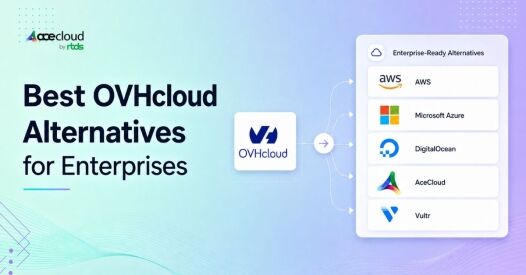
AceCloud is a strong OVHcloud alternative for enterprises that need India-hosted infrastructure, NVIDIA GPUs, managed Kubernetes, VMware private cloud, disaster recovery and direct engineering support.
Whereas, AWS, Azure and Google Cloud offer broader managed-service ecosystems, while Scaleway, Akamai Cloud, Vultr and DigitalOcean address specific needs such as European sovereignty, bandwidth or simpler infrastructure.
OVHcloud is a strong choice for European sovereignty, bare metal, OpenStack-based cloud and hosted private infrastructure. Enterprises usually consider alternatives when those strengths no longer solve the bigger operational requirement: a service is unavailable in the target region, the required GPU sits elsewhere, production support becomes expensive or internal teams are managing too much infrastructure themselves.
For India-facing businesses, regional capacity, GPU availability, disaster recovery, managed operations and predictable costs can matter more than a provider’s global footprint.
In this guide, I’ve compared ten OVHcloud alternatives by the enterprise problems they solve, where each provider is stronger, where it may fall short, and how its pricing model affects total cost.
Research note: Provider regions, pricing models, GPU availability, and support terms were reviewed against official documentation in August 2026. Capacity and service availability can change by region and configuration, so verify critical requirements directly before deployment.
Best OVHcloud Alternatives at a Glance
| Provider | Key Strength | India Infrastructure | Best For |
|---|---|---|---|
| AceCloud | Managed infrastructure, GPUs, private cloud and DR | Yes | India-hosted enterprise and AI workloads |
| Amazon Web Services | Service breadth and global scale | Yes | Complex multinational cloud environments |
| Microsoft Azure | Microsoft ecosystem and hybrid cloud | Yes | Microsoft-centric enterprises |
| Google Cloud | Data, Kubernetes and AI | Yes | Data platforms and AI applications |
| Oracle Cloud Infrastructure | Oracle databases and bare metal | Yes | Oracle enterprise workloads |
| IBM Cloud | Power Systems and OpenShift | Yes | Regulated and legacy enterprise environments |
| Akamai Cloud | Bandwidth and application delivery | Yes | APIs, media and internet-facing platforms |
| Scaleway | European sovereign infrastructure and AI | No | European cloud and AI workloads |
| Vultr | Distributed independent infrastructure | Yes | Regional compute, Kubernetes and GPU workloads |
| DigitalOcean | Operational simplicity | Yes | SaaS and lean engineering teams |
Why Do Enterprises Look for OVHcloud Alternatives?
OVHcloud does not need replacing simply because another provider has a larger product catalog. An alternative becomes relevant when it solves a measurable operational, geographic, or commercial constraint better.
Regional Service Availability Can Limit Architecture
OVHcloud operates infrastructure across Europe, North America and Asia-Pacific, including Mumbai. However, its product portfolio varies by region.
That matters when an enterprise needs compute, Kubernetes, databases, GPUs, storage and disaster recovery in the same geography. A global product page does not guarantee that the required configuration exists in Mumbai or another target region.
AI workloads make this particularly visible. OVHcloud currently documents its newer A100, H100, L4 and L40S GPU instances as available in GRA11 in Gravelines, France.
For an enterprise that must keep GPU workloads in India, European availability does not solve the requirement.
Production Support Changes the Cost Model
OVHcloud Standard support is included and positioned for experimentation and testing. Premium targets noncritical production, while Business and Enterprise plans target increasingly critical environments.
Current India pricing starts at ₹4,270 per month for Premium support, ₹21,350 for Business and ₹427,000 for Enterprise, excluding applicable taxes.
The question for an enterprise is not simply whether support is paid. It is what happens during a production incident: who takes ownership, who joins troubleshooting, and whether architecture or migration guidance is included.
Infrastructure Still Requires an Operations Team
Cloud infrastructure removes hardware procurement. It does not remove infrastructure operations.
Enterprises still need to manage Kubernetes workloads, patching, monitoring, security policies, backups, databases, capacity planning, incident response and disaster recovery.
For organizations that do not want to expand their internal platform team, the provider’s management model can matter as much as the infrastructure itself.
GPU Availability is Now a Procurement Decision
Enterprises do not buy GPU capacity by model name alone.
They need the right accelerator in the right region with sufficient CPU, RAM, storage, networking, and expansion capacity. They also need to know whether GPUs are dedicated, whether multiple accelerators can run in one system and whether the infrastructure integrates with Kubernetes.
A provider can have an impressive global GPU catalog and still be the wrong choice for an India-hosted AI workload.
Asia-Pacific Network Pricing Differs From Europe
OVHcloud includes free and unlimited outbound public traffic in most Public Cloud regions. Singapore and Sydney are the current exceptions; each includes 1,024 GB of outbound public traffic per month, per project, per datacenter, after which additional traffic is billed.
Each Asia-Pacific Public Cloud project receives 1 TB of outbound public traffic per month, after which additional transfer is charged.
Enterprises evaluating Mumbai infrastructure should therefore model costs using India-specific terms rather than OVHcloud’s European network economics.
How We Evaluated the Best OVHcloud Alternatives
We evaluated each provider around the concerns most likely to influence an enterprise migration:
- Regional availability
- Compute and GPU infrastructure
- Managed Kubernetes
- Private and hybrid cloud
- Databases and storage
- Enterprise support
- Disaster recovery
- Pricing model
- Global scalability
- Migration effort and workload portability
The objective is not to identify a universal winner. It is to determine where each provider makes more sense than OVHcloud.
1. AceCloud

AceCloud is most relevant when the problem is not access to another cloud console but the amount of infrastructure an enterprise still has to operate itself.
The platform combines cloud compute, NVIDIA GPUs, managed Kubernetes, managed databases, object and block storage, networking, VMware private cloud and disaster recovery. Its infrastructure presence in India makes those services particularly relevant to organizations with latency, data-location or operational requirements in the country.
For OVHcloud users, the main difference is the operating model. AceCloud combines infrastructure with direct engineering and managed support rather than infrastructure consumption alone.
That makes it a stronger fit when an enterprise wants fewer operational handoffs across cloud, AI infrastructure, VMware and business continuity.
Where AceCloud Stands Out
India-hosted GPU infrastructure: AceCloud publishes INR pricing for NVIDIA L4, L40S, A100, H100, H200, RTX PRO 6000 and other GPU configurations. It also supports two-, four- and eight-GPU configurations for demanding AI workloads.
Managed Kubernetes: AceCloud provides a managed high-availability control plane, autoscaling and GPU clusters. Its Kubernetes service publishes a 99.99%* control-plane SLA.
VMware private cloud: Enterprises can choose hosted VMware infrastructure with dedicated resources, monitoring, patching, security and ongoing support.
Disaster recovery: AceCloud supports continuous replication for cloud and on-premises workloads, along with cross-region and cloud-to-cloud recovery options.
Where AceCloud May Not Be the Best Choice
AceCloud does not match OVHcloud, AWS, Azure or Google Cloud in global region coverage.
It also has a smaller portfolio of proprietary serverless, analytics, and application services than the hyperscalers.
A multinational organization that needs production infrastructure across many countries may therefore use AceCloud for India-specific infrastructure rather than as its only global cloud.
Pricing
AceCloud publishes INR pricing for India-hosted GPU infrastructure.
A 1× NVIDIA H100 HGX instance with 80 GB GPU memory, 26 vCPUs and 250 GB RAM currently starts at ₹180,000 per month.
A 1× NVIDIA H200 NVL instance with 141 GB GPU memory currently starts at ₹222,775 per month, with discounted six- and twelve-month options. Pricing varies by configuration and location.
Compute, storage, networking, and other services are priced separately.
Best for: Indian enterprises, AI companies, SaaS platforms, VMware environments and organizations that want GPUs, Kubernetes, private cloud or disaster recovery with greater operational support.
2. Amazon Web Services

Moving from OVHcloud to AWS is not simply changing infrastructure providers. It usually means adopting a much larger platform model.
AWS offers virtual machines and Kubernetes, but its real advantage is the ecosystem around them: serverless computing, managed databases, event services, analytics, AI platforms, security products and automation.
For an enterprise constrained by OVHcloud’s service breadth or global reach, that difference can be significant.
AWS operates two Indian regions, Mumbai and Hyderabad, with three Availability Zones in each.
Where AWS Stands Out
AWS is stronger when an enterprise wants one platform for infrastructure and a large number of managed application services.
Services such as EC2, EKS, Lambda, RDS, Aurora, DynamoDB, S3, Redshift, Bedrock and SageMaker can reduce the amount of software an internal team has to deploy and operate.
Its geographic coverage, partner ecosystem and mature governance tools also make it easier to standardize cloud operations across multinational organizations.
Where AWS May Not Be the Best Choice
The same service breadth creates cost and architectural complexity.
Bills can combine compute, storage, IOPS, NAT processing, load balancing, cross-zone transfer, managed databases and support.
Deep use of proprietary services also reduces portability. An EC2 workload can move relatively easily. An application built around Lambda, DynamoDB, Cognito and Step Functions usually cannot.
If the original attraction to OVHcloud was open infrastructure and simpler pricing, AWS can move the architecture in the opposite direction.
Pricing
EC2 supports On-Demand, Savings Plans, Reserved Instances and Spot capacity.
AWS advertises savings of up to 72% through EC2 Instance Savings Plans compared with On-Demand pricing and up to 90% for interruptible Spot capacity.
Storage, data transfer, managed services and support remain separate cost components.
Best for: Large enterprises, global applications and architectures that need extensive managed services more than infrastructure simplicity.
3. Microsoft Azure

Azure becomes considerably more compelling when the enterprise already has a large Microsoft estate.
For organizations running Entra ID, Microsoft 365, Windows Server and SQL Server, moving infrastructure to Azure can consolidate identity, licensing, cloud governance and application hosting around an existing vendor relationship.
Its advantage over OVHcloud is therefore less about individual VM performance and more about integration.
Azure currently operates four listed India regions: Central India in Pune, South India in Chennai, West India in Mumbai and India South Central in Hyderabad.
Where Azure Stands Out
Azure is particularly strong for Windows and SQL Server workloads.
Azure Hybrid Benefit allows eligible organizations to apply qualifying Windows Server and SQL Server licenses to Azure services, potentially changing migration economics.
Azure Arc also extends management to servers and Kubernetes environments outside Azure, making the platform useful for hybrid estates that cannot move fully into public cloud.
Where Azure May Not Be the Best Choice
Pricing and licensing can become difficult to model.
VM reservations, Windows licensing, SQL Server editions, managed disks, egress, support and Hybrid Benefit eligibility all influence total cost.
A Linux-first organization relying largely on open-source infrastructure may receive less value from Azure’s strongest differentiators.
As with AWS, moving deeply into proprietary platform services can make a later migration harder.
Pricing
Azure offers pay-as-you-go virtual machines, savings plans and reserved capacity, with rates varying by instance family, operating system and region.
Licenses, managed disks, networking and support can add to the base VM price.
Best for: Enterprises standardized on Microsoft identity, Windows Server, SQL Server, Microsoft 365 or hybrid Microsoft infrastructure.
4. Google Cloud

Google Cloud makes more sense as an OVHcloud alternative when the workload is data-shaped rather than infrastructure-shaped.
A conventional VM estate can run on Google Cloud, but BigQuery, Google Kubernetes Engine and Vertex AI are the services that most clearly differentiate the platform.
For enterprises building analytics systems, Kubernetes platforms or AI applications, those services can remove operational work that an infrastructure-first cloud leaves to the customer.
Google Cloud operates regions in Mumbai and Delhi.
Where Google Cloud Stands Out
GKE is a strong choice for enterprises standardizing on Kubernetes.
BigQuery gives analytics teams a managed warehouse without operating clusters, while Vertex AI provides managed tooling for model development and deployment.
Google Cloud also offers NVIDIA GPUs in Indian regions, although specific accelerator models vary by zone and machine family.
Where Google Cloud May Not Be the Best Choice
Its strongest services are also among the least portable.
Kubernetes workloads can move. Applications deeply integrated with BigQuery, Spanner or specialized Vertex AI workflows require more redesign.
GPU availability must also be checked at the exact zone level rather than assumed from regional presence.
Pricing
Compute Engine uses usage-based pricing alongside one- and three-year committed-use discounts.
Google advertises discounts of up to 55% for most machine families and up to 70% for selected memory-optimized resources through hardware commitments.
Spot VMs can provide larger discounts for interruption-tolerant workloads.
Best for: Analytics platforms, Kubernetes-centric environments and enterprises building managed AI applications.
5. Oracle Cloud Infrastructure
OCI deserves consideration when the enterprise uses Oracle software for business-critical systems rather than treating the cloud as a generic VM platform.
The combination of Oracle Database, Exadata, bare metal, Kubernetes and enterprise application integration gives OCI a clearer reason to exist than simply being another provider of virtual machines.
Its strongest value appears when database architecture and cloud infrastructure need to be evaluated together.
Where OCI Stands Out
OCI is strongest for Oracle Database, Exadata, WebLogic and Oracle enterprise applications.
That alignment can simplify database migration, licensing and support compared with moving Oracle-heavy workloads to a completely different ecosystem.
OCI’s flexible compute model also allows CPU and memory to be adjusted more granularly than traditional fixed-instance catalogs.
Where OCI May Not Be the Best Choice
The business case becomes less compelling when Oracle software is not strategically important.
OCI also has a smaller cloud-native developer ecosystem than AWS, Azure or Google Cloud.
For a standard Linux, Kubernetes and PostgreSQL estate, another provider may offer a clearer migration advantage.
Pricing
OCI uses consumption-based pricing and displays compute costs using both vCPU and Oracle OCPU units.
Oracle emphasizes consistent commercial pricing across public cloud regions, while enterprise agreements and existing software licenses can materially affect actual cost.
OCI also includes enterprise-ready technical support for OCI services in the base service fees, so production technical support is not priced as a separate support tier in the same way as some competing clouds.
Best for: Oracle database estates, ERP applications, bare-metal workloads and organizations consolidating around Oracle infrastructure.
6. IBM Cloud

IBM Cloud has a narrow but important enterprise advantage: it supports workloads that are difficult to treat like ordinary x86 cloud applications.
An enterprise running IBM Power, AIX, IBM i or Red Hat OpenShift may find that IBM Cloud addresses migration requirements that a general-purpose cloud cannot.
That makes IBM less of a direct OVHcloud replacement and more of a specialized enterprise alternative.
Where IBM Cloud Stands Out
Power Virtual Server is the central differentiator for organizations modernizing Power-based workloads.
Red Hat OpenShift also gives enterprises a consistent container platform that can extend across IBM Cloud, on-premises infrastructure and other environments.
These capabilities make IBM particularly relevant in banking, insurance and other regulated industries with long-lived enterprise applications.
Where IBM Cloud May Not Be the Best Choice
IBM Cloud is less attractive to small or developer-led teams that prioritize frictionless self-service.
Its commercial model and product portfolio are shaped around enterprise infrastructure rather than simple application hosting.
The platform also has less broad developer adoption than AWS, Azure or Google Cloud.
Pricing
IBM Cloud pricing depends heavily on the selected infrastructure and service.
Its support model is tiered, with Basic support included and higher support levels priced separately.
Pricing varies significantly by service and configuration. Complex Power, OpenShift or enterprise agreements may also involve sales-assisted commercial terms.
Best for: Banks, insurers, IBM Power customers, OpenShift environments and regulated enterprise modernization.
7. Akamai Cloud

Akamai Cloud becomes interesting when the network is part of the application rather than simply a connection between users and compute.
For a media platform, API business, ecommerce site or software-distribution service, outbound traffic and delivery performance can represent a meaningful part of total cloud cost.
Akamai combines cloud compute with its wider delivery and security network, which changes the economics compared with evaluating a VM provider alone.
Its cloud footprint includes Mumbai and Chennai for Indian workloads.
Where Akamai Cloud Stands Out
The biggest advantage is bandwidth economics.
Akamai publishes egress overage at $0.005 per GB for core cloud infrastructure, with transfer included in many compute plans.
The same platform also offers Kubernetes, managed databases, object storage and application-delivery services.
This combination can reduce the need to buy cloud compute and CDN infrastructure separately.
Where Akamai Cloud May Not Be the Best Choice
Akamai does not offer the same breadth of managed analytics, serverless or enterprise database products as the hyperscalers.
It is also less suited to large VMware private-cloud estates or organizations whose primary requirement is deep enterprise application integration.
Its value is strongest when network delivery materially affects TCO.
Pricing
Most Akamai Cloud services are billed hourly up to a monthly cap. However, G8 Dedicated Linodes and GPU Linodes use hourly-only billing without a monthly cap.
Akamai also publishes rates for storage, load balancing and Kubernetes, while transfer allowances vary by plan.
Best for: Streaming, media, APIs, ecommerce, software delivery and applications where outbound network traffic materially affects cost.
8. Scaleway
Scaleway is one of the closest strategic alternatives for organizations attracted to OVHcloud specifically because it is European.
Both providers compete around European infrastructure, data sovereignty and reduced dependence on U.S. hyperscalers.
Scaleway extends that proposition through virtual machines, Elastic Metal, Kubernetes, object storage, databases and a growing GPU portfolio.
The reason to consider it over OVHcloud is not greater global reach. It is the combination of European ownership with growing cloud-native and AI infrastructure.
Where Scaleway Stands Out
Scaleway is investing heavily in GPU infrastructure.
Its current GPU portfolio includes L4, L40S, H100 PCIe, H100 SXM and newer B300-SXM infrastructure, with multi-GPU configurations available for selected instance families.
The platform also offers Kubernetes, bare metal and open cloud infrastructure without forcing customers into a U.S. hyperscaler ecosystem.
Where Scaleway May Not Be the Best Choice
Scaleway has no Indian cloud region.
That makes it a weak fit for workloads requiring Indian data location, low latency to Indian users or locally hosted AI capacity.
Product availability also differs by European region and availability zone.
Pricing
Scaleway publishes hourly GPU pricing.
A 1× NVIDIA L4 configuration starts at €0.79 per GPU-hour. If you want a monthly illustration, label it explicitly as an estimate based on assumed hours.
Higher-performance L40S and H100 configurations are priced separately.
Best for: European enterprises that want sovereign cloud, Kubernetes, bare metal or AI infrastructure without moving to a U.S. hyperscaler.
9. Vultr

Vultr sits between the simplicity of a developer cloud and the geographic reach expected from a larger infrastructure provider.
It operates more than 30 cloud locations globally and maintains infrastructure in Mumbai, Bangalore and Delhi NCR.
That makes it useful for businesses that want multiple deployment locations without adopting the full complexity of AWS, Azure or Google Cloud.
Its portfolio spans standard compute, optimized VMs, bare metal, Kubernetes and GPU infrastructure.
Where Vultr Stands Out
The combination of geographic reach and infrastructure choice is the main advantage.
An enterprise can run standard VMs, dedicated servers, and cloud-native workloads through the same provider.
Vultr also provides bare-metal GPU systems using high-end NVIDIA and AMD accelerators in selected regions.
Where Vultr May Not Be the Best Choice
Regional presence does not mean uniform product availability.
A specific GPU, bare-metal configuration or managed service may exist in one location but not another.
Its analytics, application services and managed database portfolio is also much narrower than the hyperscalers.
Enterprises still need sufficient internal engineering capability to operate the software layer.
Pricing
Standard cloud, optimized compute and bare-metal servers are billed hourly with monthly caps.
Many standard server products are capped at 672 billable hours per month, while GPU resources use a different monthly billing cap.
Powered-off infrastructure continues to incur charges while the resources remain reserved.
Best for: Distributed applications, Kubernetes teams and organizations that want virtual machines, bare metal and GPUs without hyperscaler complexity.
10. DigitalOcean

DigitalOcean solves a different problem from most providers on this list: too many infrastructure decisions.
Instead of trying to match OVHcloud’s bare-metal depth or AWS’s enormous catalog, DigitalOcean focuses on a smaller set of services that application teams can understand and operate quickly.
Its portfolio includes Droplets, managed Kubernetes, managed databases, object storage, volumes, App Platform, and GPU infrastructure.
DigitalOcean operates BLR1 in Bangalore, but its current GPU Droplet availability does not include BLR1. Indian regional presence therefore should not be interpreted as India-hosted GPU availability.
Where DigitalOcean Stands Out
Developer experience is the core advantage.
Pricing is relatively straightforward, documentation is strong, and the service catalog is intentionally narrower than a hyperscaler’s.
That can be valuable for SaaS companies and product teams that do not want to build a large internal cloud-platform function.
Where DigitalOcean May Not Be the Best Choice
DigitalOcean cannot replace OVHcloud’s hosted private-cloud or broad dedicated-server portfolio.
Its governance, compliance, and specialized managed-service capabilities are also narrower than the hyperscalers.
Most importantly for Indian AI deployments, the presence of BLR1 does not mean every GPU product is available there. Accelerator availability differs by data center.
Pricing
Droplets are billed per second with monthly caps.
DigitalOcean publishes standard and optimized compute plans directly, while GPU pricing depends on accelerator and configuration.
This model is relatively easy to forecast for straightforward application infrastructure.
Best for: SaaS companies, agencies, startups and lean product teams that value operational simplicity over bare-metal or private-cloud depth.
Which OVHcloud Alternative is Best for Your Requirement?
| Enterprise Requirement | Best Fit | Why |
|---|---|---|
| India-hosted enterprise cloud | AceCloud | India infrastructure with managed services and direct engineering support |
| India-hosted NVIDIA GPUs | AceCloud | H100, H200 and other GPUs with published INR pricing |
| GPU-enabled Kubernetes | AceCloud | Managed Kubernetes with dedicated GPU infrastructure |
| VMware private cloud in India | AceCloud | Hosted and fully managed VMware environments |
| Disaster recovery | AceCloud | Managed replication across cloud and on-premises workloads |
| Broadest managed-service portfolio | AWS | Extensive infrastructure and application services |
| Microsoft enterprise environment | Azure | Entra ID, Windows Server and SQL Server alignment |
| Analytics and managed AI | Google Cloud | BigQuery, GKE and Vertex AI |
| Oracle databases | OCI | Native Oracle Database and Exadata ecosystem |
| Power Systems and OpenShift | IBM Cloud | IBM Power and Red Hat integration |
| Bandwidth-heavy applications | Akamai Cloud | Low egress rates and integrated delivery infrastructure |
| European sovereign cloud | Scaleway | European ownership with growing AI infrastructure |
| Independent global infrastructure | Vultr | Broad regional footprint with compute, bare metal and GPUs |
| Simple application infrastructure | DigitalOcean | Smaller service catalog and developer-focused operations |
How Should an Enterprise Choose an OVHcloud Alternative?
Start with the limitation you are trying to solve. If OVHcloud already meets your requirements for sovereignty, bare metal, pricing and regional availability, switching providers adds migration risk without necessarily creating business value. A move makes sense when you need something materially different, such as India-hosted GPUs, deeper managed services, stronger operational support, broader global coverage or a more complete disaster recovery model.
Verify the Target Region First
Do not evaluate providers only by their global catalogs. Confirm that the required compute, GPU, Kubernetes, database, storage and network services are available in the exact region where the workload will run.
This is particularly important for GPU infrastructure, where availability can differ substantially between regions.
Compare Total Operating Cost
VM pricing is only one part of the decision.
Include storage, data transfer, backups, databases, support, software licenses and the internal engineering required to operate the environment. A provider with higher infrastructure prices can still reduce total cost if it removes work your team currently handles.
Evaluate Support and Migration Risk
Use a proof of concept to test both the workload and the provider. Measure performance, open a real technical support case and test backup restoration or failover before moving production systems.
Finally, review portability. Standard VMs, Kubernetes, and common databases are generally easier to migrate than proprietary cloud services. Understand how workloads and data can leave the new platform before committing to it.
Which OVHcloud Alternative Should You Choose?
OVHcloud remains a strong choice when European sovereignty, bare metal, and open infrastructure are the priority. There is little value in replacing it unless another provider solves a specific constraint better.
Choose AWS for service breadth, Azure for Microsoft estates, Google Cloud for data and AI and OCI for Oracle workloads. IBM Cloud fits Power Systems and OpenShift, Akamai Cloud suits bandwidth-heavy applications, Scaleway is a strong European sovereign-cloud option, and Vultr or DigitalOcean can reduce infrastructure complexity for the right workloads.
For enterprises operating in India, AceCloud is strongest where infrastructure needs to become an operational service rather than another platform to manage: NVIDIA GPUs, managed Kubernetes, VMware private cloud, disaster recovery and direct engineering support.
Book a free consultation with AceCloud to evaluate your OVHcloud workloads, migration requirements and projected infrastructure costs before making a move.
Frequently Asked Questions
There is no universal replacement. AceCloud is a strong option for India-hosted managed infrastructure, GPUs, private cloud and disaster recovery. AWS offers the broadest service portfolio, Azure suits Microsoft environments, Google Cloud is strong for data, and AI and Scaleway is a closer fit for European sovereign-cloud requirements.
AceCloud is well suited to enterprises that need India-hosted compute, NVIDIA GPUs, managed Kubernetes, VMware private cloud and disaster recovery. AWS, Azure, Google Cloud, OCI, and IBM Cloud are stronger when an enterprise needs a larger proprietary managed-service ecosystem.
Typical reasons include regional service limitations, GPU location, the cost of higher support tiers, operational burden, broader managed-service requirements, or the need for more comprehensive disaster recovery.
The decision should be tied to a measurable constraint rather than provider popularity.
For India-hosted GPU workloads, AceCloud offers H100, H200, A100, L40S and other NVIDIA accelerators with INR pricing. AWS, Azure, and Google Cloud offer larger global GPU portfolios. Scaleway, Vultr and DigitalOcean also provide GPU infrastructure, but accelerator availability varies by region.
It can be for certain compute, bare-metal and bandwidth-heavy workloads, particularly in Europe.
AWS provides a much larger managed-service ecosystem, but its bill can include more separate components. Compare compute, storage, networking, managed services, support and operational effort rather than VM price alone.
Scaleway is one of the closest alternatives for organizations that want to retain European cloud ownership while using managed Kubernetes, bare metal, and modern GPU infrastructure.
AWS, Azure, and Google Cloud have European regions but do not provide the same European-ownership proposition.
AceCloud is a relevant option for Indian enterprises that need hosted or fully managed VMware private cloud. Major hyperscalers also offer VMware migration options, but availability, operating responsibility, and commercial models differ.
Yes. An enterprise can retain European workloads on OVHcloud while running Indian production applications, AI infrastructure, Kubernetes or disaster recovery on AceCloud.
The architecture should clearly define networking, identity, data movement, and responsibility boundaries between the two providers.
Virtual machines, Kubernetes workloads and standard databases are generally more portable than specialized managed services.
Large datasets, Hosted Private Cloud environments, complex network designs and region-specific services require more planning.
A phased migration with replication, workload testing and a documented rollback path is safer than moving an entire estate at once.

