FREE WEBINAR X NetApp
Quick Answer
AWS MSK suits Indian businesses already AWS-first, with in-house Kafka expertise and a need for managed Kafka within AWS. Other managed Kafka providers are worth comparing when teams need stronger help with operations, migration, monitoring, scaling, support, disaster recovery, reliability, and India-focused assistance.
On salary-day evening, a fintech app sees a sudden spike in transactions. Payment events, fraud checks, customer notifications, and settlement updates must move between systems in real time. If consumer lag increases or event pipelines slow down, even a small delay can affect user trust, support tickets, compliance workflows, and revenue.
This is where Apache Kafka becomes critical. But the real decision is not just whether to use Kafka. It is who should run it in production, how much operational responsibility your internal team should own, and whether the platform can meet your latency, compliance, reliability, and support requirements.
For AWS-first teams, Amazon MSK is often the natural choice because it brings managed Kafka into the AWS ecosystem. However, Indian businesses should still compare AWS MSK with other managed Kafka providers before committing.
The right option depends on more than broker pricing. It depends on latency, India region availability, data residency, support, scaling, disaster recovery, migration effort and how much Kafka responsibility the internal team can handle.
Why are Indian Businesses Moving to Managed Kafka?
Indian enterprises are moving toward managed Kafka because event streaming workloads are getting larger, faster, and more business-critical.
A fintech platform may need to process payment events in real time. An e-commerce company may need to sync inventory, orders, and customer recommendations during festive sales. A logistics business may need live shipment updates. A SaaS company may need multi-tenant event ingestion, usage analytics, and real-time notifications.
According to PIB, UPI value exceeded ₹314 lakh crore in FY 2025–26, and UPI captured nearly 49% of global real-time payments, showing how large and real-time India’s digital transaction ecosystem has become.
Self-managed Kafka can support these workloads, but it comes with serious operational overhead. Teams need to manage brokers, topics, partitions, replication factor, consumer lag, ZooKeeper or KRaft, upgrades, security patching, failover, observability, and disaster recovery.
Managed Kafka reduces that burden by shifting cluster provisioning, broker infrastructure, patching, maintenance, monitoring integrations, and some reliability tasks to the provider. Application-level Kafka design still remains with the customer unless the provider explicitly includes Kafka-level operations.
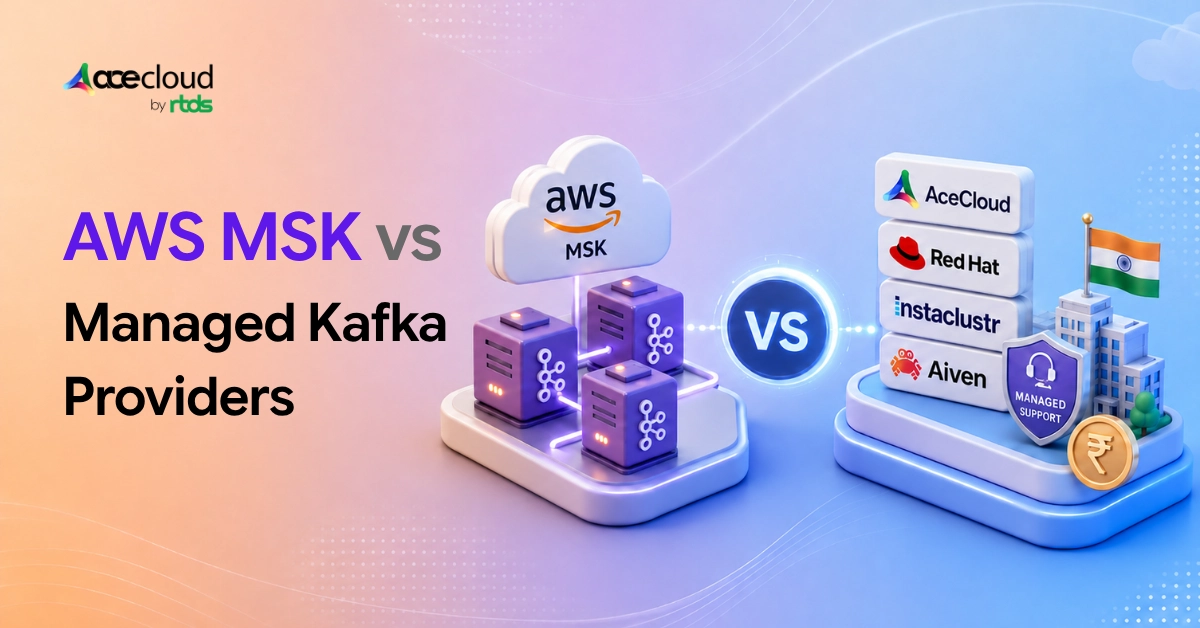
AWS MSK vs Managed Kafka Providers: Side-by-Side Comparison
Below is a side-by-side comparison to help Indian businesses evaluate whether AWS MSK or managed Kafka provider better fits their workload, team structure, and compliance needs.
| Comparison factor | AWS MSK | Managed Kafka providers |
|---|---|---|
| Best for | AWS-first teams with Kafka skills | Teams needing lower operational effort |
| Deployment model | AWS-native managed Apache Kafka | Cloud, private cloud, multi-cloud or India-hosted models |
| Kafka control | High | Varies by provider |
| Operational effort | Reduced, but not fully removed | Often lower if provider includes Kafka-level support |
| Scaling | Strong, depending on MSK model | Depends on provider design |
| Monitoring | AWS-native tools such as CloudWatch and Prometheus integrations | Provider dashboards, alerts, monitoring, and support vary |
| Connectors | MSK Connect available for Kafka Connect workloads | Varies by provider; some offer stronger managed connector support |
| Security | AWS IAM, VPC, encryption and network controls | Depends on provider controls and deployment model |
| Disaster recovery | Possible with AWS-native architecture and MSK Replicator options | Varies by provider; check active-active, active-passive, and offset replication support |
| Support | AWS support plan dependent | Provider SLA and support model dependent |
| India region choice | AWS India regions, based on service availability | Depends on provider deployment model |
| Migration help | Usually customer-led or partner-led | Often provider-assisted, depending on service depth |
| Commercial flexibility | AWS pricing model | May offer custom support or billing models |
| Vendor lock-in | AWS ecosystem dependency | Varies across cloud, private and multi-cloud providers |
Key Takeaways:
- With AWS MSK, your team gets managed Apache Kafka inside AWS, but still owns many Kafka design and operational decisions.
- With managed Kafka providers, your team may get more operational assistance, depending on the provider’s service depth.
When to Choose AWS MSK
AWS MSK is usually a strong choice when your business is already standardized on AWS and your engineering team is comfortable managing Kafka architecture.
Choose AWS MSK if:
| Decision factor | Why AWS MSK may fit |
|---|---|
| AWS-first architecture | Your applications, databases, analytics systems, and observability tools already run on AWS |
| Internal Kafka expertise | Your team can manage topics, partitions, retention, consumer lag, and scaling decisions |
| AWS-native security | You want IAM, VPC, encryption, security groups, and AWS-native access control |
| AWS integrations | You need integrations with CloudWatch, IAM, AWS Glue Schema Registry, Lambda, S3, and other AWS services |
| Control | You want more control over Kafka configuration and infrastructure choices |
| Existing AWS contracts | Your procurement, billing, and support are already aligned with AWS |
AWS MSK can work well for mature platform teams that want managed infrastructure but still prefer to own Kafka architecture.
When to Choose Managed Kafka Provider
A managed Kafka provider may be a better fit when your team wants Kafka outcomes without owning every operational detail.
Compare other managed Kafka providers if:
| Decision factor | Why a managed Kafka provider may fit |
|---|---|
| Limited Kafka expertise | Your team does not want to manage deep Kafka operations internally |
| Local support need | You want India-based support, escalation, or professional services |
| Migration complexity | You need help moving from self-managed Kafka or another platform |
| Hybrid or private cloud | You need deployment outside AWS or closer to specific workloads |
| Compliance review | You need more clarity around data residency, support access, and local hosting |
| Operational assistance | You want help with monitoring, sizing, scaling, DR, and incident response |
| Commercial flexibility | You need custom billing, support packaging, or managed service terms |
| Faster production readiness | You want provider-led setup, configuration, monitoring, and migration planning |
The goal is not to avoid AWS MSK. The goal is to compare whether AWS MSK gives your business the right level of support, control, compliance, and operational ownership.
What Indian Businesses Should Compare Before Buying
1. Operational responsibility
Operational ownership is the most critical factor when choosing a Kafka platform. While managed services reduce infrastructure burden, Kafka still requires ongoing management in production. Teams must handle topic design, partitioning, consumer lag, scaling, monitoring, and incident response.
With AWS MSK, AWS manages infrastructure tasks like provisioning, patching, and availability, but your team still owns Kafka-level decisions such as topic configuration, partition strategy, and troubleshooting. In contrast, some managed Kafka providers offer deeper operational support, including monitoring, scaling assistance, and incident handling.
The key question is: Who takes responsibility when Kafka issues impact production?
If your team has strong Kafka expertise and prefers control, AWS MSK is suitable. If you want reduced operational overhead and provider-led support, a managed Kafka provider may be a better fit.
2. India region availability and latency
Region selection directly impacts producer-to-broker latency, broker-to-consumer latency, replication lag, cross-AZ cost, DR design and user-facing workflow latency. Kafka acts as a real-time data backbone, so latency between producers, brokers, and consumers must be minimal.
For Indian businesses handling payments, ecommerce spikes, logistics tracking, or real-time analytics, even small delays can affect operations. Hosting Kafka closer to application workloads reduces latency and improves reliability.
Businesses should verify whether the Kafka service is available in Indian regions and whether all required features are supported there. It is also important to check if data, logs, or backups are stored outside India, as this can impact compliance and latency.
Additionally, evaluate Multi-AZ support, disaster recovery region placement, and private networking options. Always confirm actual service availability instead of assuming uniform support across regions.
Need help deciding whether your Kafka workloads should remain self-managed, move to AWS MSK, or shift to another managed Kafka platform? Book a Kafka readiness assessment with AceCloud.
3. Data residency and compliance
Kafka often carries sensitive data such as payment transactions, customer information, and audit logs. For Indian businesses, especially in regulated sectors like BFSI, fintech, and healthcare, data residency is a critical consideration.
Organizations must understand where Kafka data is stored, replicated, and backed up. This includes topic data, replicas, logs, monitoring data, and disaster recovery copies. Regulatory requirements, such as RBI guidelines for payment data, may require data to remain within India.
The goal is not to restrict all workloads to India but to ensure clarity on data flow and storage locations. Businesses should classify data based on sensitivity and compliance requirements before selecting a Kafka deployment model.
A well-defined data governance strategy helps avoid compliance risks and ensures that Kafka aligns with regulatory expectations.
4. Total cost of ownership
Kafka cost evaluation should go beyond broker or cluster pricing. While broker or compute cost is visible upfront, the real cost includes storage, data transfer, monitoring, support, and engineering effort.
As workloads grow, factors like retention policies, cross-zone traffic, replication, and connectors can significantly increase expenses. Additionally, internal engineering time spent on troubleshooting and optimization adds hidden costs.
A realistic Kafka TCO includes infrastructure, storage, networking, monitoring tools, support plans, migration effort, compliance overhead, and disaster recovery setup.
A practical Kafka TCO formula is:
Kafka TCO = broker/compute cost + storage/retention + cross-AZ/cross-region data transfer + replication/DR + connectors + schema registry + monitoring/logging + support + engineering time + migration risk + compliance overhead + backup/restore testing + incident costAWS MSK may be cost-effective for AWS-native teams familiar with AWS pricing. Managed Kafka providers may offer bundled support or predictable pricing models.
The right approach is to compare total cost for the required performance, reliability, and support level, not just monthly cluster pricing.
5. Scalability and performance
Kafka scalability is not just about adding brokers or switching to a larger managed tier. It involves managing throughput, partition distribution, storage performance, and consumer lag under real-world conditions.
Indian businesses often face unpredictable traffic spikes during events like salary days, festive sales, or campaigns. The Kafka platform must scale without causing unacceptable partition rebalancing, leader movement, storage bottlenecks, client errors, replication lag or consumer lag.
Key factors to evaluate include scaling speed, partition balancing, throughput limits, and how the system behaves under high load. Storage performance also matters for workloads with long retention or replay requirements.
Additionally, assess how the platform handles failover and whether scaling actions are automated or manual. Monitoring capabilities for consumer lag and topic health are equally important.
Before finalizing a provider, run workload-specific benchmarks using realistic traffic patterns to ensure the platform meets performance expectations.
6. Disaster recovery, RPO, and RTO
Disaster recovery is essential for Kafka because it sits at the core of business-critical systems. Any downtime can disrupt payments, analytics, notifications, and operational workflows.
Businesses should clearly define Recovery Point Objective (RPO) and Recovery Time Objective (RTO) before choosing a provider. These determine acceptable data loss and recovery time during failures.
Evaluate whether the provider supports active-active or active-passive setups, and whether consumer offsets, topic configurations, and access controls are replicated. Offset synchronization is especially important to avoid duplicate or missed processing.
Also, check if the disaster recovery region is within India for compliance-sensitive workloads. Understand who is responsible for initiating failover and how often DR processes are tested.
A reliable Kafka platform should provide tested DR mechanisms, documented failover/failback steps, RPO/RTO targets, offset handling, client cutover process and regular DR drills, not just general HA claims.
7. Security and private networking
Kafka security must align with enterprise network, identity, encryption, audit and compliance standards. It is not enough for a provider to claim security support, businesses must verify how security is implemented and managed.
Key areas include network isolation through VPCs, private connectivity, and IP restrictions. Identity and access controls such as IAM, ACLs, and authentication mechanisms like SASL or mTLS should be evaluated.
Encryption in transit and at rest is essential, along with proper key management. Businesses should also ensure audit logging, monitoring, and integration with SIEM tools for security visibility.
Another important factor is controlling provider access to systems during support or maintenance.
The provider should not only offer these features but also assist in configuring them correctly for production environments.
8. Vender lock-in
Vendor lock-in should be evaluated early in the decision process. AWS MSK may create dependency on AWS services, which is acceptable for AWS-first organizations but limiting for multi-cloud or hybrid strategies.
Managed Kafka providers can also introduce lock-in through proprietary tools, dashboards, or deployment models.
Businesses should check whether standard Kafka clients are supported and whether configurations, schemas, and connectors can be easily migrated. Monitoring tools and observability setups should also be portable.
An exit strategy is important, even if migration is not planned immediately.
The goal is not to eliminate lock-in entirely but to understand its impact and ensure flexibility for future changes.
9. Support and SLA
Support quality often determines the real value of a Kafka platform. Kafka issues such as consumer lag, broker failures, or connector errors require quick resolution to avoid business impact.
Businesses should evaluate whether 24×7 support is available and whether local or India-based assistance is provided. It is important to understand escalation processes, response times, and whether Kafka-level troubleshooting is included.
Check if the provider offers help with migration, capacity planning, disaster recovery, and cost optimization. Dedicated support engineers can be valuable for critical workloads.
Also, review what the SLA actually covers, whether it includes infrastructure only or extends to Kafka operations.
Strong support can reduce downtime, improve reliability, and lower the burden on internal teams.
10. Migration Support
Migration is often complex and underestimated when adopting a new Kafka platform. Moving from self-managed Kafka or another provider involves more than setting up a new cluster; it is a data, client, schema, security, connector and cutover project.
Businesses must migrate topics, partitions, consumer offsets, ACLs, schemas, and connectors. Compatibility between Kafka versions and Schema Registry tools must also be verified.
A proper migration plan includes compatibility testing, dual-write or replication strategy, shadow consumers, data validation, cutover window, rollback plan and post-cutover lag/error monitoring. Producers and consumers may require configuration changes during cutover.
Without careful planning, migration can lead to downtime, data loss, or performance issues.
If internal Kafka expertise is limited, choosing a provider that offers migration assistance can significantly reduce risk and ensure a smoother transition.
Compare AWS MSK vs Managed Kafka with AceCloud Experts
Choosing between AWS MSK and managed Kafka providers is not just an infrastructure decision. For Indian businesses, it affects latency, data residency, migration risk, disaster recovery, support, scalability, and total cost of ownership.
AWS MSK can work well for AWS-first teams with Kafka expertise, while AceCloud Managed Kafka is built for businesses that need local support, private deployment, proactive monitoring, migration assistance, and lower operational complexity.
Before you commit, evaluate what your team should manage internally and where expert support can reduce risk.
Book a free consultation to assess your Kafka workloads and choose the right managed Kafka strategy.
Frequently Asked Questions
AWS MSK is Amazon Managed Streaming for Apache Kafka. It is AWS’s managed Apache Kafka service for running Kafka clusters and Kafka-based applications inside the AWS ecosystem.
AWS MSK manages much of the Kafka infrastructure, but businesses still need to manage Kafka design decisions such as topics, partitions, retention, producers, consumers, monitoring, security and cost optimization.
AceCloud Managed Kafka can be considered an alternative for Indian businesses that want managed Kafka with India-focused support, private networking, monitoring, security controls and lower operational complexity, provided its Kafka version, HA/DR model, SLA, backup policy, connector support and migration scope match the workload. AWS MSK may still be better for teams deeply standardized on AWS.
It depends on broker usage, storage, data transfer, connectors, monitoring, support, migration and engineering effort. Businesses should compare total cost of ownership, not only headline pricing.
Kafka can be suitable for fintech workloads, but teams should review latency, data residency, encryption, audit logs, access controls, disaster recovery and applicable regulatory requirements before choosing a provider.
AWS MSK can replace self-managed Kafka for many AWS-based workloads. Migration should include a review of Kafka versions, topics, partitions, consumer offsets, ACLs, connectors, schemas, monitoring and rollback plans.