
India’s digital infrastructure now runs almost entirely on cloud. E-commerce platforms process millions of transactions, startups train AI models on hyperscale compute, and enterprises depend on external identity and control layers. India’s digital growth is now deeply tied to cloud environments.
This model has delivered speed and scale. It has also created structural interdependence. Reliability cannot be outsourced to scale. When critical workloads sit on shared network and control layers, exposure extends beyond a single enterprise.
Systems may appear independent, but many rely on the same backbone. When that backbone fails, independence proves illusory. Decades of infrastructure evolution have shown that concentration amplifies consequences. We have normalised architectural concentration in the name of efficiency. That trade-off now needs to be re-examined.
A June 2025 Cisco ThousandEyes report recorded 1,843 network outage incidents in one month, reflecting instability in the routing and connectivity layers that underpin the internet. These are not isolated IT disruptions. They are indicators of systemic exposure and therefore a board-level concern.
In hyperscaler environments, the dominant failure mode is internal complexity: flawed updates, dependency conflicts, and control plane disruptions. When consumer platforms, enterprise systems, and public services slow together, the issue is no longer uptime. It is architectural concentration risk. Without isolating failure domains, scale amplifies disruption rather than containing it.
Read More: Express Computer

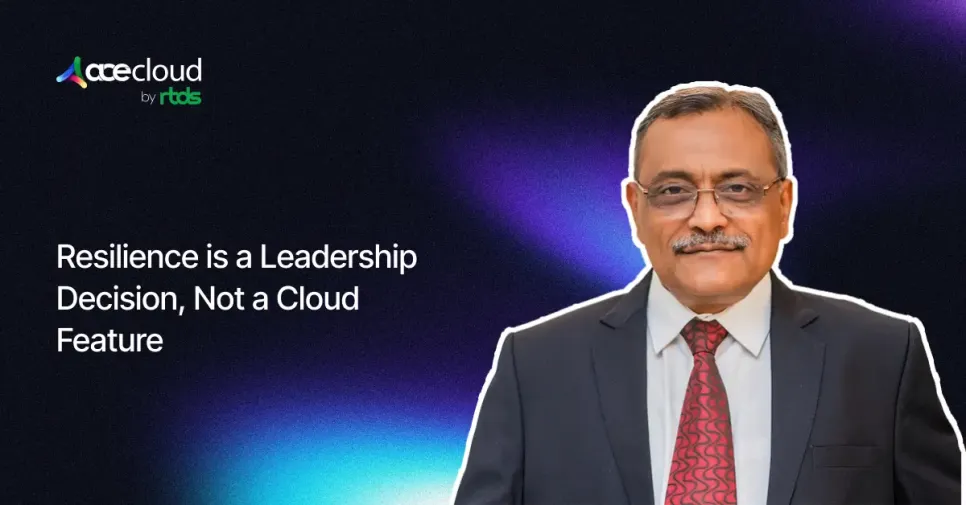
Vinay Chhabra is the Co-Founder & Managing Director of AceCloud (a brand of RTDS), a leading provider of end-to-end cloud computing solutions to global enterprises across industries at scale. As a visionary leader, Mr. Chhabra plays a crucial role in shaping the company’s strategic direction and firmly believes that organizational success hinges on investing in talent and fostering a culture of innovation. His proactive approach involves continuously exploring new opportunities and integrating emerging technologies into AceCloud’s business framework to stay ahead in a dynamic market.


