

Public cloud services are easier to use when you understand their building blocks, not just their dashboards and marketing terms. This topic matters because cloud usage keeps expanding across engineering teams, especially for data platforms and GPU-based ML workloads.
- “Infrastructure” means the compute, networking, storage and control software that run in provider data centers.
- “Deployment” means the repeatable steps you use to plan, provision, secure, release and operate workloads on that infrastructure.
By the end, you should be able to explain how multi-tenant hardware becomes your isolated environment and how deployments stay reliable.
NOTE: You can skip this guide and simply connect with our dedicated Public Cloud Expert to get answers to all your cloud-related queries. Book Free Consultation Session!
What is a Public Cloud?
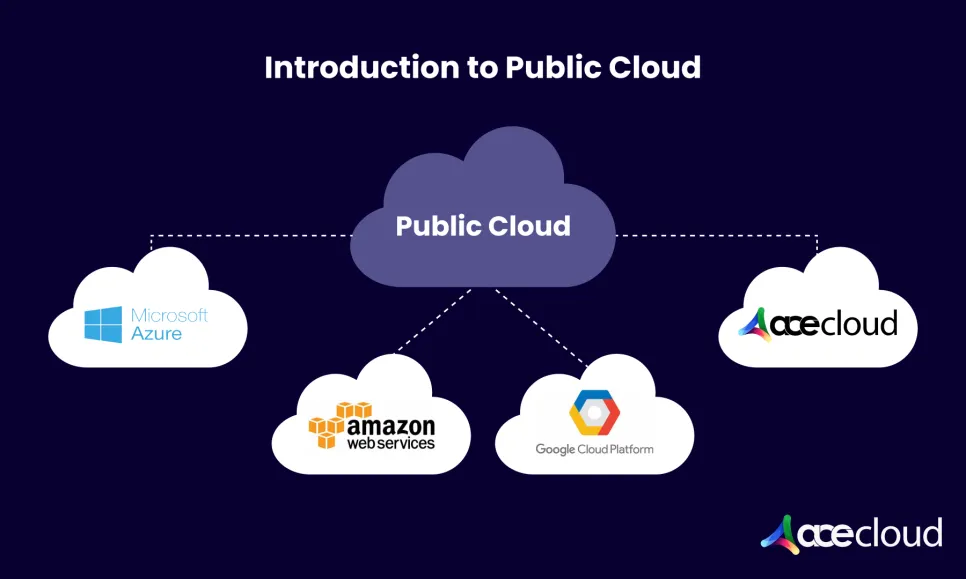
A public cloud is a shared cloud platform where you rent resources from a provider instead of owning the underlying hardware. NIST defines public cloud as infrastructure provisioned for “open use by the general public,” which captures the idea of broad, shared access.
In contrast, a private cloud is dedicated to one organization, which can simplify certain controls but increase ownership and capacity planning work. A hybrid cloud combines public and private environments, which can help with data residency or latency but adds integration and operational overhead.
Multi Tenancy
Public cloud typically uses multi-tenancy, meaning many customers share the same physical fleets while remaining logically separated. This sharing reduces unit cost because providers spread power, cooling, staffing and hardware to refresh cycles across many tenants.
Shared Responsibility Model
At the same time, you operate under a shared responsibility model, where providers secure the cloud platform and you secure what you build on it. For example, the provider maintains physical security and hypervisor hardening, while you manage IAM roles, network rules and data protection settings.
Common Use Cases
Common public cloud use cases include web and API hosting, data pipelines, batch analytics, GPU training and elastic inference endpoints. For ML teams, the main advantage is fast access to specialized hardware and the ability to scale experiments without long procurement cycles.
What are Core Components of Public Cloud Infrastructure?
Public cloud works because multiple infrastructure layers cooperate, from physical equipment to automation software that exposes APIs. You can troubleshoot faster when you know which layer owns the problem, such as hardware capacity, network reachability or deployment tooling.
Cloud Data Centers and Physical Hardware
Cloud data centers are built from racks of servers that provide CPU and GPU compute, plus high-throughput networking and storage backplanes. Providers design redundant power, cooling and connectivity because component failure is normal at large scale.
Uptime Institute reports that 53% of operators experienced an outage in the past three years, which reinforces the need for redundancy planning. Hardware fleets follow lifecycle processes, including burn-in testing, monitoring, replacement schedules and secure decommissioning.
For ML practitioners, GPU nodes often include specialized interconnects and optimized drivers, which reduce training time and improve utilization stability. Additionally, providers partition capacity into instance families, which lets you choose predictable CPU, memory and GPU ratios for different workload shapes.
Software-defined Networking and Segmentation
Software-defined networking lets you create VPC-style networks that behave like private data centers, even though they run on shared hardware. You typically configure subnets, route tables and security groups, which control how packets flow and which ports remain reachable.
Load balancers distribute traffic across instances, while NAT gateways let private workloads reach the internet without exposing inbound paths. Peering and private links connect networks across accounts or environments, which supports shared data platforms and segmented ML training clusters.
Real-world disruptions happen for many causes, including power outages and cable damage, which is why segmentation and resilient routing matter. If you isolate tiers and control egress, a failure or attack in one segment is less likely to propagate into training data stores or production inference.
Cloud Storage Systems and Data Protection
Cloud storage usually comes in three forms: object, block and file, each optimized for different access patterns. Object storage fits datasets, checkpoints and logs because it scales widely and works well with parallel readers.
Block storage fits databases and VM disks because it offers consistent low-latency reads and writes at the volume level. Durability means your data remains intact over time, while availability means the service responds when you try to access that data.
You still need backups and tested restores because your own deletes, overwrites and key mismanagement can break recovery plans.
Automation and Orchestration
Cloud feels on-demand because control software translates API requests into scheduled work on shared fleets. Hypervisors and container runtimes isolate workloads, while schedulers place them on hosts that match your CPU, memory and GPU requirements.
Infrastructure-as-Code helps you create repeatable environments, which reduces configuration drift between dev, staging and production. Kubernetes adds orchestration primitives like deployments, services and autoscaling, which suit microservices and many ML serving patterns.
CNCF reports 80% of organizations run Kubernetes in production and 60% use CI/CD for most or all applications, showing how common automation has become. If you treat cloud resources as versioned configuration, you can review changes, roll back failures and audit who changed what.
How Public Cloud Infrastructure Works?

Under the hood, public cloud is a resource allocation system that balances efficiency, isolation, security and reliability at scale. You can design better architectures when you understand how pooling, boundaries and automation interact.
Hardware Resource Pooling
Public cloud relies on pooling, which means many physical resources are grouped and then sliced into logical units for customers. Virtualization abstracts hardware into instances, which makes capacity scheduling faster and more flexible than manual provisioning.
Providers use quotas and placement policies to manage fairness, which reduces noisy-neighbor effects when many tenants share the same racks. For ML, pooling also enables bursty training, where you scale up for runs and scale down afterward without leaving hardware idle.
Additionally, providers monitor utilization and failures across fleets, which helps them proactively replace failing components before performance degrades.
Security and Isolation
Cloud isolation is enforced across identity, network and compute layers, which limits what each tenant can see and control. IAM systems define who can act, what they can access and which actions require stronger controls like MFA or short-lived tokens.
Network segmentation limits lateral movement because workloads communicate only through allowed paths, not through flat networks. Encryption protects data at rest and in transit, while secrets managers reduce the chance of hard-coded credentials leaking into repositories.
Flexera reports top cloud challenges include managing cloud spend (84%) and security (77%), which highlights why guardrails matter. If you automate least-privilege policies and logging, you can reduce risk without relying on manual review for every change.
Global Network and Data Distribution
Providers group data centers into regions, then split regions into availability zones that act as fault isolation boundaries. If you deploy across zones, a single facility event is less likely to take down both your compute and your storage access paths.
Active-active patterns spread traffic across zones continuously, while active-passive patterns keep a standby that takes over during failure. For ML pipelines, zone-aware design can protect feature stores, model registries and training data access during localized outages.
Additionally, placing workloads closer to users or data sources reduces latency, which improves API responsiveness and speeds up distributed training coordination.
Elasticity and Autoscaling
Elasticity means capacity can grow or shrink based on demand, which reduces both manual intervention and wasted spend. Horizontal scaling adds more instances or pods, while vertical scaling increases CPU, memory or GPU size per node.
Autoscaling depends on signals like CPU utilization, queue depth, request latency or custom metrics from your inference service. Warm pools and pre-provisioned node groups can reduce scale-up time, which matters when traffic spikes or batch training jobs start together.
If you couple autoscaling with tagging and cost allocation, you can identify which teams and models drive growth in usage.
How to Deploy Workloads on Public Cloud?
Cloud deployment works best as a repeatable loop that starts with planning and ends with monitored operations and continuous improvement. You can reduce risk by standardizing inputs, automation and controls before production traffic depends on them.
Assessment and Planning
You should map dependencies, data flows and ownership because hidden coupling is a common cause of migration delays. Classify data and define RTO and RPO targets because these choices determine backup, replication and recovery design.
IBM cites a USD 4.44 million global average cost of a data breach, which supports investing early in classification and access controls. Additionally, baseline current cost and performance, since you need a reference to judge whether cloud changes improved outcomes.
Provisioning Resources
You should use Infrastructure-as-Code to create repeatable environments with reviewable changes and consistent naming and tagging.
Define modules for networks, IAM and compute, then reuse them across dev, staging and production to reduce drift.
Additionally, you can apply policy checks in pipelines to block risky configurations before they reach production.
Configuration and Security
You should implement least-privilege IAM roles, encrypted defaults and centralized logging because these controls reduce blast radius during mistakes.
Policy-as-code helps enforce standards consistently, which avoids one-off exceptions that become hard to audit later.
Additionally, you can separate accounts or projects by environment to simplify access review and incident containment.
Continuous Deployment and Management
You should define SLOs, alerts and runbooks because reliable operations depend on fast detection and consistent response actions. Regular patching, backup testing and incident drills reduce recovery time because teams learn the failure paths before emergencies happen.
DORA’s “four keys” include deployment frequency, lead time for changes, change failure rate and time to restore service, which guide measurable improvement. Additionally, you should track cost metrics alongside reliability, since performance fixes that ignore spend often create new operational problems.
Key Takeaways!
Public cloud is a layered system where hardware, networking, storage and orchestration combine to deliver on-demand resources. Multi-tenancy works because providers pool capacity and enforce isolation through virtualization, IAM and network segmentation.
Resilience improves when you design around regions and availability zones, then test failover paths in realistic scenarios. Deployments succeed when you plan dependencies, automate provisioning and enforce security guardrails through repeatable workflows.
Feeling overwhelmed? Why not connect with the cloud experts to get answers to all your queries? Just use your free consultation session and book your demo with us!
Frequently Asked Questions
NIST defines it as cloud infrastructure provisioned for “open use by the general public,” which means shared access through a provider platform.
It depends on utilization patterns, governance and architecture choices, since unused capacity and misconfigured scaling can raise spend quickly.
Isolation relies on virtualization boundaries, IAM authorization and network segmentation, which limit what each tenant can see or reach. Additionally, encryption and audit logs help you detect misuse and reduce exposure if credentials leak or workloads are compromised.
Durability describes the likelihood of data remaining intact over time, while availability describes whether you can access data when needed.
Zones provide fault isolation because they are separate data centers with redundant power, networking and connectivity inside a region. If you spread workloads across zones, you reduce the chance that a single facility event disrupts both your application and its dependencies.
