For years, your Kubernetes placement decision was simple: pick the region with the best latency, the lowest cost, and the team’s operational comfort. That decision just got more complicated.
DPDP, RBI outsourcing guidelines, and customer due diligence from BFSI buyers are now showing up in architecture reviews, vendor risk reviews, and security reviews. Kubernetes location is no longer just an infrastructure choice; it affects where workloads, logs, backups, snapshots, secrets, telemetry and managed-control-plane evidence may reside, who can access them and whether those controls can be proven during an audit or incident.
The question has changed from “Can this cluster run the workload?” to “Can this cluster run the workload in a way we can govern, audit, and defend?”
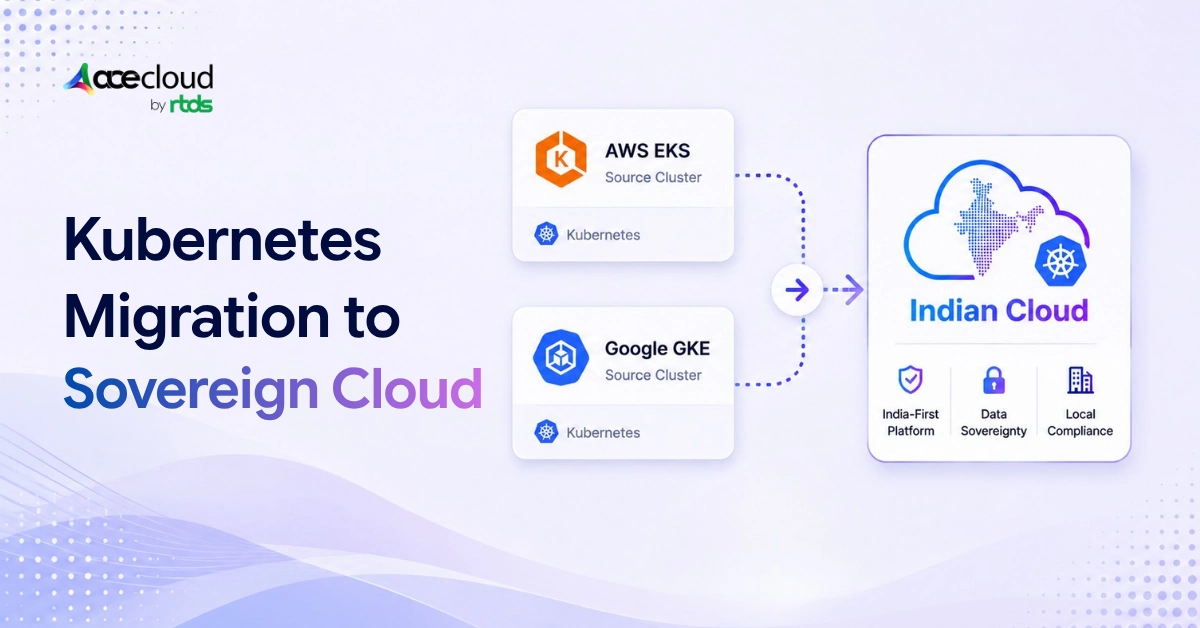
That is why Kubernetes sovereign cloud in India is becoming a serious platform strategy for banks, fintechs, SaaS companies, and enterprises handling regulated or sensitive data. It gives platform, security and compliance teams a clearer way to design clusters around data residency, access control, auditability, encryption-key governance, log retention, backup location, recovery testing and support-access boundaries from the start.
Why Kubernetes Location Now Matters in India?
Kubernetes location matters because compliance questions now cover not only where the application runs, but also where the control plane, logs, backups, telemetry, support access and recovery copies are handled.
From performance decision to compliance decision
Earlier, Kubernetes placement was mostly an engineering trade-off. You picked a region based on latency, cost, availability and the team’s operational comfort.
Now, placement also affects residency, legal jurisdiction and the practical path of provider access. It also changes where logs are stored, where backups or snapshots replicate, which teams can access them and how quickly you can contain, investigate and recover from an incident.
This matters because ‘Kubernetes’ is not only worker nodes. It includes the managed control plane, the audit trail, the storage layers and the backup system that quietly copies data.
What changes for banks, fintechs, SaaS and enterprises
If you are an RBI-regulated entity, cloud-hosted or managed Kubernetes may fall into outsourced IT risk depending on the service model, criticality and access to customer data or regulated systems. That means you still own outcomes for confidentiality, integrity, monitoring and exit readiness, even when you outsource operations.
If you are a fintech vendor or a SaaS provider selling into BFSI, buyers often ask for proof. Therefore, your cluster location and access model become part of customer due diligence, not a backend detail.
If you are an enterprise processing digital personal data, DPDP readiness becomes a data-governance and platform-control requirement, but not automatically a requirement to host every Kubernetes cluster in India. Accordingly, you should be able to explain where personal data flows, where it rests and who can access it.
Why Kubernetes sits inside the regulated data path
Kubernetes commonly handles personal data directly through APIs and services. It also handles personal data indirectly through logs, traces, crash outputs, and debug tooling.
This indirect path is where teams get surprised. A single failed job can print identifiers, tokens, request bodies or payload fragments into logs that are then shipped to SIEM, APM, support or third-party observability tools.
Data sovereignty has become a clear priority in many infrastructure buying decisions, especially for container and cloud-native environments. Nutanix reports 80% treat data sovereignty as a high priority or must-include factor, while 57% feel the need to run infrastructure within a single country.
What a Sovereign Kubernetes Architecture Includes?
A sovereign Kubernetes architecture does not need to be overly complex. It needs to be clear, controlled and easy to evidence during audits, incidents and vendor reviews.
For Indian enterprises, the architecture should cover the full operating model, not just worker nodes. That includes the control plane, API endpoint, etcd or managed state, worker nodes, storage, logs, backups, secrets, encryption keys, observability tools, image registry, CI/CD path, support access and exit planning.
| Architecture Layer | What to Design For |
|---|---|
| Landing zone | India-hosted VPC, private networking, firewall rules and secure connectivity |
| Control plane | Private API endpoint, audit logs, managed upgrades and access governance |
| Worker nodes | Segmented node pools based on workload sensitivity, environment, tenant, data class, GPU/CPU requirement and patching policy |
| Storage | India-hosted persistent volumes, snapshots and object storage |
| Secrets | etcd encryption, external secrets, KMS or HSM integration and rotation |
| Observability | Approved log, metric and trace pipelines with masking and retention controls |
| Backup and DR | Approved backup location, restore testing and deletion process |
| Governance | Audit rights, subcontractor visibility, support access controls and exit plan |
This reference model gives cloud teams a shared way to discuss Kubernetes sovereign cloud India without reducing the topic to only ‘which region are we using?’
Kubernetes documentation warns that API resources are stored in etcd without at-rest encryption by default and that Secrets are stored unencrypted by default in etcd unless encryption is configured; secrets and key management should therefore be part of the architecture from day one.
Data Residency, Data Sovereignty and Sovereign Kubernetes: What’s the Difference?
Before choosing a Kubernetes environment, teams must understand how residency, sovereignty and sovereign Kubernetes differ across location, access and control.
| Concept | Meaning | Kubernetes Impact | What to Check |
|---|---|---|---|
| Data Residency | Where data is stored, processed, backed up or restored. | Covers worker nodes, volumes, object storage, logs, snapshots and backups. | Check whether data, logs, backups and DR copies stay in the approved location. |
| Data Localization | A legal, regulatory or policy requirement to keep specific categories of data within a defined geography. | May affect where certain workloads, logs, replicas, snapshots, backups and DR copies can be hosted. | Check whether DPDP, RBI, sectoral rules, customer contracts or internal policies require certain data to remain in India. |
| Data Sovereignty | Which country’s laws, access rules and controls apply to the data. | Provider access, support access, subcontractors, admin rights and key management matter. | Check who can access the cluster, where support operates from and how keys are governed. |
| Sovereign Kubernetes | Kubernetes designed for local residency, compliance, access control and auditability. | Covers the control plane, nodes, storage, logs, backups, keys and operations. | Check whether the full cluster can be secured, monitored, audited, recovered and exited responsibly. |
An Indian cloud region can support data residency, but sovereign Kubernetes requires stronger proof. Enterprises need visibility and control across the full cluster environment, including access, logs, backups, keys, support operations and audit evidence.
What DPDP Changes for Kubernetes Workloads?
DPDP does not automatically require every Kubernetes cluster to run in India. That distinction is important.
However, DPDP increases scrutiny around how personal data is collected, processed, protected, retained, erased and shared with processors. This affects Kubernetes because personal data may move through many layers of the cluster environment.
Under DPDP, a Data Fiduciary determines the purpose and means of processing personal data, while a Data Processor processes personal data on behalf of the Data Fiduciary. This matters for managed Kubernetes because the cloud provider, managed Kubernetes operator, monitoring platform, backup provider, support partner or incident-response vendor may sit inside the processing chain depending on access and data handling.
The mistake many teams make is reviewing only the production database. Personal data may also appear in API payloads, application logs, Kubernetes audit logs, traces, metrics, crash dumps, support tickets, CI/CD logs, persistent volumes, snapshots and backups.
DPDP makes deletion, retention and evidence harder to ignore, especially when personal data is duplicated into logs, backups, replicas and third-party tools. The Act includes obligations around ceasing processing and causing Data Processors to cease processing when consent is withdrawn, unless continued processing is required or authorized by law.
For Kubernetes teams, this means deletion planning cannot stop at the live application. It should account for logs, backups, replicas, snapshots and processor-held copies wherever applicable.
Why RBI Guidelines Make Cloud Outsourcing Risk Extend to Kubernetes?
RBI’s IT outsourcing directions apply directly to covered regulated entities such as banks, payment banks, certain NBFCs, credit information companies and all-India financial institutions. But the impact does not stop there. Fintech vendors, SaaS providers, cloud partners, and technology companies serving BFSI customers also feel the effect because their customers need stronger vendor governance, auditability, data protection, and exit planning.
RBI’s Master Direction on Outsourcing of Information Technology Services includes cloud computing services within the scope of outsourced IT services. It also discusses cloud service and deployment models such as IaaS, PaaS, SaaS and related cloud models; avoid over-listing DBaaS/cloud networking unless you cite the exact RBI appendix wording in the final article.
For Kubernetes, this matters because a cloud-hosted cluster may become part of an outsourced IT arrangement. If a bank runs applications on a managed Kubernetes environment, it needs confidence in access controls, audit logs, subcontractor visibility, data confidentiality, incident reporting, business continuity, and exit rights.
RBI expects regulated entities to remain accountable for outsourced IT risk and customer obligations; present this as the RE’s responsibility, not as a certification that any cloud provider is automatically “RBI compliant.” It also expects access to customer data to follow a need-to-know basis. RBI further requires regulated entities to understand and monitor service providers that have access to their data, systems, records, or resources.
This directly maps to Kubernetes controls:
| RBI concern | Kubernetes design implication |
|---|---|
| Audit rights | Kubernetes audit logs, provider evidence, SIEM integration |
| Confidentiality | Encryption, secrets management, private networking |
| Integrity | Signed images, admission controls, vulnerability scanning |
| Need-to-know access | IAM, RBAC, MFA, least privilege |
| Subcontractor risk | Provider due diligence and support access boundaries |
| Resilience | Backup, restore testing, DR plans, failover |
| Exit strategy | Portable workloads, backup export, secure deletion |
For BFSI workloads, ‘RBI compliant cloud’ should not be treated as a marketing phrase. It should be translated into practical architecture and contractual controls.
That means asking hard questions before running Kubernetes workloads:
- Who manages the control plane?
- Where does etcd run?
- Can provider staff access cluster data?
- Where are backups stored?
- Are audit logs tamper-resistant?
- Can workloads be moved if the vendor relationship ends?
- Are subcontractors visible and governed?
Which Kubernetes Controls ShouldEnterprises Map DPDP and RBI Expectations?
A control map gives you a shared language across engineering, security and compliance, which lowers friction during urgent decisions.
Control plane and API server
You should prefer private API endpoints and controlled administrator access. This reduces exposure because the API server is the administrative front door to the cluster and a high-value target.
If you use managed Kubernetes, document the shared-responsibility model clearly across control-plane patching, etcd/state protection, worker-node patching, network controls, logging, backups and incident response. That clarity matters because auditors often ask which party patches, monitors and responds for control plane components.
You should also define your audit policy and retention rules. Without that, you may have logs but still lack reliable evidence because retention, searchability, integrity and export paths were not designed upfront.
RBAC and least privilege
RBAC should reflect real job roles rather than convenience permissions. Namespace-scoped roles reduce accidental privilege and limit blast radius.
Avoid broad cluster-admin access except for a small set of platform operators. Then protect those operators with MFA, short-lived credentials and regular access reviews.
This matters because access mistakes are common during incidents. Least privilege reduces damage when someone moves quickly under pressure.
Secrets and encryption
Kubernetes warns that Secrets are stored unencrypted in etcd by default, and the API server stores plain-text resource representations in etcd unless at-rest encryption is configured. You should enable encryption at rest and keep key material controlled and audited.
You should also prevent secrets from landing in CI logs and manifests. Build pipelines often become an unintended data store when developers debug releases.
Finally, implement secret rotation and token governance. These steps reduce credential exposure risk and improve containment during breach response.
Observability and monitoring
Observability data often contains identifiers that qualify as personal data in practice. IP addresses, customer IDs, and transaction references commonly appear in logs and traces.
Treat observability as regulated data when it contains regulated context. Then apply residency, access and retention controls just like you would for databases.
You should also implement log redaction standards for teams. Redaction reduces risk because it limits what is collected in the first place.
Network policies and workload isolation
Network policies help you enforce workload boundaries inside the cluster. Ingress and egress controls matter because data movement often happens through allowed outbound calls.
Private networking reduces exposure to internet scanning and misrouted traffic. Additionally, segmentation limits lateral movement when a single pod is compromised.
For regulated workloads, restrict egress to approved destinations. That control reduces the chance of accidental cross-border data transfers.
Backup, retention, deletion and exit
Backups, snapshots, replicas and DR copies should follow the same residency, encryption, retention and deletion rules as production data unless a documented legal or operational exception applies. Otherwise, your deletion story becomes incomplete, even when production systems are well controlled.Otherwise, your deletion story becomes incomplete, even when production systems are well controlled.
Exit readiness also needs technical proof, not procurement language. You should test portability for images, volumes, logs and audit evidence before you need it.
Thales reports 55% say cloud environments are more complex to secure than on-premises. It also reports 54% of cloud data is classified as sensitive, which raises the stakes for telemetry and backups.
| Control area | Kubernetes control | Compliance value |
|---|---|---|
| Data residency | India-hosted nodes, storage and backups | Reduces location and transfer ambiguity |
| Access control | IAM, RBAC, MFA and least privilege | Supports need-to-know access |
| Secrets | etcd encryption, external secrets and KMS | Reduces credential exposure risk |
| Auditability | Kubernetes audit logs and SIEM | Supports investigation and evidence |
| Network isolation | Network policies and private ingress | Limits lateral movement |
| Backup and DR | India-based backups and restore testing | Supports continuity and deletion control |
| Vendor governance | Audit rights, support logs and sub-processor visibility | Supports RBI-style outsourcing review |
Should You Move Your Kubernetes Clusters to Sovereign Cloud?
Not every workload needs immediate migration. The smarter approach is phased, risk-based, and business-aligned.
- Start with workload classification.
- Identify which applications process personal data, financial data, payment data, citizen data, health data, AI training data, or sensitive business information.
- Then map where that data moves across applications, APIs, logs, backups, monitoring tools, CI/CD systems, and support workflows.
- Next, perform provider due diligence. Do not stop at region availability.
- Ask where the control plane runs, where backups are stored, who can access operational systems, which subcontractors are involved, how encryption keys are managed, whether audit evidence is available, and how secure deletion works.
Then plan migration in phases:
| Phase | What to move | Goal |
|---|---|---|
| Phase 1 | Non-critical workloads | Validate networking, logging, cost, and access |
| Phase 2 | Internal applications | Test platform workflows and governance |
| Phase 3 | Sensitive workloads | Add encryption, RBAC, monitoring, and backup controls |
| Phase 4 | Regulated workloads | Add audit evidence, DR tests, vendor review, and exit plan |
This phased path helps teams avoid rushed migrations. It also gives the evidence they need before moving critical workloads.
Exit planning should be part of the same discussion.
- Can the organization move workloads to another provider without losing images, volumes, logs, backups, IAM mappings, or compliance evidence?
- Can data be securely deleted?
- Can the provider support an orderly transition?
A sovereign cloud strategy should reduce lock-in, not create a new form of it.
Evaluate your Kubernetes workloads, data residency needs, access controls, audit evidence, backup location and compliance gaps with AceCloud experts before moving regulated workloads.
Build Sovereign Kubernetes Confidence with AceCloud
Kubernetes Sovereign Cloud India is no longer just an infrastructure choice. It is a strategic step toward stronger data residency, auditability, access governance and compliance readiness. As DPDP and RBI expectations reshape how enterprises run regulated workloads, teams need Kubernetes environments they can secure, monitor, recover and defend with confidence.
AceCloud can position its managed Kubernetes for Indian enterprises as India-hosted, production-grade Kubernetes with managed control plane operations, security-focused architecture and support for regulated-workload planning; avoid implying that the platform alone guarantees compliance.
For regulated teams, that means the Kubernetes control plane is not treated as a vague managed service. AceCloud’s managed Kubernetes control plane is operated in Indian data centers, with AceCloud’s broader cloud platform supporting data sovereignty across Indian regions such as Noida and Mumbai.
AceCloud can state that it manages core control-plane operations, automated patching, controlled upgrades and HA/failover capabilities where those are contractually included; clearly define whether the 99.99% commitment applies to the managed control plane, worker nodes, customer workloads or the broader service.
Governance can be designed around IAM integration, Kubernetes RBAC, namespace boundaries, audit logging, network policies, secret management, encryption, monitoring, alerts and access-review workflows so access to cluster resources is scoped, logged and reviewable.
For an RBI outsourcing review, enterprises can ask AceCloud for an evidence pack covering the shared responsibility model, data residency confirmation, SLA and support terms, RBAC and access design, audit log and monitoring approach, backup and restore controls, incident and support-access records, exit support, and applicable certifications such as ISO/IEC 27001:2022, ISO/IEC 20000:2018, ISO/IEC 27017:2015 and ISO/IEC 27018:2019.*
Ready to evaluate your cluster strategy? Book a Free Consultation with AceCloud to assess your Kubernetes workloads, identify compliance gaps and plan a sovereign cloud roadmap. Or talk to an expert to build a secure, India-ready Kubernetes foundation.
Frequently Asked Questions
No. DPDP does not automatically require every Kubernetes cluster to run in India. However, it increases scrutiny over how personal data is processed, secured, retained, deleted and transferred. Accordingly, sensitive or regulated workloads often benefit from an India-hosted sovereign cloud architecture.
Yes, RBI-regulated entities can use cloud services, but they must treat cloud adoption as an outsourcing, risk-management, governance and exit-readiness decision where applicable. However, RBI-regulated entities must treat cloud as an outsourcing and risk governance decision, including due diligence, auditability, resilience and exit planning expectations.
Application data, secrets, logs, audit records, metadata, traces, ingress logs, backups, snapshots, persistent volumes, access records and traffic data can all become compliance-relevant. Therefore, you should design controls for the entire data path, not only the primary database.
No. An Indian region supports data residency, but sovereign cloud also includes jurisdiction, access control, operational governance, encryption keys, auditability, subcontractor visibility and support boundaries. If you cannot evidence these controls through architecture, logs, contracts, access records, backup policies and operational runbooks, sovereignty claims are weak.
You should check data location, control plane location and backup and DR locations. You should also validate encryption, KMS or HSM support, IAM, RBAC and audit logs. Provider access controls, subcontractor visibility, incident response and exit rights should be part of the same review.
Sovereign Kubernetes in India means running container workloads in an environment designed for Indian data residency where required, controlled administrator access, encryption and key governance, auditable operations, support-access boundaries, recoverability and clear provider oversight.
AceCloud can support India-hosted managed Kubernetes with a managed control plane, 99.99%* uptime commitment, RBAC-led access governance, audit visibility, encryption, monitoring, backup and restore support, and compliance-focused documentation. For BFSI and regulated workloads, teams can use AceCloud to design a Kubernetes environment around Indian data residency where required, access control, auditability, support governance, backup location, encryption-key governance and RBI-style outsourcing review evidence.
Data residency refers to where data is stored, processed, backed up or restored. Data localization refers to a legal, regulatory or policy requirement to keep certain categories of data within a specific geography. For Kubernetes teams, both matter because workloads, logs, audit records, backups, replicas, snapshots, persistent volumes, object storage and DR copies may all need location-specific controls.