High-memory workloads are expanding because more business-critical systems now depend on large working datasets, fast memory access and predictable data movement across RAM, SSD, storage and network layers. Real-time analytics, low-latency application responses, in-memory databases, AI feature serving, ERP reporting, and large-scale data processing all place heavy pressure on infrastructure.
For teams, performance is no longer defined by CPU and storage alone. Memory capacity, memory bandwidth, data locality, persistence, network throughput, and scaling architecture often decide whether a workload runs efficiently or becomes slow, expensive, and difficult to manage.
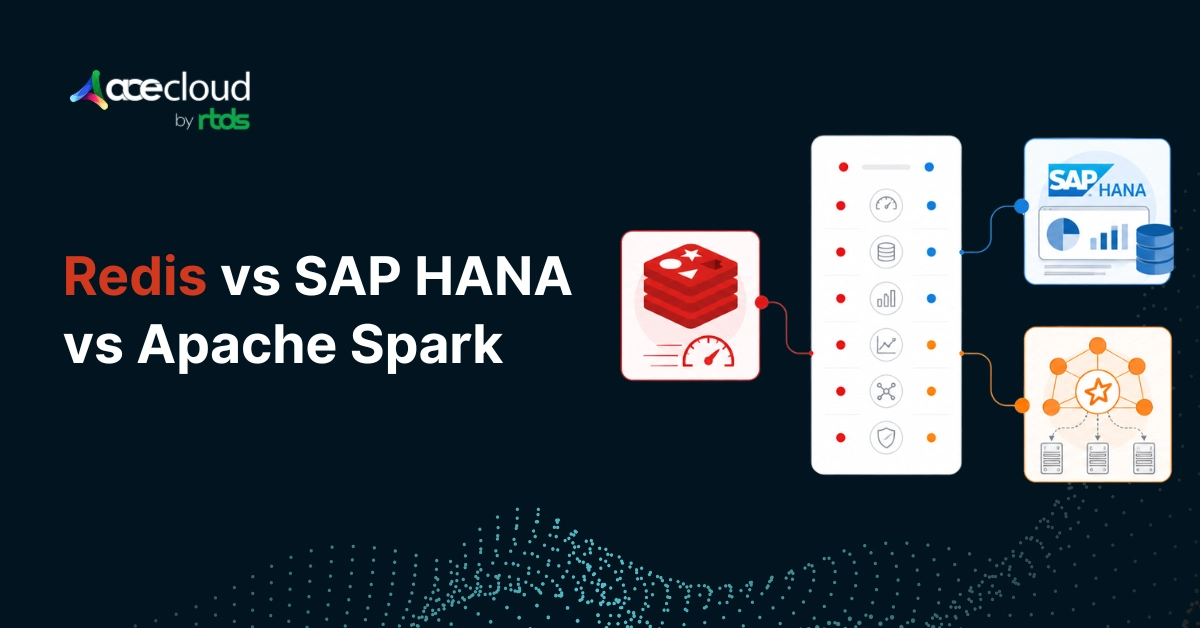
However, Redis, SAP HANA, and Apache Spark are not competing products in a single category.
- Redis is an in-memory data structure store used for caching, session storage, counters, queues/streams, real-time application state, vector use cases and low-latency operational access.
- SAP HANA is an enterprise in-memory, column-oriented, multi-model database designed for governed transactions and analytics on business data, especially in SAP-centric environments.
- Apache Spark is a distributed processing engine built for large-scale ETL, machine learning, batch processing and streaming analytics; it uses memory to accelerate distributed computation, but it is not an operational in-memory database or request-time cache.
The right choice depends on the workload pattern:
- Choose Redis when latency is the main problem.
- Choose SAP HANA when enterprise transactional analytics are the priority.
- Choose Apache Spark when distributed data processing, ETL, ML pipelines, batch analytics or streaming throughput at scale is the challenge.
This decision is also becoming more strategic because Gartner estimates worldwide end-user spending on AI-optimized IaaS will reach $18.3 billion in 2025 and $37.5 billion in 2026.
Quick Comparison: Redis vs SAP HANA vs Apache Spark
Below is the side-by-side comparison table that you can use to quickly map each platform to the workload requirement, infrastructure pattern, and buyer team it serves best.
| Evaluation Criteria | Redis | SAP HANA | Apache Spark |
|---|---|---|---|
| Core category | In-memory cache and operational data store | Enterprise in-memory database | Distributed data processing engine |
| Primary infrastructure role | Low-latency app access, caching, sessions, queues, real-time state | SAP workloads, ERP analytics, OLTP, OLAP, governed enterprise data | ETL, data lakes, ML pipelines, batch and streaming analytics |
| Best-fit workload | Excellent for sub-ms or millisecond reads/writes | Strong for real-time enterprise queries | Weak for request-response latency |
| Ultra-low-latency reads/writes | Excellent | Good | Weak for app-level latency |
| Throughput-oriented processing | Strong | Strong | Excellent |
| Enterprise transactional analytics | Weak to Medium | Excellent | Medium |
| Large-scale ETL | Weak | Medium | Excellent |
| Real-time cache layer | Excellent | Weak | Weak |
| SQL analytics | Limited | Excellent | Excellent |
| ML and AI pipelines | Medium | Medium | Excellent |
| Streaming analytics | Medium | Medium | Excellent |
| Memory architecture | RAM-first, with optional SSD/flash tiering | In-memory column store with warm data tiering | Executor memory, storage memory, shuffle memory |
| Memory tiering | Strong | Strong | Cluster-dependent |
| Scaling model | Sharding, clustering, replicas | Mostly scale-up, with scale-out options | Horizontal scale-out across workers and executors |
| Persistence and durability | Optional persistence, often paired with a primary database | Strong database persistence with logs, backups, HA, DR | Depends on storage, checkpoints, lineage, and job design |
| Primary infrastructure bottleneck | Memory-optimized VMs, low-latency network, fast replicas | Certified memory-optimized or bare metal infrastructure | Distributed clusters, high-memory workers, fast network and storage |
| Main bottlenecks | Hot keys, memory pressure, shard imbalance, replication lag | Memory sizing, storage I/O, data tiering, backup and HA design | Shuffle spills, executor OOM, JVM pressure, skewed partitions |
| Cost risk | Large replicated RAM datasets can get expensive | High infra and licensing expectations | Idle clusters and inefficient jobs can waste spend |
| Not ideal for | Complex SQL analytics or SAP-native transactions | Simple caching or lightweight app acceleration | Sub-ms cache access or transactional enterprise databases |
| Choose when | Latency is the main problem | Governed enterprise analytics are the priority | Distributed data processing is the challenge |
Key Takeaways:
- Redis is the best choice when applications need fast access to hot operational data such as cache entries, sessions, counters, queues, leaderboards, or real-time state.
- SAP HANA is the best choice when enterprises need governed in-memory transactions and analytics for SAP, ERP, finance, supply chain, and business reporting workloads.
- Apache Spark is the best choice when teams need distributed throughput for ETL, data lake processing, ML pipelines, batch analytics, and streaming workloads.
The simplest decision rule: choose Redis for latency, SAP HANA for enterprise transactional analytics, and Apache Spark for distributed processing at scale.
When to Choose Redis for High-Memory Workloads?
Choose Redis when latency is the primary problem. Redis performs best when applications need fast access to hot operational data: cached objects, sessions, queues, counters, rate limits, gaming leaderboards, recommendation features, semantic cache results, or vector search lookups.
Infrastructure for Redis should prioritize RAM, low-latency networking, CPU throughput, shard planning, replication, and monitoring. For smaller caches, general-purpose instances may be enough. For larger datasets, memory-optimized instances, clustering, sharding, and replication become important.
How Redis manages memory and tiering?
Redis is RAM-first by default, which supports low latency when hot data stays memory-resident. In Redis Enterprise deployments, Auto Tiering can place frequently accessed hot data in DRAM while keeping warm data on SSD to reduce DRAM pressure. This pattern matters when datasets grow faster than budget, but you still need fast access for a subset of keys.
Redis limitations
Redis is not the best choice for complex enterprise relational analytics, SAP-native transactions, or large-scale batch processing. It can also become expensive when every copy of a large dataset must remain fully in RAM.
When to Choose SAP HANA for High-Memory Workloads?
Choose SAP HANA when the workload is enterprise-critical and requires governed, real-time transactional and analytical processing. It is a strong fit for SAP S/4HANA, ERP analytics, financial reporting, supply chain analytics, enterprise BI, OLTP, OLAP, and business workloads that need consistency and fast analytical access on operational data.
SAP HANA’s columnar in-memory architecture improves analytical scan efficiency because data is organized by columns rather than rows, while HANA also supports transactional workloads in the same system. This matters for reporting and analytics because queries often scan a subset of columns across large datasets. SAP documentation states that HANA can run OLTP and OLAP on one system without the need for redundant data storage or aggregates, which can reduce the need for separate operational and analytical copies in SAP-centric designs.
How SAP HANA’s columnar in-memory architecture helps?
SAP HANA is a column-oriented in-memory database, which improves scan efficiency for analytics while still supporting transactions. Columnar storage reduces unnecessary reads when queries touch a subset of columns, which helps reporting workloads that aggregate large tables.
How SAP HANA data tiering and Native Storage Extension help?
Enterprise datasets rarely stay “hot” forever, which makes tiering a core cost control lever. SAP HANA Native Storage Extension, often called Native Storage Extension (NSE), is positioned as a built-in disk extension that can process warm data stored on disk. This approach can reduce memory footprint while keeping warm data accessible through HANA database semantics, but it still requires careful data classification, sizing and performance testing.
SAP HANA limitations
SAP HANA is not a lightweight cache replacement. It requires SAP expertise, certified infrastructure choices, sizing discipline, storage planning, backup design, HA, DR, and governance.
When to Choose Apache Spark for High-Memory Workloads?
Choose Apache Spark when the workload is defined by distributed data volume, data transformation and throughput, not per-request application latency. Spark is ideal for ETL pipelines, batch analytics, data lake processing, ML feature engineering, streaming analytics, log analytics, IoT analytics, and large joins or aggregations.
How Spark use execution memory and storage memory?
Spark uses execution memory for compute-heavy tasks like shuffles, joins, sorts, and aggregations. It uses storage memory for caching data that will be reused across stages, such as cached DataFrames. Execution and storage memory share a unified memory pool, which means mis-sizing, skew or excessive caching can cause spills, garbage collection pressure and expensive recomputation under pressure.
Why is Spark not a low-latency application cache?
Spark is not an in-memory database that serves per-request operational traffic. It uses memory to accelerate distributed computation and it prioritizes throughput over micro-latency. For that reason, Spark is a weak fit for session state, leaderboards, and request-time caching.
Spark limitations
Spark can fail or become expensive at scale when partitioning is poor, executor memory is misconfigured, shuffle is heavy, joins are skewed or storage/network throughput is insufficient. JVM heap pressure can also lead to garbage collection overhead and spills to disk, which increases job runtime variance.
Design and scale high-memory workloads with AceCloud infrastructure built for low-latency caching, enterprise analytics, distributed processing, managed Redis, storage, networking and Kubernetes-ready deployments.
Comparing Redis, SAP HANA and Apache Spark in a Decision Matrix
The cleanest way to compare these technologies is by workload type.
| Workload Type | Best Choice | Why |
|---|---|---|
| Real-time cache | Redis | Designed for fast operational access |
| Session storage | Redis | Low-latency key-value access |
| Leaderboards and counters | Redis | Fast updates and reads |
| ERP analytics | SAP HANA | Built for SAP and enterprise data |
| Finance reporting | SAP HANA | Strong OLTP plus OLAP fit |
| Data lake ETL | Apache Spark | Distributed processing at scale |
| ML feature engineering | Apache Spark | Handles large pipelines and transformations |
| Streaming analytics | Apache Spark | Strong distributed stream processing |
| Semantic caching | Redis | Fast repeated AI query access |
| Large SQL analytics | SAP HANA or Spark | Depends on enterprise context and data scale |
Which Infrastructure Pattern Should Teams Use?
For infrastructure buyers, the most useful question is not only which platform is best, but how each platform should be deployed in a real architecture.
| Infrastructure Pattern | Best For | How It Helps |
|---|---|---|
| Redis + primary database | Cache, sessions, real-time state, hot reads | Redis accelerates hot operational data while the primary database remains the system of record |
| SAP HANA + data lake or storage tier | ERP analytics, finance, supply chain, governed reporting | SAP HANA handles enterprise hot data while warm and cold data can move to lower-cost storage tiers |
| Spark + object storage | ETL, analytics, ML pipelines, data lake processing | Spark processes large datasets stored in object or distributed storage without forcing all data into memory |
| Redis + Spark | Real-time feature serving and AI application acceleration | Spark prepares features or analytics outputs, while Redis serves them with low latency |
| SAP HANA + Spark | Enterprise analytics plus big data processing | SAP HANA manages governed business data, while Spark handles large-scale distributed transformation and enrichment |
How Should Teams Think About Cost and Complexity?
High-memory workloads are expensive because memory is costly, overprovisioning is common, and performance problems often lead teams to add more infrastructure before fixing architecture.
- Redis can be cost-efficient for caching and hot operational access, especially when TTLs, eviction policies and Redis Enterprise tiering keep only the right data in DRAM. But large replicated Redis clusters can become expensive when every shard and replica must live fully in RAM or when persistence/replication multiplies the footprint.
- SAP HANA usually has a higher enterprise infrastructure profile because it requires careful sizing, certified hardware choices, persistent storage, backup, HA, DR, and SAP operational expertise.
- Spark can be cost-efficient for large-scale distributed processing, but poor partitioning, skewed joins, idle clusters, excessive shuffle, and oversized executors can waste resources quickly.
According to Flexera’s 2026 State of the Cloud Report, 85% of organizations cite managing cloud spend as a top cloud challenge, while 82% cite security. This makes cost control especially important for high-memory workloads, where overprovisioned RAM, idle clusters, replicated datasets, and poor tiering can quickly increase infrastructure spend.
Which Infrastructure Should You Choose in the End?
- Choose Redis when latency is the primary constraint and you need fast access to operational data. It fits cache layers, sessions, queues, real-time state, leaderboards, vector lookups, and semantic caching.
- Choose SAP HANA when enterprise consistency, SAP integration, real-time transactions, and governed analytics are the primary constraints. It is designed to support transactional and analytical workloads on enterprise business data, especially in SAP-centric environments.
- Choose Spark when distributed data volume and transforms are the primary constraints. It fits ETL, analytics, streaming pipelines, and ML feature engineering across large datasets.
Ready to Build the Right Infrastructure for High-Memory Workloads?
Choosing between Redis, SAP HANA, and Apache Spark is ultimately an infrastructure decision. Redis needs low-latency memory-first architecture, SAP HANA needs resilient enterprise-grade compute, storage, and networking, and Spark needs distributed clusters built for throughput, scale, and data movement. The wrong setup can increase latency, inflate cloud costs, and slow business-critical workloads.
AceCloud helps teams design and deploy scalable cloud infrastructure for high-memory, data-intensive, and AI-driven workloads, with compute, storage, networking, managed Kubernetes, managed Redis, and migration support tailored to your workload pattern.
Book a free consultation with AceCloud or talk to an expert to evaluate your Redis, SAP HANA, or Spark infrastructure strategy.
Frequently Asked Questions
The best infrastructure depends on the workload shape and the success metric.
- Redis is best for real-time application memory and operational state.
- SAP HANA is best for enterprise in-memory transactions and analytics with governance.
- Apache Spark is best for distributed data processing, including ETL, streaming, and ML pipelines.
Yes, Redis is strong for high-memory workloads that need fast access to hot operational data, but cost and resilience depend on sharding, replication, persistence, tiering and eviction strategy. You should use it for caching, sessions, counters, streams/queues, vectors, semantic caching and real-time state where low latency matters.
SAP HANA is an in-memory, column-oriented, multi-model database designed for transactions and analytics in a single system. SAP positions it as an in-memory-first database that stores and processes data primarily in memory while using persistence, logs and storage extensions for durability and warm-data management.
Yes, Spark can be memory intensive because shuffles, joins, sorts, aggregations, caching, and ML workloads all use executor memory. If memory is undersized or partitioning is poor, Spark can spill to disk, trigger garbage collection pressure or recompute cached data, which usually increases runtime variance and cost.
Usually, no, because Redis and SAP HANA solve different categories of problems and have different persistence, query, transaction and governance models. Redis is for operational low-latency access patterns, while SAP HANA is for enterprise transactional and analytical database workloads with SAP integration.
No, Spark is a distributed processing engine, not a sub-millisecond operational cache. You should not use Spark for session storage or request-time caching because it is not designed for that access pattern.
Spark can replace some large-scale analytical processing workloads, especially data lake transforms and offline pipelines. However, it does not replace SAP-native transactional workloads that depend on SAP HANA semantics, SAP application integration, governance and operational consistency.
Cost depends on the workload and the operational model. Redis can be cost-efficient when you tier warm data and keep only hot keys in RAM. Spark can be cost-efficient when you scale clusters to job windows and use durable storage efficiently. SAP HANA is typically justified by enterprise SAP workload value, governed real-time analytics, transactional consistency and the cost of availability, compliance and operational integration.