For a while, the AI conversation was mostly about generation: writing emails faster, summarizing documents, producing code, and creating images on demand. Indeed, that is still a huge part of the story. But the conversation has shifted.
More teams now want systems that can act, work through steps, use tools, and move toward a business outcome. That is exactly why terms like Generative AI, AI Agents, and Agentic AI are being used so often and so loosely.
If you ask us, that distinction matters.
You see, if you call everything ‘agentic AI’, you risk overengineering simple workflows and setting the wrong expectations. If you treat every tool-using assistant like a full agentic system, you blur the difference between a narrow task executor and a broader goal-seeking architecture.
The better question is not which label sounds more advanced. It is: what level of autonomy does your workflow actually need?
Summary: Generative AI vs. AI Agents vs. Agentic AI
Let’s summarize the differences between the three forms of AI implementation in a business organization.
Generative AI
Generative AI is an AI that produces content (text, images, audio, code, summaries, and similar outputs) from prompts and learned patterns. It is designed to turn intent into an answer or artifact quickly, which is why it became the first widely adopted layer of modern AI in business.
AI Agent
An AI agent is a system that can do more than respond. It can use tools, call APIs, fetch data, maintain task state, and make bounded decisions to complete a task. An AI Call Assistant is a practical example of an AI agent that can handle customer interactions, automate phone conversations, and perform tasks based on user requests. You can also refer to AI agents as applications that plan, call tools, collaborate across specialists, and keep enough state to complete multi-step work. In other words, agents are models that autonomously use tools in a loop.
Agentic AI
Agentic AI is a broader, goal-oriented pattern. It can plan, break work into steps, adapt to changing conditions, use memory across stages, and sometimes coordinate multiple agents or systems to achieve an outcome. An explicit distinction of AI agents from agentic AI can be framed like this: agentic AI as a more advanced paradigm marked by dynamic task decomposition, persistent memory, multi-agent collaboration, and coordinated autonomy.
Takeaway: Generative AI creates outputs. AI agents execute tasks. Agentic AI drives toward outcomes.
What Is Generative AI?
Generative AI works by producing content from patterns learned during training plus the context supplied at runtime.
In practice, that means a user provides a prompt, instructions, examples, or constraints, and the model generates a response, i.e., a paragraph, an image, a summary, a spreadsheet formula, or a code snippet.

(Source: GeeksforGeeks)
The interaction model is usually simple: prompt in, output out.
Advantages
Its strength is creation. It can draft articles, summarize meeting notes, explain technical concepts, rewrite content for a different audience, translate text, produce marketing copy, and generate code drafts.
That usefulness is one reason adoption rose so sharply. Stanford HAI’s 2025 AI Index reported that 78% of organizations used AI in at least one business function in 2024, up from 55% in 2023.
The reported generative AI use in at least one business function doubled from 33% to 71% over the same period.
Limitations
Generative AI does not automatically verify facts, decide whether something should happen in a business system, or reliably manage a multi-step process from beginning to end.
It may give a smart recommendation, but that is not the same as performing the work. In most implementations, it remains reactive: it waits for the user’s request and responds, rather than independently managing progress toward a goal.
NOTE:The easiest way to think about generative AI is as a highly capable creator or assistant at the keyboard. It helps you produce faster. It does not inherently operate like an autonomous worker.
What Is an AI Agent?
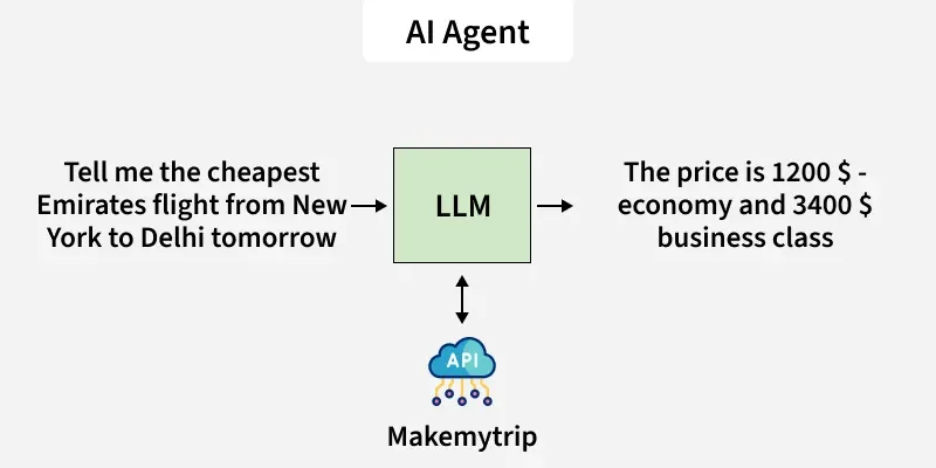
AI agents mark the move from generation to execution. Instead of only answering with text, an agent can decide which tool to use, retrieve the right data, interact with software, and complete a defined task.
Core components
- Most agents combine a reasoning model, instructions or an objective, tool access, task state, and a control loop.
- The model determines what to do next, whether a tool is needed, what data to fetch, and when the task is finished or should be handed off.
- That architecture is what separates an agent from a one-shot chatbot or a plain prompt template.
Examples of AI agents
- A customer support agent can look up order status, check policy, and draft a response. A customer support agent can look up order status, check policy, and draft a response. Zendesk built this pattern into its platform as AI agents for customer service, which resolve routine requests end to end and hand the rest to a human with full conversation context.
- A recruiting agent can screen profiles against role criteria and schedule shortlisted candidates.
- A finance operations agent can gather invoice data, compare it with purchase orders, and flag mismatches.
In all three cases, the system is not just producing text. It is carrying out bounded work with tools.
Also Read: AI Agent vs Large Language Models
Limitations
Many AI agents are still bounded systems. They may be excellent inside a narrow operational scope, but that does not automatically make them ‘agentic’ in the broader sense.
A refund-handling agent, for example, may solve one class of problem very well without becoming a system that can autonomously pursue a wider business goal across changing conditions.
NOTE: An AI agent is best understood as a specialized digital worker. It can do things, not just say things, but it is usually hired for a specific job.
What Is Agentic AI?
Agentic AI is where the center of gravity moves from a discrete task to a broader goal. Instead of stopping after a single action or response, the system can decide what sub-steps are needed, execute them in sequence, react to what happens, and continue until it reaches an outcome or needs human input.

That is why agentic AI is often described as proactive rather than merely reactive. A system becomes agentic when it can decompose goals into sub-tasks, use tools across stages, maintain memory or state, adapt when conditions change, and sometimes coordinate multiple specialist agents.
Examples of agentic AI
- A travel-planning system that works through policy, budget, calendar constraints, and bookings
- A research workflow that gathers evidence, compares sources, drafts findings, and asks for approval before publishing
- A cross-system service flow that investigates a customer issue, triggers follow-up actions, and closes the loop end to end.
If an AI agent is a digital worker, agentic AI is closer to a self-directed operator or orchestrator. It is not just focused on one action. It is managing the route to the result.
Also read: Best Agentic AI Frameworks for Production Scale
When NOT to use Agentic AI
You should not reach for agentic AI when the workflow is fixed, deterministic, and well understood. It is also the wrong choice when the cost of mistakes is high but the organization lacks approvals, narrow permissions, or reliable evaluation. In many cases, a workflow or a bounded agent will deliver better value with less operational risk.
Sometimes the smarter solution is not more autonomy, but better workflow design.
| Situation | Use agentic AI? | Better alternative |
|---|---|---|
| Fixed, repetitive process | No | Workflow or traditional automation |
| Simple tool-calling task | Usually no | AI agent |
| High-risk environment without guardrails | No | Human-led or tightly controlled workflow |
| Multi-step, changing process | Yes, potentially | Agentic AI with approvals |
NOTE: Agentic AI may include one or more agents, but it usually refers to system-level behavior, not just the existence of tool use. In other words, not every agent is part of a truly agentic system, and not every tool-using chatbot deserves the label.
AI Workflow vs. AI Agent vs. Agentic AI: The Difference Most Skip
Now that you know the basic differences between the three, let’s dive deeper to learn the differences between AI workflow, AI agent and agentic AI.
AI workflow
An AI workflow follows a largely predetermined path. The logic is mostly designed in advance: classify the input, retrieve the right information, generate the output, then send it for review or onward processing. Workflows are often the best answer when the path is known and repeatable.
AI agent
An AI agent adds dynamic choice inside a bounded scope. It can decide which tool to call, what information to retrieve, and how to complete the task, but it still operates inside a defined domain. The path is more flexible than a workflow, yet still limited by the agent’s scope and permissions.
Agentic AI
Agentic AI extends that flexibility to broader goals and longer horizons. It may coordinate multiple tools, tasks, or agents, revise plans as conditions change, and rely more heavily on ongoing state and orchestration. The process is less predefined and more adaptive.
| Type | Path | Decision-making | Best use case | Example |
|---|---|---|---|---|
| AI Workflow | Predefined | Low | Repeatable, structured processes | Classify, then retrieve, then summarize |
| AI Agent | Flexible within scope | Medium | Task execution with tools | Support agent checking order status |
| Agentic AI | Dynamic and evolving | High | Goal-oriented orchestration | End-to-end travel planning |
Rule of Thumb:If the path is known, start with a workflow. If the task varies but stays bounded, use an agent. If the goal is complex, evolving, and multi-step, then agentic AI may be justified.
Side-by-Side Comparison: Generative AI vs. AI Agents vs. Agentic AI
The differences become much clearer when you compare the three across autonomy, tool use, memory, and fit-for-purpose. The table below is a synthesis of the distinctions:
| Criteria | Generative AI | AI Agents | Agentic AI |
|---|---|---|---|
| Primary purpose | Create content | Execute bounded tasks | Achieve outcomes |
| Core focus | Output generation | Task completion | Goal orchestration |
| Autonomy level | Low | Medium | High |
| Tool usage | Limited or optional | Yes, within scope | Extensive, often multi-step |
| Memory / state | Mostly prompt-level | Task-level context | Persistent, cross-step context |
| Human involvement | High | Moderate | Lower, with approvals and guardrails |
| Best for | Writing, summarizing, ideation | Support, scheduling, retrieval, actions | Adaptive workflows, orchestration, planning |
| Typical behavior | Reactive | Semi-autonomous | Proactive and adaptive |
| Main risk | Hallucinations | Wrong tool or action | Compound errors, overreach |
Takeaway: Generative AI is mostly reactive and output-driven. AI agents are tool-using and task-driven. Agentic AI is adaptive and outcome-driven.
Running Example: How Each Would Handle the Same Task
To understand the differences practically, imagine the request: ‘Plan my business trip to Singapore next month under a fixed budget.’
How generative AI handles it (content generation)
A generative AI system can suggest airlines, recommend hotel areas, draft an itinerary, build a packing list, and even write the approval email to your manager. That is useful, but it still leaves the execution to you.
How an AI agent handles it (bounded execution)
An AI agent can go further. It can search flights, compare prices, check company travel policy, and build a shortlist. Depending on permissions, it may even reserve the chosen option after approval. Now the system is not just suggesting ideas; it is using tools to carry out a defined travel-planning task.
How agentic AI handles it (adaptive orchestration)
An agentic AI system handles the outcome more end-to-end. It can check the calendar, understand the budget, factor in loyalty preferences, watch for price changes, revise the plan if fares jump, request approval at the right time, book when cleared, update the itinerary, and send reminders. That is the jump from assistance to orchestration.
Seen side by side, the shift in autonomy is obvious:
| System Type | What it does in the trip-planning scenario |
|---|---|
| Generative AI | Suggests flights, hotels, itinerary ideas, and a packing list |
| AI Agent | Compares prices, checks travel policy, builds a shortlist, may reserve after approval |
| Agentic AI | Reads calendar, tracks budget, adapts to price changes, seeks approval, books, updates itinerary |
Real-World Use Cases: When Each Technology Makes Sense
Let’s discuss the real-world applications of generative AI, agentic AI, and AI agents.
Best use cases for generative AI
Generative AI is a strong fit for blog drafting, summarization, ideation, translation, documentation, code drafting, and marketing copy. It creates leverage when the bottleneck is producing or reshaping information.
Best use cases for AI agents
AI agents fit better when the value comes from task execution. It is excellent for customer support actions, scheduling, operational data retrieval, internal help desk workflows, sales prep, and other bounded processes that need tool access and some decision-making.
Best use cases for agentic AI
Agentic AI makes more sense for research automation, cross-system case resolution, supply-chain exception handling, claims processing, travel orchestration, and other multi-step workflows where the path changes based on new information. These are not just tasks. They are processes with branching decisions and feedback loops.
Also read: Best Cloud Platforms for Agentic AI Infrastructure
This practical mapping will help you choose faster:
| Technology | Best use cases | Not ideal for |
|---|---|---|
| Generative AI | Content creation, summaries, translation, code drafts, ideation | Execution-heavy, multi-step workflows |
| AI Agents | Help desk actions, scheduling, data retrieval, bounded automation | Open-ended strategy, long-horizon orchestration |
| Agentic AI | Research automation, supply-chain exceptions, claims workflows, travel orchestration | Fixed, deterministic processes |
NOTE:The more autonomy you add, the stronger guardrails, monitoring, and human oversight you will need.
Risks, Governance, and Evaluation: What the Hype Pieces Miss
As soon as AI can call tools and act on external systems, the risk surface expands. Risks now include hallucinations, tool misuse, prompt injection, excessive autonomy, data leakage, and silent failure across long chains of actions. NIST has specifically highlighted agent hijacking, where malicious instructions embedded in encountered content can redirect an agent toward unintended behavior.
Why agentic systems need stronger guardrails
Agentic systems need stronger controls because the consequences are no longer limited to a poor paragraph or an inaccurate summary. A flawed decision can trigger an external action, expose data, or create downstream errors across multiple systems. More tools and longer chains mean more ways to fail.
What good governance looks like
Good governance means input and output controls, tool constraints, human approval for sensitive actions, scoped permissions, traces, logs, and clear escalation rules. OpenAI’s current agent guidance explicitly recommends approvals and guardrails as part of production agent design, not as optional extras.
How to evaluate these systems
You do not evaluate agentic systems only on answer quality. You also need to test tool choice, task completion, reliability, policy compliance, and recovery from failure.
OpenAI emphasize traces, state, orchestration, and structured runtime behavior precisely because multi-step systems fail in more ways than simple chat systems do. The most useful way to present this section is by pairing risks with safeguards:
| Risk | Example | Mitigation |
|---|---|---|
| Hallucination | Wrong recommendation or fabricated information | Verification, grounding, human review |
| Tool misuse | Wrong API call or system action | Permissions, tool constraints, approvals |
| Prompt injection / hijacking | Malicious hidden instructions influence behavior | Input filtering, isolation, monitoring |
| Excessive autonomy | Acting without the right approval | Human checkpoints, scoped permissions |
| Silent failure | Multi-step process goes off track unnoticed | Tracing, alerts, evals, logging |
How to Choose the Right Approach for Your Business?
Not sure how to go about choosing between Generative AI, Agentic AI, and AI Agents? This is for you:
Choose generative AI if
Choose generative AI when your main need is content creation, summarization, ideation, translation, or knowledge assistance. It is often the best first step because it offers the fastest path to productivity gains with relatively low system complexity.
Choose an AI agent if
Choose an AI agent when you need execution with tools inside a defined scope, i.e. retrieving data, routing requests, scheduling, updating records, or handling bounded operational workflows.
Choose agentic AI if
Choose agentic AI when the work requires multi-step planning, adaptation, memory, and coordination across systems or sub-tasks, especially when the path to the goal cannot be fully hard-coded in advance.
Questions to ask before a decision
Ask six practical questions:
- Is the task predictable?
- Does it need tools?
- Does it require memory?
- Does it need to adapt mid-process?
- What happens if it makes a wrong move?
- Where must a human approve?
Those questions usually matter more than the label you put on the system.
| If your need is to | Choose |
|---|---|
| Generate content or insights | Generative AI |
| Complete a bounded task with tools | AI Agent |
| Manage a multi-step, adaptive goal | Agentic AI |
Make Most of Agentic AI with AceCloud
Generative AI, AI agents, and agentic AI are connected, but they are not interchangeable. Generative AI is best at creating. AI agents are best at doing. Agentic AI is best at orchestrating toward outcomes.
However, the strongest systems are not the ones with the highest autonomy on paper. They are the ones with the right autonomy for the job, the right guardrails for the risk, and the right architecture for the workflow.
Are you looking to leverage Agentic AI for your organization? We can help you develop and deploy an end-to-end enterprise Agentic AI system. Simply book your free consultation and connect with our Agentic AI and cloud experts. Get connected to discover AI-driven growth opportunities!
Frequently Asked Questions
No. AI agents are usually task-focused systems that can use tools to complete bounded work, while agentic AI refers to broader, goal-oriented systems that can plan, adapt, and sometimes coordinate multiple agents or workflows.
Generative AI mainly creates outputs like text, images, code, or summaries. Agentic AI goes further by planning actions, using tools, and driving toward outcomes across multiple steps.
Yes. In many real-world systems, a generative model is one component inside an agent or agentic system, where it helps reason, write, summarize, or decide what to do next.
Use AI agents when the system needs to do more than generate content — for example, retrieve data, call tools, update systems, or complete a bounded operational task.
Avoid agentic AI for fixed, deterministic, low-variance workflows where a standard automation or simpler AI workflow will do the job more reliably and cheaply.
Examples include travel orchestration, research automation, claims handling, supply-chain exception management, and cross-system customer issue resolution.
The biggest risks include hallucinations, tool misuse, prompt injection, excessive autonomy, data leakage, and silent failures in multi-step processes.
A workflow follows a predefined path, while an AI agent has more flexibility to choose tools and actions within a defined scope.