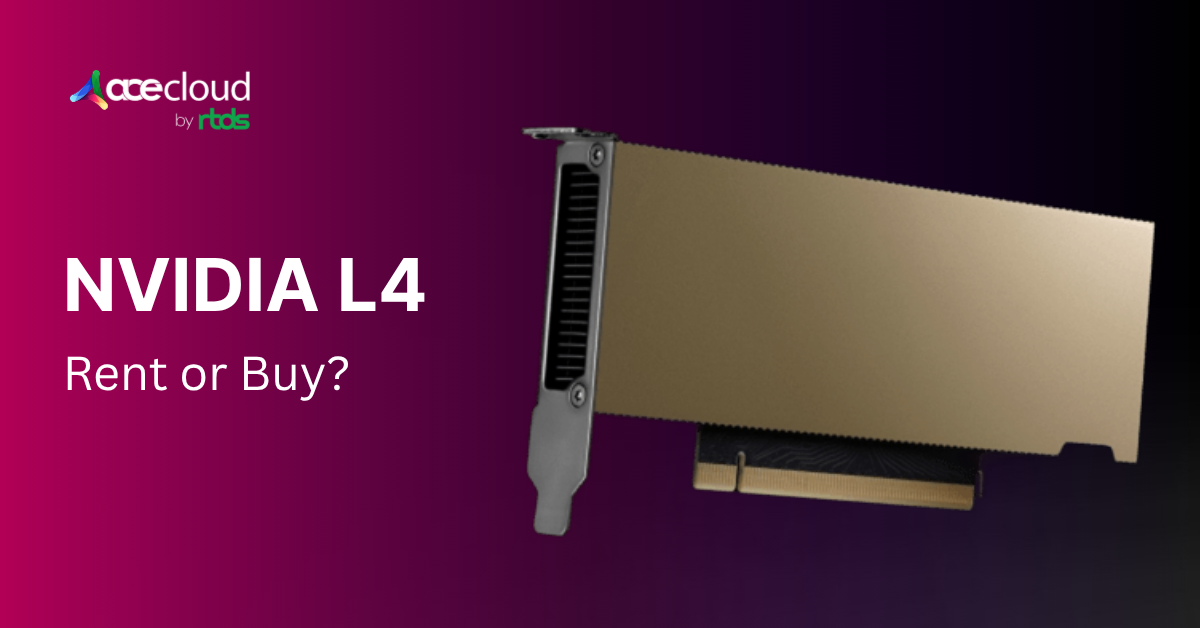
If you are considering buying or renting NVIDIA L4 GPU in India, you are on the right track. It is a low-profile Ada Lovelace tensor core GPU engineered for AI inference, media processing and graphics-intensive pipelines.
To answer the question, NVIDIA L4 price in India changes quite drastically if you move from buying to renting. If you expect more than about 2,000 hours per year on a single L4, buying often becomes cheaper. However, renting remains attractive for unpredictable bursts, pilot phases and multi-region presence.
The GPU is rentable today on mainstream clouds in Mumbai and across additional AWS regions, which compresses pilots and de-risks procurement. As a result, your rent or buy decision becomes a utilization and governance question rather than an availability problem, enabling a faster, lower-risk path to production.
What is NVIDIA L4?
The NVIDIA L4 is a low-power inference accelerator optimized for AI inference, AI-generated video, vector database queries and real-time avatars. It offers FP8 tensor performance up to 485 TFLOPS and INT8 throughput up to 485 TOPS, with NVENC 2, NVDEC 4 and four JPEG decoders that reduce CPU dependency in video pipelines.
Moreover, it has 24 GB GDDR6, 300 GB/s bandwidth, two NVENC encoders, four NVDEC engines, four JPEG decoders and a 72 W TDP on PCIe Gen4 x16. It is used for LLM inference, vector search, digital avatars and high-density video transformation where latency and density targets must be met reliably.
Compared to T4, NVIDIA reports large uplifts in media and graphics performance on L4 that translate to denser nodes and lower latency. Thus, Indian startups, AI R&D labs and cloud-native inference teams should evaluate L4 when density, power and availability matter.
How Much it Costs to Buy NVIDIA L4 in India?
In India, public list prices span enterprise resellers and marketplaces. Current examples include ₹2,36,000 and ₹3,62,799 on Amazon India for a PNY L4.
Lead times vary with import cycles and distribution allotments, so you should confirm stock, delivery windows and RMA terms. For global context, US list prices range roughly $2,539–$3,499, depending on channel and condition.
Therefore, procurement of AI inference hardware in India should model landed cost including customs, GST and any extended warranty where uptime and advance replacement are material to SLAs.
What are Current Rental Prices in India and Globally?
To benchmark opex, map hourly or monthly rates across Indian providers and global clouds.
- In India, AceCloud offers L4 on managed Kubernetes GPU clusters with a starting price of ₹41.92 per GPU-hour and its comparison blog shows monthly L4 from ₹25,500 (with 8 vCPUs and 32GB RAM).
- E2E Networks publishes an L4 plan at ₹50 per hour on its public pricing page.
- Neysa’s September 3, 2025 post cites $1.5/hour on-demand and $800/month reserved for L4.
- Globally, Runpod advertises L4 from $0.39/hour.
- On hyperscalers, Google Cloud exposes L4 through G2 machine types, with third-party trackers showing g2-standard-4 in Mumbai around $0.736/hour on-demand.
- AWS G6 instances use NVIDIA L4, with the g6.xlarge commonly listed near $0.8048/hour by pricing trackers.
Disclaimer: GPU-as-a-Service (GPUaaS) rates fluctuate by region, commitments and spot availability, so you should validate your dates and zones.
When Does Renting Beat Buying and Vice Versa?
To decide confidently, let’s use a simple total cost of ownership model that links utilization to cash outlay.
We will use model inputs like GPU price, host allocation, power, support and expected rented hours with the negotiated hourly rate.
Let’s first convert capex to an annual figure by amortizing over three to four years based on refresh policy. Then compare that annualized number to rental opex computed from hours multiplied by the effective rate.
Illustrative Capex
- Assume ₹2,40,000 for one L4 plus ₹1,50,000 as your share of a qualified server and networking.
- Add ₹36,000 per year for support, cooling and power, given the L4’s 72 W envelope.
- These assumptions yield roughly ₹1,33,500 per year when amortized across four years.
Illustrative Opex
If you rent at ₹50–₹75 per hour, multiply it by your expected hours.
Case A: 500 hours per month
At about 6,000 hours per year, renting totals ₹3,00,000–₹4,50,000, which exceeds the annualized capex above. Therefore, buying is favorable when you can sustain that utilization and maintain operational readiness.
Case B: 24×7 inference
At 8,760 hours per year, renting reaches ₹4,38,000–₹6,57,000, which widens the advantage for owned hardware. Savings improve further if you depreciate the host longer or secure lower GPU procurement costs.
Decision threshold
A practical rule is this: if you expect more than about 2,000 hours per year on a single L4, buying often becomes cheaper.
Let’s find out how we reached this conclusion.
Inputs you can audit
- L4 card price is ₹240,000, host share is ₹150,000, and annual power, cooling and support is ₹36,000.
- Assuming amortization horizon is 4 years.
- The realistic rental band in India ₹50–₹75 per hour after storage, images, orchestration and support are considered.
Let’s combine the L4 at ₹240,000 with a ₹150,000 server share, which totals ₹390,000 per GPU.
Amortized across four years, capex contributes ₹97,500 per year, adding ₹36,000 for operations yields ₹133,500 per year.
Let’s call this annual ownership cost C = ₹133,500.
Here’s the break-even formula you can use:
H = (Ownership Cost, C) / (Effective Rental Rate, R)
- For effective rental rate of ₹50/h = (₹133,500 ÷ ₹50/hr = 2,670) hours.
- For effective rental rate of ₹60/h = (₹133,500 ÷ ₹60/hr = 2,225 ) hours.
- Similarly, for effective rental rate of ₹65/h, the break-even point is2,054 hours.
- For effective rental rate of ₹70/h, the break-even point is~1,907 hours.
- And for effective rental rate of ₹75/h, you break-even at 1,780 hours.
Equivalently, at 2,000 hours your ownership cost per hour is
C ÷ 2,000 = ₹133,500 ÷ 2,000hrs = ₹66.75/h,
So, renting is cheaper below ₹66.75/h, and buying is cheaper above it.
What this means for your decision
If your effective rate typically lands ₹65–₹70/h, your break-even falls between ~1,900 and ~2,050 hours, which communicates cleanly as “about 2,000 hours per year.”
However, renting remains attractive for unpredictable bursts, pilot phases and multi-region presence.
Note: You should include soft costs such as staff time, change windows and downtime exposure because these affect realized benefits.
What Infrastructure Is Required to Run an L4 On-Prem?
To avoid surprises, validate mechanical, thermal and software readiness before placing orders.
- You need a server with a PCIe Gen4 x16 slot and chassis airflow that supports a passive, single-slot, low-profile card. Plan for 72 W per GPU plus headroom for CPUs, memory and fans so the PSU remains within efficient curves.
- Many 1U and 2U designs accept one to four L4s, while larger chassis support six to eight with appropriate risers. Confirm bracket type, airflow direction and spacer kits with your integrator to reduce rework during installation.
- On the software side, standard Linux distributions with supported NVIDIA drivers and CUDA deliver a predictable base layer.
For observability, pair DCGM with node exporters so your team tracks utilization, thermals and encoder usage across clusters.
L4 vs T4, A10 and L40S: India Inference Benchmarks
To match the right GPU to the right workload, you should compare by memory, media engines and precision support.
- L4 brings FP8 and INT8 acceleration with 24 GB memory plus newer NVENC and NVDEC blocks that strengthen media AI.
- T4 remains a capable baseline with 16 GB memory and older media engines, yet it trails in video and transformer serving. NVIDIA guide show significant L4 uplifts over T4 in media and graphics.
- A10 and L40S deliver higher absolute performance and bandwidth for heavier models or mixed training, though they cost more to rent or buy.
As a result, choose L4 for inference-heavy, media-rich workloads where power, space and time to deploy are constrained. Choose A10 or L40S when you need bigger context windows, higher batch sizes or limited fine-tuning without cluster sprawl.
Key Takeaway
Purchase if utilization is high, workloads are steady and infrastructure is ready. Rent if usage is variable, budgets are constrained and fast scaling matters. Expect roughly ₹2.36–3.63 lakh to buy or around ₹50/hour in India to rent, with hyperscalers and global GPU clouds charging more per hour but adding integrated services.
If you prefer renting with predictable performance and support, AceCloud provides a 99.99%* uptime SLA, free migration assistance and managed Kubernetes for rapid rollout. You can try our NVIDIA L4 for free with India-denominated pricing and credits or start on managed GPU clusters where L4 begins at ₹41.92/GPU-hour.
Disclaimer: All prices and availability were checked on October 14, 2025. Please verify current rates before purchasing or committing to long-term contracts.
Frequently Asked Questions:
Yes. G2 machine types with L4 are available in asia-south1 (Mumbai).
Yes. AWS lists G6 instances with NVIDIA L4 for inference and graphics.
About ₹2.36–3.63 lakh depending on source and import.
It draws roughly 72 W in a single-slot PCIe form factor with updated NVENC and NVDEC for media-heavy pipelines.