
Artificial intelligence launches come and go, but every so often a model release tells a much bigger story about where a company is heading. Meta Muse Spark is one of those moments. Announced on April 8, 2026, Muse Spark is the first model from Meta Superintelligence Labs, the unit Meta built after reshaping its AI strategy in 2025.
That alone makes it worth watching. What makes it more important is where Meta plans to deploy it. Muse Spark already powers the Meta AI app and meta.ai, and Meta says it will roll out across WhatsApp, Instagram, Facebook, Messenger, and AI glasses in the coming weeks.
What is Meta Muse Spark (Meta AI)?
Meta Muse Spark is the first model in a new Muse family that Meta says is built to support personal superintelligence. In plain terms, Meta is positioning it as a fast, multimodal reasoning model that can help with everyday tasks, visual understanding, and more advanced problem solving.

Meta says Muse Spark is small and fast by design, yet capable enough to reason through complex questions in science, math, and health. It also says the model is purpose-built for Meta products, which means its long-term value is tied as much to distribution as to raw benchmark scores.
That product-first strategy is central to understanding Meta Muse Spark. Meta is not launching this model as a broad open-weight release like Llama 4. Instead, Muse Spark is going straight into consumer products that already have enormous reach.
Why Muse Spark’s release timing matters?
In April 2025, Meta released Llama 4 Scout and Llama 4 Maverick as open-weight multimodal models. But Reuters later reported that Llama 4 had disappointed internally and had been delayed during development because it did not meet expectations on reasoning and math benchmarks.
By mid-2025, Meta had invested $14.3 billion in Scale AI, brought Alexandr Wang into its superintelligence effort, and reorganized its AI work under Meta Superintelligence Labs. Muse Spark is the first visible result of that reset, so the launch carries strategic weight far beyond a normal product update.
Also read: Meta Muse Spark vs Gemini 3.1 Pro vs Sonnet 4.6 vs Opus 4.6 vs GPT 5.2
What are the Key Features of Meta Muse Spark?
Here are some of the key features you can consider when choosing Muse Spark over other LLMs in the market.
Multimodal reasoning, faster answers, and deeper thinking
Meta says Muse Spark upgrades the Meta AI experience with Instant and Thinking modes, so users can choose between quick responses and deeper reasoning depending on the task. The model can also launch multiple subagents in parallel.
Meta’s own example is family trip planning, where separate agents can draft an itinerary, compare destinations, and find kid-friendly activities at the same time.
On the technical side, Meta describes Muse Spark as a natively multimodal reasoning model with tool use, visual chain of thought, and multi-agent orchestration. That combination places Meta Muse Spark firmly in the reasoning-model category rather than the basic assistant category.
Visual understanding is a major selling point
One of the clearest differentiators in the official launch materials is visual perception. Meta says Muse Spark can identify products from a photo, compare alternatives, estimate calorie counts from food images, and help users interpret some charts and health-related visuals.
It also says the model performs strongly in visual coding, allowing people to create lightweight websites, dashboards, and mini-games from prompts.
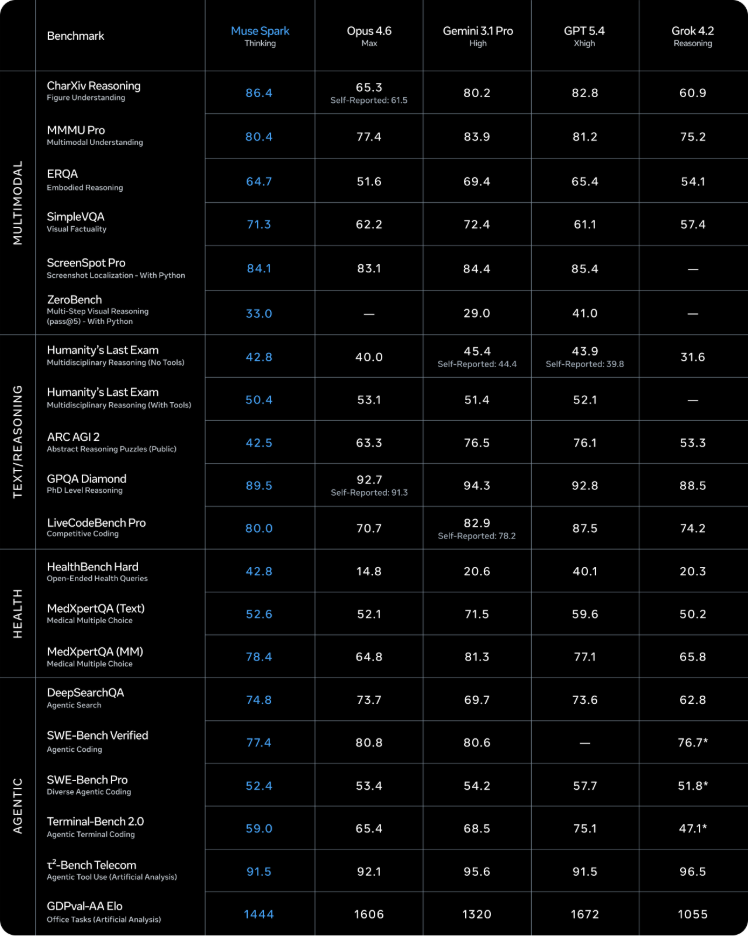
Artificial Analysis supports the idea that vision is one of Muse Spark’s best areas, reporting that the model scored 80.5 percent on MMMU-Pro, making it the second-most capable vision model they had benchmarked at launch.
Real-world Use Cases for Meta Muse Spark
Let’s discuss some of the most practical real-world use cases you can consider before choosing Muse Spark as your go-to model.
A consumer AI assistant embedded in Meta’s ecosystem
The most important use case is also the broadest one. Meta Muse Spark is designed to be the intelligence layer inside Meta AI, not just a model that sits behind an API.
That means users are likely to encounter it while searching for recommendations, asking practical questions, creating media, exploring products, and eventually using AI features across Meta apps and AI glasses.
Meta also says the model will unlock features that cite recommendations and content shared across Instagram, Facebook, and Threads. For Meta, this is a direct path to making AI more social, more personalized, and more native to its ecosystem than a standalone browser chatbot.
Shopping, discovery, and recommendation
Shopping is another major use case. Meta says shopping mode can help users discover what to wear, how to style a room, and what to buy for someone they know, drawing from creator and brand content already flowing through Meta’s apps.
That fits neatly with the company’s broader AI business strategy. In January 2026, Meta said AI was already improving engagement and ad performance across its apps, and in October 2025 it said interactions with its generative AI features would be used to personalize content and ads.
In other words, Meta Muse Spark is not only about helping users choose products. It could also become a powerful bridge between search, recommendation, commerce, and advertising inside Meta’s network.
Health and visual help, with important caveats
Meta is also pushing Muse Spark for health-related assistance. It says health is one of the top reasons people turn to AI, and its launch materials say Muse Spark can provide more detailed responses on some health questions, including questions that involve images and charts.
Meta adds that it collaborated with over 1,000 physicians to improve health reasoning. Still, this is the part of the product that deserves the most caution. A recent WIRED report found troubling results when testing Muse Spark on health inputs, which suggests that better health reasoning does not mean the model should be treated like a doctor.
For readers and businesses alike, this is a good place to separate promising capability from trustworthy clinical use.
Meta Muse Spark Pricing, Access, and Availability
Although we haven’t received a publicly available pricing for Meta Muse Spark, we have collated the details that can help you get started with the AI model.
How to use Meta Muse Spark right now
As of April 2026, Muse Spark is available to consumers through the Meta AI app and meta.ai. Meta says the upgraded experience is starting in the United States there first, with broader rollout to more countries and to Instagram, Facebook, Messenger, WhatsApp, and AI glasses in the coming weeks.
For developers and businesses hoping to build on it directly, the picture is more limited. Meta says Muse Spark will be offered in private preview via API to select partners. The Verge also reports that the API is in private preview rather than public general availability.
What Meta Muse pricing looks like in April 2026
There is still no standard public pricing sheet for Meta Muse Spark. Meta has not announced public token pricing, broad self-serve API access, or a public developer pricing page. There was no public API at the time of publishing, and its provider’s page showed no active public API providers for Muse Spark.
So, the most accurate pricing info is this: public consumer access exists through Meta AI surfaces, while direct API pricing remains unannounced because broad public API access has not launched.
That may disappoint developers, but it also reveals Meta’s current priority. Right now, the company seems more focused on distribution through first-party products than on monetizing Muse Spark as a conventional API.
Meta Muse Spark’s Performance, Benchmarks, and Limitations
Let’s go deeper to understand how Muse Spark performs when stacked against other AI models in the market in 2026.
Where Meta Muse Spark looks strong
Independent benchmarking makes the launch much more credible. Artificial Analysis reported that Muse Spark scored 52 on its Intelligence Index, placing it within the top five models it had benchmarked at launch.
The same analysis found strong reasoning and instruction-following performance, with a 39.9 percent score on HLE and especially strong vision results. Reuters also reported that independent tests showed Muse Spark matching top rivals in some areas. For a model that arrived after a turbulent year for Meta AI, that is a meaningful rebound.
Where it still falls short
Reuters reported that Muse Spark still lags in coding and abstract reasoning relative to the very top frontier systems. Artificial Analysis likewise said its agentic performance does not stand out, noting that the model trails leading rivals on some work-task and terminal benchmarks.
While Meta Muse Spark is clearly competitive, it is not the undisputedly best model on the market. It looks strongest in multimodal consumer use, visual understanding, and broad reasoning, while the long-horizon agentic and coding story still needs work.
Privacy, Safety, and What Users Should Watch
The biggest trust questions around Meta Muse Spark about where the assistant lives and how it fits into Meta’s wider data and product ecosystem. In October 2025, Meta said interactions with its generative AI features would be used to personalize content and ads across its platforms.
It also said users could still adjust what they see through Ads Preferences and feed controls. For anyone using Muse Spark heavily for shopping, interests, or life planning, that matters. The assistant is not floating outside Meta’s ecosystem and is a part of it.
Meta has also tried to show that safety work is advancing alongside capability. On April 7, 2026, it published version 2.0 of its Advanced AI Scaling Framework. Its Muse Spark documentation say the model underwent extensive safety evaluations before deployment because of its reasoning capabilities in dual-use scientific domains.
Beyond model-level safety, Meta has also been integrating AI into its internal risk review process to detect privacy, safety, and security concerns earlier in product development.
That does not remove every concern, but it does show that Meta understands Muse Spark will be judged not just on intelligence, but on reliability, safeguards, and how responsibly it is deployed at scale.
Why Meta Muse Spark Matters in 2026?
Part of what makes this launch so significant is the scale behind it.
- Meta reported full-year 2025 capital expenditures of $72.22 billion, then said it expected 2026 capital expenditures in the range of $115 billion to $135 billion, with growth driven by investments supporting Meta Superintelligence Labs and the core business.
- In March 2026, the company also said it was developing and deploying four new generations of MTIA chips within two years to support ranking, recommendations, and generative AI workloads.
Those numbers make one point very clear. Meta is not treating Muse Spark as a side experiment. It is building the infrastructure to run AI for billions of people.
Is Meta Muse Spark the Future of GenAI?
Meta Muse Spark matters because it represents a shift in how Meta wants AI to work. Instead of releasing another broadly downloadable model and hoping developers carry it forward, Meta is building a tightly integrated assistant that lives inside products people already use every day.
That makes Muse Spark feel less like a research milestone and more like a distribution strategy with intelligence attached. The model already looks strong in multimodal perception, visual reasoning, and consumer-facing use cases.
At the same time, public API access, pricing, advanced coding performance, and health trustworthiness remain open questions. In April 2026, the most accurate verdict is this: Meta Muse Spark is a serious comeback signal for Meta AI. The next phase will depend on how well Meta turns that early momentum into reliable products people actually trust.
Frequently Asked Questions
Meta Muse Spark is Meta’s newest flagship AI model and the first release from Meta Superintelligence Labs. It is designed to power the Meta AI experience across Meta’s apps and services with stronger reasoning, multimodal understanding, and faster responses.
Meta announced Muse Spark on April 8, 2026. The launch marked an important step in Meta’s broader AI strategy after major investments in infrastructure, talent, and product integration.
Muse Spark can handle text and image inputs, support travel planning, help with shopping decisions, answer research-style questions, assist with visual understanding, and generate lightweight coding outputs such as mini-games, dashboards, and simple websites.
Meta says Muse Spark powers the Meta AI app and meta.ai, with rollout planned across WhatsApp, Instagram, Facebook, Messenger, and AI glasses. Availability may vary by region and product.
For consumers, access is currently tied to Meta AI surfaces such as the Meta AI app and website. Meta has not announced standard public API pricing yet, so there is no public token-based pricing model available as of April 2026.
Not at the moment in a broad public sense. Meta has said API access is in private preview for select partners, which means developers cannot yet rely on a fully open public API offering.
Meta Muse Spark appears competitive in multimodal reasoning and visual understanding, especially for consumer-facing use cases inside Meta’s ecosystem. However, reports suggest it still trails some top frontier models in certain coding and abstract reasoning tasks.
Muse Spark can answer some health-related questions and interpret certain visuals, but it should not be treated as a substitute for a licensed medical professional. For serious symptoms, diagnosis, or treatment decisions, users should rely on qualified medical guidance.
Muse Spark matters because it shows Meta is shifting from only releasing open models to building AI directly into products used by billions of people. It is not just a model launch. It is part of Meta’s larger push to make AI central to search, recommendations, commerce, messaging, and everyday digital experiences.




![Best Open-Weight Models for Vibe Coding [2026]](https://acecloud.ai/wp-content/uploads/2026/09/best-open-weight-models-vibe-coding.webp)