
Introduction
High-performance computing (HPC) is a major driver of innovation, growth, and efficiency across different industries. Considering the increasing volume and complexity of data generated by businesses and research organizations, HPC allows large amounts of data to be processed faster and solve problems that are otherwise infeasible using traditional computing.
HPC systems are composed of extremely powerful supercomputers or clusters of computers, which work harmoniously to achieve speeds approaching trillions of calculations per second, allowing industries to tackle their most computationally demanding problems.
As per Grand View Research, the global market size of HPC is expected to reach USD 87.31 billion by 2030, and the CAGR is 7.5% from the year 2023 – 2030. This growth is due to the high demand for the cloud-based solutions of HPC, and other trends such as AI and machine learning are becoming popular, along with the need to realize fast data analysis.
HPC already has applications in various research fields, such as the sciences, medicine, finance, engineering, and the entertainment industry.
In this blog, we will discuss how these industries use HPC to spearhead innovation and efficiency.

Source: High Performance Computing Market Share Report, 2030 (grandviewresearch.com)
HPC in Scientific Research and Simulation
Scientific research relies on HPC to execute large, complex simulations and analyze large datasets. Many breakthroughs would never have been realized without the power of HPC because traditional computing methods cannot process the scale of data required in current research.
HPC allows scientists to run large-scale simulations, which allows them to model phenomena that are too small or fast to be observed in real life.
For example, HPC is the computing power behind the modeling of global weather patterns and the forecasting of the effects of climate change in climate science. HPC systems can process trillions of data points within these models to make accurate predictions.
NASA uses High-performance computing to simulate airflow behavior around aircraft and spacecraft to engineer safer, more efficient aircraft and spacecraft. High-performance computing is also used in astrophysics to model galaxy formation or interactions between black holes and other celestial objects.
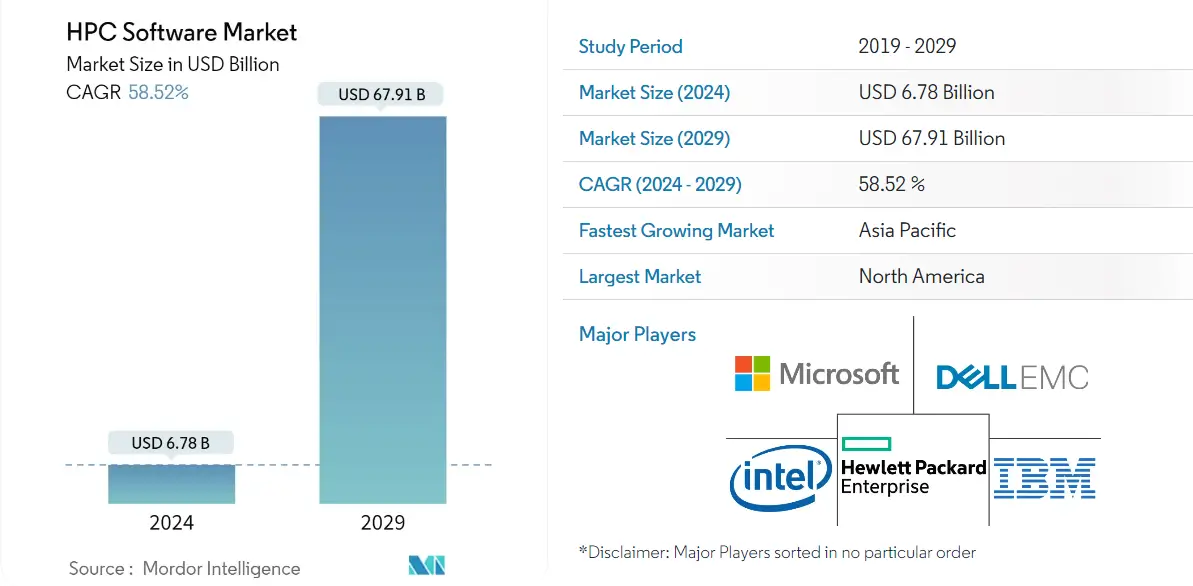
According to Modern Intelligence, the market size of HPC in the software industry is expected to grow to USD 67.91 billion by 2029, a CAGR of 58.52% from 2024 to 2029. It has also been observed that increased reliance on HPC systems in scientific research leads to a higher probability of discovering models and values more accurately and faster in physics, chemistry, biology, and astronomy.
HPC in Healthcare and Drug Discovery
High-performance computing in healthcare and drug discovery research has shown great promise in identifying new therapeutics, drugs, and remedies for various diseases that have long affected humans. HPC-aided diagnosis and proper treatment strategies sometimes save humans from illnesses and sometimes improve recovery times.
Indeed, HPC has become indispensable in healthcare, particularly medical research and drug development. The approximate time to produce new drugs by traditional drug development methods is nearly a decade. In contrast, High-performance computing has shortened the time even for developing vaccines and new medicines through simulated molecular interactions and results prediction. Notably, during COVID-19, the HPC (High-performance computing) system was vital in increasing the pace of finding vaccines and treatments.
The most dramatic example would be the use of IBM’s Summit, one of the world’s most powerful supercomputers, to simulate the interaction of the SARS-CoV-2 virus with various compounds and drug molecules. Within a few days, Summit analyzed billions of molecular interactions to narrow the list to possible treatments. Through the spike protein model, besides all those other uses of HPC systems, the researchers understood how the virus infects human cells and planned vaccines for that reason.
Pharmaceutical companies also depend on HPC to model drug interactions, identify side effects, and predict a patient’s response. HPC is used in personalized medicine to give doctors genetic data analysis to design a treatment for an individual patient.
To this end, for example, in medical imaging, HPC can process complex data from MRIs, CT scans, and other diagnostic equipment. The images of the human system can be processed in real time, thereby allowing doctors to attain a diagnosis much quicker and, therefore, more accurately. It may consequently help improve patient outcomes, especially in disciplines such as oncology and neurology.
Recommended Read: GPU vs. CPU: Which One Is Best for High-Performance Computing (HPC)?
HPC in Financial Services
Another important user of HPC is the financial sector. For example, most banks analyze voluminous data daily, including stock prices, market trends, and customer transactions. Real-time analysis of such information makes the systems fundamental in enabling faster and more informed decisions within firms.
HPC is also very critical in high-frequency trading. Such trading involves executing trades in less than a few milliseconds to exploit relatively small fluctuations in market prices. The data is processed through HPC systems at lightning-fast speeds; thus, the companies can earn as much profit as possible by making trades quicker than their competitors.
Besides trading, HPC is also used in risk management and fraud detection. Banks might, for instance, run complex simulation applications that calculate market risks while examining how changes in the overall economic environment are more likely to affect portfolios. Similarly, HPC systems scan large datasets for signs of fraudulent activity to help banks detect fraud in real time.
HPC also assumes crucial significance in credit scoring, where rather complicated models assess an individual’s creditworthiness. As the financial markets become increasingly complex and timely decisions are required, the role of HPC in finance will grow ever more significantly.
HPC in Engineering and Manufacturing
In engineering and manufacturing, HPC (High-performance computing) allows a company to simulate designs, test them on a computer, and optimize manufacturing processes before making a product in this view. It, therefore, decreases the need for more time-consuming and costly physical prototypes while allowing them to develop much better products. Heavy machinery, consumer electronics, aerospace, and automotive are but a few examples of industries using HPC.
Automotive giants such as Ford and General Motors use HPC to run simulations of crashes to test safety even before building a real model. HPC can be used to analyze crash forces at diverse points in the car, spot potential weaknesses, and suggest improvements. In the aerospace industry, companies such as Boeing and Airbus use HPC to simulate situations in aircraft under many conditions, delivering high performance and greater safety.
As per insideHPC, the growth of manufacturing analytics software is projected at $19.47 billion, and manufacturing growth is expected to be 40% to $16 billion. One major driver in such growth is the increased adoption of simulations and digital twins, virtual models of actual products that allow engineers to test performance and make improvements before they are produced.
HPC is also used in material science. By simulating the properties of new materials, one can predict how the latter will behave in certain conditions. For manufacturers, this represents a possibility to develop stronger, lighter, and more durable materials. These, for example, can be used in the construction, aerospace, or automotive industries.
HPC in Entertainment and Media
With the big, complex problems required to make realistic animations, VFX, and simulations, which are now an integral part of movies, television shows, and video games, HPC plays a critical role in the entertainment industry. Rendering high-quality visuals is energy-intensive because each frame might contain millions of pixels and complex lighting, shading, and texture effects.
For instance, Pixar and Disney would use HPC when rendering an animated film because the computer screen has millions of terabytes that need to be processed to generate all those details. Whereas calculating a frame within an animated movie can take hours, HPC will make it much faster for studios. High-performance computing is also used in video game development for realistic physics, lighting, and effects such as particles or explosions.
Advancements in HPC are driving the animation and VFX market globally, with rising demand for better content, such as high-quality 3D animations, special effects, and virtual reality experiences.
HPC is used in content streaming, where platforms like Netflix and Amazon Prime Video rely on these systems to encode, compress, and deliver high-definition video content to millions of viewers simultaneously.
HPC in the Oil and Gas Industry
Oil and gas industry firms need HPC to analyze seismic data and perform subterranean formations modeling to identify more precise drilling areas. Such simulations enable engineers to predict where oil and gas reserves could be located, drastically lowering the risk of drilling in a non-productive area without causing significant environmental problems.
Shell, for example, exploits High-Performance computing to process seismic data and simulate the behavior of rock layers beneath the earth. The company then makes informed decisions about where to drill using reduced time, money, and resources. This enables companies to explore with lesser environmental impact by rapidly processing tremendous volumes of data.
High-performance computing will also play a critical role in a significant increase in efficiency and cost reduction. HPC also supports simulations that predict the behavior of oil and gas fields over time, which companies can use to optimize production and extend the life of their assets.
Conclusion
High-performance computing has catalyzed innovation, efficiency, and growth across this broad spectrum of industries-including scientific research, healthcare, finance, engineering, entertainment, and energy systems. HPC allows businesses and researchers to solve complex problems, process large datasets, develop accurate models and simulations, and more. As data-driven decision-making takes on ever greater importance, the place of High-performance computing will only increase in importance soon.
Ongoing innovation in HPC technology, from AI to cloud-based solutions, will continue to push the frontiers of what is possible, providing new opportunities for innovation and efficiency for industries worldwide. As technology becomes more powerful and accessible, businesses of all sizes will finally have the power of HPC systems right at their fingertips. Book a free consultation with an AceCloud expert today.

Related Post







Get in Touch

Credits First!
- 24*7 Human Support
- Pay-as-you-go Pricing
- No Egress Cost
- Multi Tier Security