

Quick Answer
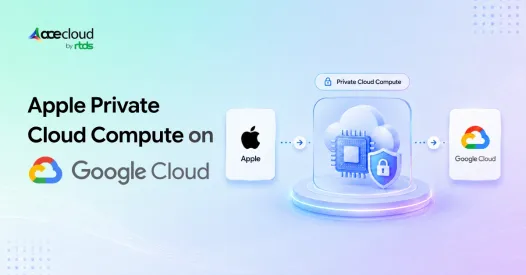
Apple is expanding Private Cloud Compute (PCC) beyond its own data centers. Google Cloud will now support certain computationally demanding AI workloads for Apple. Apple maintains that its privacy model, software verification, and workload control will continue to apply regardless of where the compute physically sits.
When we first read that Apple was extending Private Cloud Compute onto Google Cloud, our first reaction was honestly just curiosity. Apple has spent years building a reputation around owning its own infrastructure end to end. So why bring Google into the picture now?
The more we sat with it, the more it started to look less like a one-off decision and more like a preview of where enterprise AI infrastructure is headed generally. We wanted to break down what is happening here and, more importantly, what it means for the rest of us who are not Apple but still need to figure out where our AI workloads should live.
Is Apple Using a Hybrid Cloud Architecture?
Yes. Apple combines on device processing, Apple controlled cloud systems and third-party public cloud capacity, and that combination is a hybrid AI infrastructure pattern.
We can think of it as three layers stacked on top of each other.
- First, there is on device processing for requests that do not need to leave the phone.
- Second, there is Apple operated Private Cloud Compute for anything that needs more horsepower but still stays inside Apple’s own walls.
- Third, and this is the new part, there is Private Cloud Compute running on Google Cloud infrastructure for certain workloads that need it.
In a conventional hybrid cloud deployment model, private and public environments stay separate but get coordinated based on workload, security and business needs. Apple is applying the same idea here, just on a much larger scale.
- Apple controls the AI layer: Foundation Models, Private Cloud Compute software, request routing, software signing, and attestation policies.
- Google, Intel, and NVIDIA provide secure infrastructure: Google Cloud supplies data centres and Titan security, Intel TDX isolates confidential virtual machines, and NVIDIA Blackwell GPUs protect AI inference.
- Requests remain privacy-protected: Apple devices verify approved hardware and software before sending encrypted data, processing is temporary, and cloud administrators are designed to have no access to live user prompts.
Hybrid cloud is not simply the act of using more than one environment. It is the coordinated placement and governance of workloads across them, and that distinction matters more than people usually give it credit for.
What Does Apple’s Google Cloud Move Mean for Enterprises?
Enterprise AI infrastructure is becoming hybrid. Organizations retain control over sensitive data, software and security policies, and they use public cloud infrastructure for extra capacity and specialized AI hardware on top of that.
The bigger lesson for us is not that every company should rush to use Google Cloud. It is that infrastructure ownership and workload control can be separated. Those used to be treated as the same thing. Apparently, they no longer have to be.
Why is AI Pushing Enterprises toward Hybrid Cloud?
AI strengthens the case for hybrid cloud. Enterprises need control over sensitive workloads, and they need flexible access to expensive, fast moving computing resources. Hybrid cloud gives them both.
We have watched this play out with more than a few of our own customers. GPU requirements shift quickly, sometimes within a single quarter. Inference demand can be genuinely hard to forecast, especially early on.
Buying hardware sized for peak usage often means paying for capacity that sits idle most of the year. Some of your data will need a dedicated or tightly controlled environment no matter what. And public clouds tend to get you faster access to the newest accelerators than building it yourself ever will.
Pilots and production deployments also just behave differently, which is a distinction worth planning for early. For variable and experimental workloads, GPU as a Service can hand you accelerator capacity without forcing you to buy and run all that hardware in house.
Hybrid infrastructure lets enterprises rent AI capacity without outsourcing their entire data, application, and governance architecture. If you are trying to get a handle on the cost side of this, the FinOps Foundation has solid guidance on forecasting AI infrastructure costs.
What Should Enterprises Keep Under Their Control?
Enterprises should hold onto the policies, identities, encryption mechanisms and verification systems that govern their workloads. They do not need to own every physical server.
We would like to describe this as the control plane. It determines who can access a workload, which software it is allowed to run, where it can operate, and how its activity gets monitored and verified.
In practice, this usually covers identity and access management, encryption and key ownership, approved software and container images, data classification policies, workload authorization, data residency rules, logging and audit records, vendor access controls, and incident response procedures.
A managed private cloud is a good fit for sensitive or predictable workloads that need dedicated resources, stronger isolation, and consistent performance. The goal of hybrid cloud is not to own all the compute. It is to preserve control of the trust model no matter where the compute happens to run.
How Should Enterprises Decide Where an AI Workload Runs?
Base AI workload placement on data sensitivity, compliance, latency, hardware needs, integration requirements and demand predictability. Skip the blanket cloud first or on premises first rule.
Here is a quick way we tend to frame this decision for our own planning conversations.
| Decision factor | Private infrastructure may suit | Public cloud may suit |
|---|---|---|
| Data sensitivity | Regulated or proprietary data | Appropriately protected, lower risk data |
| Demand | Stable and predictable | Variable or rapidly growing |
| Hardware | Existing dedicated capacity | Specialized or newer accelerators |
| Latency | Close to internal systems | Distributed users and services |
| Economics | Sustained utilization | Pilots and demand spikes |
| Compliance | Strict residency requirements | Approved cloud regions |
Workload placement also depends on having a secure cloud networking architecture in place, with proper segmentation, private routing and traffic controls.
Our general rule is to keep workloads private when control requirements dominate, and to lean on public cloud capacity when elasticity, geographic reach or specialized hardware create more value than the added complexity costs you.
How Can Enterprises Build a Hybrid AI Strategy?
Start with one clearly defined AI workload. Figure out which controls need to stay internal. Test whether public cloud capacity adds enough value to justify the added complexity.
A framework we keep coming back to looks something like this:
- Classify the workload and the data it touches.
- Define the security controls the enterprise must own outright.
- Compare private capacity against public cloud options honestly, not just on price.
- Standardize identity, encryption, and monitoring before you scale anything.
- Test performance, portability, and recovery under real conditions.
- Measure cost and operating complexity before expanding further.
A structured cloud migration strategy can help your team assess dependencies and decide whether individual workloads should be retained, rehosted, replatformed, or replaced.
If you are looking for a low risk place to start, internal knowledge search, document classification, development and model testing, customer service inference, and temporary capacity during demand spikes are all reasonable first candidates.
NOTE: Operating in two environments does not create a hybrid cloud strategy unless both environments are governed as one operating model.
Why Make Disaster Recovery a Part of Hybrid Cloud Planning?
A hybrid architecture must be able to restore applications, data, and connectivity when one environment goes down. Without that, it is not finished.
This means paying attention to recovery time objectives, recovery point objectives, data replication, who owns failover, application dependencies, network recovery, and regular recovery testing that actually happens on a schedule rather than once and never again. It is worth evaluating cloud disaster recovery options before spreading production AI workloads across multiple environments.
Resilience does not come merely from having multiple environments. It comes from having a tested method for recovering workloads across them.
Choose Hybrid by Design, Not by Accident
Apple’s Google Cloud expansion does not mean every enterprise should place its AI workloads on GCP. What it shows is that infrastructure ownership and workload control can be separated.
At AceCloud, we believe that a well-designed hybrid architecture lets companies retain governance over sensitive systems while still accessing public cloud capacity and specialized compute where it makes sense.
The companies that benefit most from this shift will be the ones that know exactly which workloads belong where, and that keep control consistent everywhere those workloads happen to run.
Want to know how we empower enterprises with a hybrid cloud setup? Book your free consultation today and connect with our hybrid cloud expert now!
Frequently Asked Questions
No. Apple is using Google Cloud infrastructure for selected workloads while continuing to operate its own systems. The arrangement expands available capacity rather than replacing Apple’s complete private AI infrastructure.
Hybrid cloud lets enterprises keep sensitive or predictable workloads in controlled environments while using public cloud capacity for experiments, specialized hardware and variable demand.
Not automatically. Enterprises can still end up dependent on proprietary APIs, hardware and management tools. Portability has to be deliberately designed and tested on a regular basis.
No. It tends to be most valuable when private control requirements and public cloud capacity needs coexist, and when the benefits outweigh the extra operational complexity involved.


