Introduction
In the post-corona economy, companies have realized the cloud as the modern facilitator of best services in terms of cost, security, agility, and scalability for their digital transformation. Businesses now depend significantly on the cloud and have successfully turned towards outsourcing their software-defined infrastructure to the right cloud provider for an on-demand service.
Every business aspires to be the fastest in this growing market, supporting the needs of an ever-increasing workforce and endeavoring to procure a seamless and hassle-free IT infrastructure.
One such solution is software-defined infrastructure, commonly called SDI. SDI helps relieve your business from the weight of infrastructure management and enables you to cope with growing competition and increasing agility.
The global software-defined infrastructure market is projected to grow at a CAGR of 23%, reaching an estimated value of USD 143.12 billion by 2030
But how does this intelligent infrastructure simplify, automate, and virtualize critical business needs around the clock? Let’s take a deep dive into what SDI is and learn how it simplifies the complexities of manual tasks through automation to help empower your business.
Reinvent Your Business: Understanding SDI
SDI is a technology that refers to logically pooled computation, memory, storage, and networking resources that are managed by software with little human intervention.
SDI-enabled data centers are smarter, self-aware, self-healing, self-optimizing, self-scaling, and automated, which reduces new service deployment times from weeks to minutes.
According to a poll performed by 451 Research, more than 60% of businesses regard cloud computing as a major infrastructure need, with key benefits such as data security, service agility, and lower operational costs.
With businesses increasingly favoring the cloud for their infrastructure, Software-Defined Infrastructure (SDI) is set to play a crucial role in transforming entire workflows. To understand how SDI aids in this transformation, consider a data center processing a real-time, compute-intensive analytics job.
SDI can automatically allocate this workload to servers closest to the data, optimizing performance. Simultaneously, less intensive or time-sensitive tasks can be shifted elsewhere, ensuring efficient resource utilization. For businesses, this means faster insights without the need to invest in additional computing power.
SDI began over a decade ago with compute virtualization, revolutionizing enterprise computing by delivering significant efficiency and performance gains.
Investing in modern data center infrastructure is essential for businesses. When aligned with the cloud, SDI becomes cost-effective, reducing capital expenses and enhancing operational efficiency for data center owners.
How Does SDI Make the System Orchestrated and Self-Servicing?
Internal stakeholders and external customers require the enterprise data center infrastructure to evolve, modernize, and adopt more cloud-like attributes to support service agility.
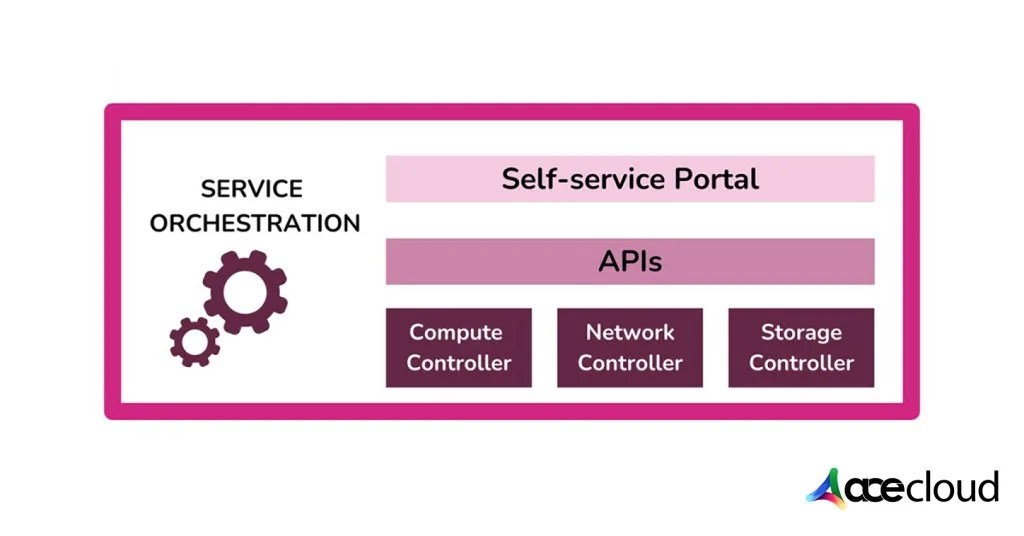
As illustrated in the image below, SDI enables services to be continuously orchestrated and automatically configured and managed by computer systems and applications. The underlying physical servers abstract the computing, storage, and network elements into the resource pool.
Orchestration software integrates the resource pools into programmable management environments, and this entire process is called Service Orchestration.
APIs act as a software intermediary, enabling users to interact with the backend services. The customer can easily access and dynamically provision all the deployed services on the self-service portal.
How is SDI Re-architecting the Modern Data Centers?
SDI functioning starts with the continual work of the orchestrator (automated configuration and management system), which monitors resources and uses the data and analysis of the running server or machine deployed physically.
When the demand fluctuates, the orchestrator analyzes its needs and dynamically decides what resources will be best supported. As soon as the system starts learning from past decisions, it turns the data center into a smart-analyzing brain using machine learning and the cloud.
After learning about SDI’s abstract workings, it’s time to learn the technology’s basics. Below is a pictorial representation of SDI components.

The SDI has the following four layers:
- Physical Infrastructure:This is the basic level where all the hardware resources like servers, hypervisors, firmware, networking, and storage devices are kept. The cloud allows these components to be scaled according to fluctuating IT demands, thus drastically reducing the equipment cost.
- Virtualization Layer:The virtualization layer lies above the physical layer of the SDI architecture, where fixed-function appliances on the servers are replaced with virtual machines by abstracting the function from the hardware on which it resides. These servers are used to scale up the storage solutions that automatically augment the performance and cost.
- Software-Defined Capabilities:Software-Defined Compute, Software-Defined Storage, and Software-Defined Networking are the software-defined capabilities that are virtualized and abstracted from the physical hardware. Here, an intelligent control and monitoring system manages all the services and configures and manages these virtual resources.
- Management Services:SDI consists of a user interface at this level to define performance, availability of resources, optimization, elasticity, and scalability. The management services layer will handle all infrastructure tasks required to guarantee that targeted SLA (Service Level Agreement) and performance criteria are upheld.
Top 5 Reasons Why You Should Choose SDI
There are several benefits of adopting SDI when considering migrating your infrastructure to the cloud and leveraging parameters like SLA performance, availability, scalability, and elasticity at the infrastructure management level. Let us look at some of them below.
- Decouple hardware from software- IT infrastructure, which includes computing, networks, and storage, is supplied as a set of virtualized services, removing the costs of special-purpose hardware procurement and maintenance. Because of open-standards-based hardware and software, this reduces capital expenditures and increases resource utilization.
- Easy setup-Provisioning, setting up, and de-provisioning computing and storage are all handled with just a few clicks, simply improving your experience and enhancing the portability of IT workloads.>
- Better ROI-SDI helps you save costs in two ways: relying on open standards and protocols developed by the industry rather than proprietary hardware and software and employing cloud and virtualization technologies to maximize usage of your current IT assets.
- Enable automation- SDI makes computing, networking, and storage resources more efficient by automating the manual resource provisioning. Automating requirement management and provisioning will reduce the variety of professionals needed, simplify monitoring and manageability, and improve self-service abilities to enhance service and meet Service-Level Agreements (SLAs).
- Increase your agility and flexibility-SDI allows us to allocate infrastructure resources based on the needs of your business. By virtualizing the IT infrastructure, network, storage, and servers, companies can work much more flexibly, and with the right SDI approach, we can build a more agile infrastructure.
Enhancing Digital Transformation with SDI and Cloud Integration
The tremendous expansion of digital data has put unprecedented demands on traditional storage architectures and enterprise networks, resulting in performance and service agility constraints. To address these challenges, businesses must advance along the cloud maturity curve, moving towards higher levels of automation and orchestration for self-service provisioning and real-time service level agreements (SLAs).
Software-Defined Infrastructure (SDI) enhances the effectiveness of public cloud solutions by utilizing an architectural platform where software controls the infrastructure. This reduces maintenance efforts and data retrieval processes while significantly lowering IT costs. Additionally, SDI enables seamless workload migration to public or private clouds without compromising data integrity, enhancing overall efficiency.
Renowned companies leveraging Software-Defined Infrastructure include:
- PayPal: Directs nearly all its web traffic through an OpenStack private cloud.
- Walmart Stores: Built a massive private cloud using the OpenStack platform for its e-commerce operations, with several petabytes of storage.
SDI automation enhances agility and flexibility, enabling organizations focused on digital transformation to handle dynamic workloads and fluctuating business demands effectively. Furthermore, adopting SDI can reduce unnecessary spending and ensure a satisfactory Return on Investment (ROI).
But will the cloud be used to run full workloads?
Certainly, as per Medium, 27% respondents projected that 95% of workloads would be run in the cloud in the next 5 years, while 20% predicted that most workloads would be hosted in the cloud over the next 10 years.
True software-defined and scalable storage systems help you seamlessly handle hundreds of petabytes and even exabytes of data. AceCloud’s global Software-Defined Data Center (SDCC) provides a consistent approach to application portability across public clouds. If you strive for agility with efficient and precise delivery while keeping the best price in mind, consider AceCloud. Book a free consultation and get expert advice today!