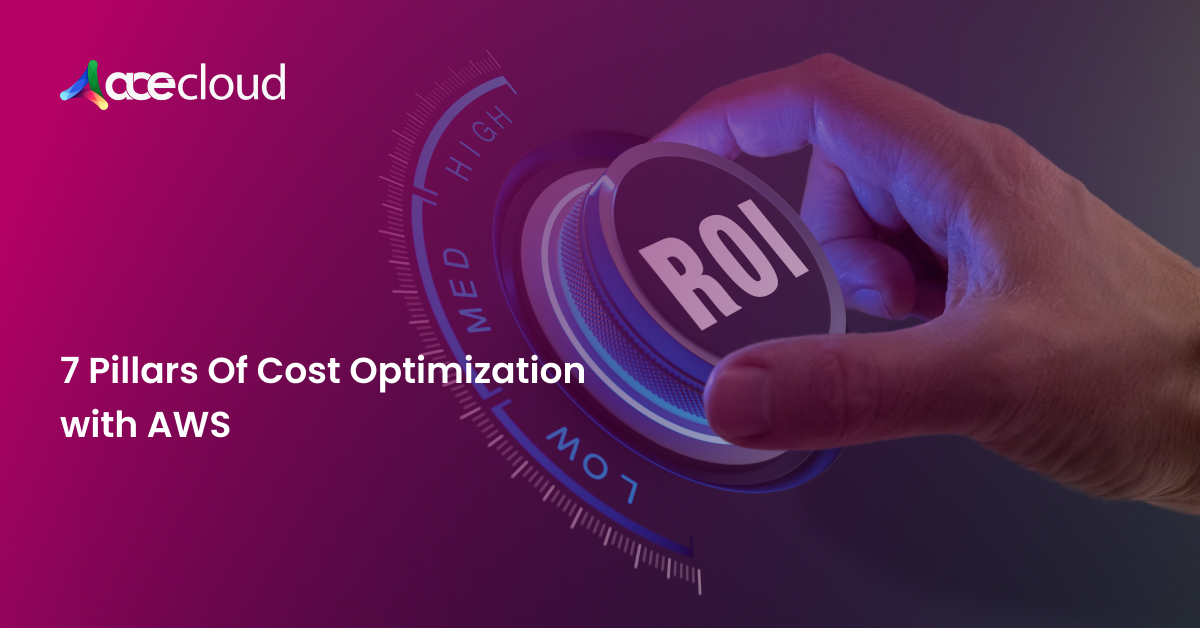
As organizations adopt cloud computing, managing their expenses has become more critical than ever. Although cloud computing offers immense business potential, its cost can quickly add up if not managed correctly. To help organizations optimize their spending, Amazon Web Services (AWS) provides various cost optimization tools and services.
The 7 Pillars of Cost Optimization Using AWS are:
1. Cost-Effective Architecture:
For cost optimization it is essential to design a cost-effective architecture. To create a cost-effective architecture, AWS provides various services, such as Amazon EC2, Amazon RDS, Amazon S3, and Amazon DynamoDB. Organizations can utilize services that match their business needs, reduce unnecessary expenses, and improve overall performance. For example, organizations can use AWS’s Reserved Instances, which offer up to 75% discount compared to On-Demand pricing for a specific amount of time.
Recommended Reading: AWS Cloud Readiness Assessment for Your Business
2. Right Sizing:
Right-sizing is the process of selecting the right instance types and sizes based on your workload requirements. AWS provides various tools to identify underutilized and over-provisioned resources, such as Amazon CloudWatch and AWS Trusted Advisor. Using these tools, you can optimize your resource usage and reduce costs. For example, if you have a low-traffic website, you can choose a smaller instance size to save on costs.
3. Elasticity:
Elasticity is the ability to scale resources up or down based on demand automatically. AWS provides various services, such as Amazon EC2 Auto Scaling and Amazon RDS Auto Scaling, to scale resources automatically. By utilizing these services, you can ensure that you have enough resources to handle the workload without overspending. Additionally, you can set up cost alerts to notify you when your expenses exceed the budget.
4. Use of AWS Spot Instances:
AWS Spot Instances provide a cost-effective way to run applications with flexible start and end times. Spot Instances allow organizations to bid on unused Amazon EC2 capacity, which can lead to up to 90% cost savings compared to On-Demand pricing. Although Spot Instances may not be suitable for all workloads, they do provide significant cost savings for applications with flexible start and end times.
5. AWS Savings Plans:
AWS Savings Plans offer discounts on compute usage in exchange for a commitment to use a specific number of resources over a one or three-year period. By purchasing a Savings Plan, organizations can save up to 72% compared to On-Demand pricing. Savings Plans provide more flexibility than Reserved Instances, as they are applied to a broader range of EC2 instances, regardless of region or family.
6. Use of Serverless Computing:
Serverless computing allows organizations to run their applications without provisioning or managing servers. AWS provides various serverless computing services, such as AWS Lambda and Amazon S3, which can help organizations reduce costs by paying only for the resources used. Serverless computing is an effective cost optimization strategy to eliminate the cost of idle or unused resources.
7. Continuous Improvement:
Continuous Improvement is an ongoing process of identifying areas for improvement and implementing changes to optimize costs. AWS provides various tools, such as AWS Cost Explorer, AWS Budgets, and AWS Cost Anomaly Detection, to help organizations identify areas for improvement. By continuously monitoring and optimizing expenses, organizations can ensure that they get the most value from their cloud investment.
Conclusion
In conclusion, cost optimization is a critical aspect of cloud computing, and AWS provides various tools and services to help organizations optimize their expenses. By following the 7 pillars of cost optimization, organizations can design a cost-effective architecture, right-size their resources, use elasticity, take advantage of Spot Instances and Savings Plans, leverage serverless computing, and continuously improve their cost optimization strategies. By implementing these strategies, organizations have proven to reduce costs.
Contact AceCloud – AWS consulting partner for cloud solution & services.









 24th March
 4–5 PM IST