

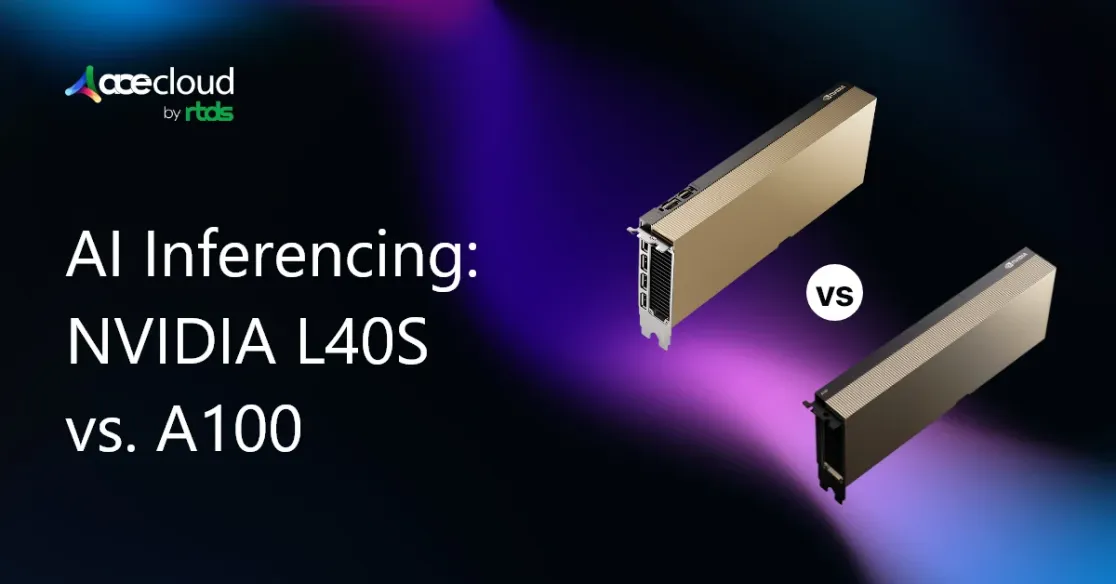
You have two great GPUs on the table for AI inference: L40S and A100. The right choice depends on model shape, context length, batch size and isolation needs.
Ideally, L40S shines when a single GPU can carry the whole graph with low precision. A100 steps up when memory gets tight or the model spans multiple GPUs. But how can you make the choice for your specific AI inference workload?
To help you, we have mapped real workload scenarios to a clear pick. You will see when FP8 throughput beats HBM bandwidth and when NVLink changes latency. Let’s first define both the Cloud GPUs and dive into the details later.
What is NVIDIA L40S?
L40S is a data center GPU optimized for high-throughput inference, real-time graphics and virtual workstations. It shines when a single GPU can hold the full model and you can run low-precision kernels.
Deployment is simple in standard PCIe servers and scaling out is straightforward for bursty or spiky traffic. While L40S supports vGPU capabilities, it does not offer NVLink. So, it suits teams prioritizing raw single-instance throughput and cost efficiency over multi-GPU interconnects or hard isolation.
What is NVIDIA A100?
A100 is another data center GPU built for large models, long contexts and multi-GPU scaling in production. It handles heavier batching and complex graphs more gracefully and supports features for fast interconnect and hard multi-tenant isolation.
Choose it when your workloads need more headroom, strict performance guarantees and stable tail latency across shared environments. It fits enterprises running mixed training and inference or serving many tenants with predictable quality of service.
A100 Vs. L40S: Explaining Key Differences
Here are the key differences in structure and function between A100 and L40S.
| Feature | NVIDIA L40S | NVIDIA A100 |
|---|---|---|
| Architecture | Ada Lovelace | Ampere |
| Memory | 48GB GDDR6 (864 GB/s bandwidth) | Up to 80GB HBM2e (1.9–2 TB/s bandwidth) |
| CUDA Cores | 18,176 | 6,912 |
| Tensor Cores | 568 (4th Gen) | 432 (3rd Gen) |
| RT Cores | 142 (3rd Gen) | None |
| FP32 Performance | 91.6 TFLOPS | 19.5 TFLOPS |
| TF32 Tensor Core Performance | Up to 366 TFLOPS | Up to 312 TFLOPS |
| FP8 Tensor Core Performance | Up to 1,466 TFLOPS | Not Supported |
| FP64 Double Precision | Not Supported | 9.7 TFLOPS |
| Power Consumption (TDP) | Up to 350W | Up to 400W |
| Multi-Instance GPU (MIG) | Not Supported | Supported (up to 7 instances) |
Here’s a deeper, inference-focused breakdown of L40S vs A100 to help you pick with confidence.
Architecture and precisions
- L40S (Ada) adds a Transformer Engine with FP8, pushing peak tensor to ~1.466 PFLOPS with sparsity. This favors high-throughput, low-precision inference on LLMs and diffusion.
- A100 (Ampere) tops out at FP16/BF16 tensor ~624 TFLOPS with sparsity and supports INT8/INT4 widely. No FP8. Great mixed-precision versatility and mature kernels.
Memory capacity and bandwidth
- L40S has 48 GB GDDR6 with ~864 GB/s bandwidth. Works well for 7B–13B class models, image, speech and most single-GPU serving. Larger contexts or big batches can hit memory walls faster.
- A100 80 GB has 80 GB HBM2e with ~1.94–2.04 TB/s bandwidth. Better for big KV caches, 70B-class models and tighter latency under heavy batching.
Interconnect and scale-out
- L40S is PCIe Gen4 x16 only at ~64 GB/s bidirectional. There is no NVLink. Multi-GPU tensor parallel inference is limited by PCIe latency and bandwidth.
- A100 SXM offers NVLink up to ~600 GB/s and NVSwitch in HGX systems. This matters when a single model spans multiple GPUs or when you chase lowest tail latency.
Isolation and multi-tenancy
- A100 supports MIG. You can slice one 80 GB GPU into up to seven instances with ~10 GB each on A100-80GB, giving per-tenant QoS with Kubernetes and hypervisors.
- L40S has no MIG. You can share at the software level, but not with hardware-enforced isolation and dedicated memory slices.
Form factors and power
- L40S supports dual-slot PCIe, 350 W TDP. Simple to drop into standard 1U/2U PCIe servers.
- A100 supports PCIe 300 W or SXM 400 W TDP options. SXM brings NVLink and higher sustained clocks in HGX/DGX designs.
Looking for cost comparisons on these GPUs? Check out our detailed Cloud GPU Pricing for L40S and A100 to see real-world rates, usage tiers, and savings opportunities for your AI inference workloads.
Throughput vs model fit in practice
- If your model fits on one GPU and you run low-precision kernels, L40S usually wins on throughput per dollar. Its FP8-optimized Tensor Cores are built for modern inference.
- If you need more VRAM or multi-GPU parallelism, A100-80GB pulls ahead. More memory, far higher HBM bandwidth and NVLink reduce stalls and inter-GPU chatter.
Latency and batching knobs
- L40S shines when you can batch requests and stay within 48 GB. FP8 helps keep tensor cores busy at small and mid batches.
- A100 maintains lower latency at higher batch sizes due to HBM and NVLink. It also handles longer contexts or larger beam widths before paging or partitioning.
Multi-model and VDI-style deployments
- A100 + MIG is ideal when you must host many small models with hard isolation on a single card, each with guaranteed memory and compute.
- L40S supports NVIDIA vGPU but no MIG. Use it when you value raw single-instance throughput over strict hardware slicing.
Evidence from vendor materials
- NVIDIA’s L40S collateral shows FP8 peaks ~1.466 PFLOPS and explicitly lists no NVLink, no MIG.
- NVIDIA’s A100 page details 80 GB HBM2e, ~2.0 TB/s bandwidth, NVLink ~600 GB/s and up to 7 MIG instances.
- Vendor data also shows L40S leading Stable Diffusion inference versus A100 in some paths, which aligns with its FP8 advantage. Treat these as config-dependent.
While the NVIDIA L40S is emerging as a strong replacement for the A100 in AI inference workloads, it’s also important to see how it compares with other leading GPUs. We’ve created a detailed guide on NVIDIA L40S vs H100 vs A100 – Key Differences & Use Cases that breaks down performance, efficiency, and pricing across all three cards.
L40S vs. A100: AI Inference-First Scenarios
Here are some of the real-world scenarios you can consider as a reference and make an informed decision.
| Scenario | Typical Workloads | Cloud GPU | Reason |
|---|---|---|---|
| Single-GPU LLMs that fit | 7B–13B chat, 8k–16k context | L40S | Strong low-precision throughput, great value on PCIe |
| Long-context chat | 32k–64k context, streaming + batching | A100 80 GB | More VRAM and HBM reduce KV pressure and tail latency |
| 70B-class serving | Llama-3.1-70B, similar | A100 80 GB SXM | NVLink and VRAM for tensor or model parallel |
| Many small models with isolation | Hundreds of 3B–7B per node | A100 with MIG | Hard partitions give QoS and fixed memory per tenant |
| Image generation and diffusion | SDXL, ControlNet, LoRA | L40S | Excellent single-GPU throughput, no need for NVLink |
| Multi-frame or video diffusion | Long sequences, big UNets | A100 80 GB | Extra VRAM and bandwidth cut host swaps |
| Speech AI at scale | ASR, TTS | L40S | High tokens per second, good perf per watt |
| Embeddings and rerankers at high QPS | Text-embedding, cross-encoder | L40S | Best throughput per dollar, easy horizontal scale |
| RAG with mixed models | Embedder + reranker + 7B–13B gen | Hybrid | L40S for embed + rerank, A100 for generator |
| Tight latency under bursts | Consumer chat, p95 < 150 ms | A100 80 GB | HBM and headroom steady tail latency |
| Offline batch at huge scale | Nightly scoring, bulk gen | L40S | Better fleet cost if graphs fit one GPU |
| PCIe-only racks | 1U/2U servers, modest power | L40S | Drop-in PCIe, strong perf |
| Heavy multi-GPU serving | TP=2–4 for large models | A100 SXM | NVLink or NVSwitch lowers all-to-all cost |
| Multi-tenant VDI or vGPU | Secured desktops with AI assists | A100 with MIG | Hard memory and SM slicing tame noisy neighbors |
| Cost-sensitive POCs and spikes | Pilots, A/B runs, daytime bursts | L40S | Strong single-GPU throughput, easy to scale out |
Case Study: Check out our case study on how AceCloud’s Cloud GPU helped Predis.ai gain average savings of 60% in cost and 70% in time.
Choose the Right Cloud GPU for AI Inference
There you have it. We have shared everything you need to know when choosing between L40S and A100. If we were you, we would treat the decision as a workload fit, not a spec race.
You can consider this rule of thumb: If one GPU holds your model with headroom, L40S usually wins on throughput per dollar. If you need bigger VRAM, longer contexts, NVLink or hard isolation, A100 80 GB is safer.
We know making a quick decision can be overwhelming. Thus, we suggest you connect with our Cloud GPU experts and validate your AI inference workload with a short pilot on your real prompts and target latencies. Connect today!


