

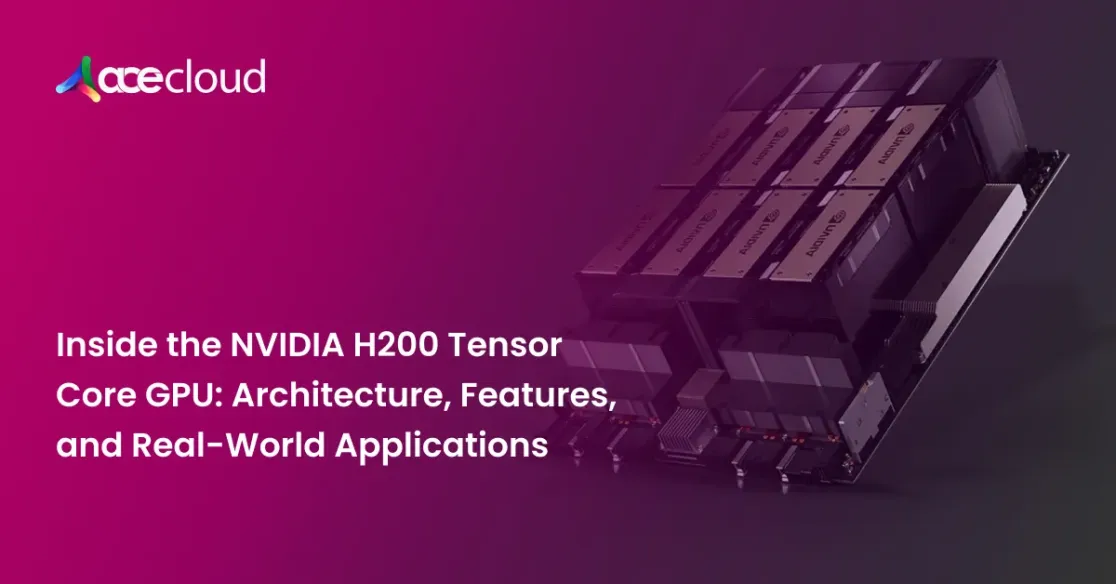
In an era where Artificial Intelligence (AI) and High-Performance Computing (HPC) are transforming industries, the demand for powerful, efficient GPUs is skyrocketing. NVIDIA H200 Tensor Core GPU is a groundbreaking innovation designed to tackle the most complex AI and HPC challenges.
With enhancements in memory, processing power, and scalability, the H200 sets a new standard for accelerating Large Language Models (LLMs), multimodal AI, and scientific research.
Let’s dive into the H200’s architecture, features, and the unparalleled value it brings to modern computing.
What is the H200 Tensor Core GPU?
NVIDIA introduced the H200 GPU in November 2023. Building on the features of its predecessor, the NVIDIA H100, the H200 offers advanced enhancements to handle extensive AI and large language Model (LLM) workloads. For instance, compared to the H100, the NVIDIA H200 Tensor offers 2x memory capacity and 2.4x bandwidth.
Moreover, the H200’s tensor cores facilitate precision handling, essential to managing and optimizing large language models. With H200, developers like you get AI efficiency with accuracy—a rare combination.
Built on the Hooper architecture, first introduced in the H100 model, H200 offers advanced features to optimize High-Performance Computing (HPC) and trillion-parameter AI. With its transformer engine, AI models can achieve both FP8 and FP16 precisions, meaning more computation per second at better accuracy. Moreover, the Hopper architecture offers other features, such as NVLink, NVSwitch System, Second Generation MIG, and DPX Instructions.
Let’s check out the technical specifications of the H200 GPU that make it a game-changer.
| Features | H200 SXM | H200 NVL |
| FP64 | 34 TFLOPS | 34 TFLOPS |
| FP64 Tensor Core | 67 TFLOPS | 67 TFLOPS |
| FP32 | 67 TFLOPS | 67 TFLOPS |
| TF32 Tensor Core | 989 TFLOPS | 989 TFLOPS |
| BFLOAT16 Tensor Core | 1,979 TFLOPS | 1,979 TFLOPS |
| FP16 Tensor Core | 1,979 TFLOPS | 1,979 TFLOPS |
| FP8 Tensor Core | 3,958 TFLOPS | 3,958 TFLOPS |
| INT8 Tensor Core | 3,958 TFLOPS | 3,958 TFLOPS |
| GPU Memory | 141GB | 141GB |
| GPU Memory Bandwidth | 4.8TB/s | 4.8TB/s |
| Max Thermal Design Power (TDP) | Up to 700W | Up to 600W |
| Form Factor | SXM | PPIe Dual-slot air-cooled |
| Interconnect | NVIDIA NVLink™: 900GB/s PCIe Gen5: 128GB/s | 2- or 4-way NVIDIA NVLink bridge: 900GB/s PCIe Gen5: 128GB/s |
Recommended Read: High-Performance Computing with Cloud GPUs for AI/ML – All You Need to Know

NVIDIA H200: Key Architectural Features
The H200 offers enhancements in its architecture to accommodate all the requirements of modern-day AI engines.
1. Enhanced AI Inference
AI Inference is the process where the AI models make sense of that data, offering valuable insights to businesses. However, AI models lack efficiency and dependability without a powerful AI inference platform.
With NVIDIA H200, you get a powerful AI inference platform that offers maximum throughput at a minimum Total Cost of Ownership. This supports complex models like Llama2 70B and GPT-3 175B, increasing their efficiency to 1.9x and 1.6x, respectively. H200 makes AI inference easy, be it speech recognition, content generation, or simulations.
2. Power Efficiency
The NVIDIA H200 offers 50 percent better power efficiency than the H100. This is because, despite the same power consumption as the H100, the H200 offers better performance for AI workloads and High-Performance Computing.
Apart from offering you a high-throughput environment, H200 also enables you to encourage a sustainable business process.
3. Multi-Instance GPU (MIG)
The Multi-Instance GPU (MIG) feature of NVIDIA H200 Tensor enhances the scalability of the GPU infrastructure. With MIG, each H200 can be divided into different GPU instances (a maximum of 7), improving GPU utilization and reducing costs. All Hopper architecture GPUs, like H100 and H200, support the MIG feature.
With MIG, developers can run multiple workloads simultaneously on individual virtual GPUs with their own resources, like compute and memory. For instance, on an NVIDIA H200 Tensor GPU, you can create either –
- 7 GPU instances of 10GB each
- 4 GPU instances of 20GB each
- 2 GPU instances of 40GB each
- 1 GPU instance of 80GB each
The GPU monitoring runs simultaneously on each instance. The MIG feature helps the H200 support domains like application virtualization and Kubernetes.
4. Memory Boost
The NVIDIA H200 takes AI acceleration to a new level with its HBM3e memory. It offers 141GB at 4.8 TBps, improving tremendously compared to the H100 by a factor of 2 and 2.4, respectively.
This boost in memory and bandwidth enables Large Language Models to store and process data, essential for accurate and efficient results. Moreover, the enhanced memory in the NVIDIA H200 also facilitates the deployment of a High-Performance Computing (HPC) environment, which is required by the scientific community for complex computations and weather forecasting, among others.
5. Multi-Precision Computing
The H200 GPU supports a range of precision formats, from FP8 and BF16 to FP32 and INT8, which can be switched dynamically for optimized workload performance. This feature balances speed and accuracy for extensive LLMs and multimodal models, enabling faster computations without sacrificing output quality.
Real-World Applications of the NVIDIA H200
- Accelerating LLM Development: The H200 significantly reduces training and inference times for large language models. Its high memory bandwidth and precision optimization enable it to efficiently handle models like GPT-4 or Llama2 70B. With real-world benchmarks showing nearly 2x performance gains over its predecessor, the H200 ensures faster deployment of AI-powered solutions.
- Transforming Vision and Multimodal AI: The H200 accelerates image-text embedding processes for vision-language models, enabling quicker model training for applications like object recognition and visual search. With its precision, flexibility, and high memory bandwidth, the H200 handles diverse datasets in real-time, ensuring high-quality results.
- Enhancing Fraud Detection Systems: The H200’s ability to process high-dimensional data makes it invaluable for real-time fraud detection. It enables deep learning models to analyze transaction patterns and detect anomalies at scale, delivering faster insights critical to financial and cybersecurity industries.
- Pioneering Scientific Research: The H200’s advanced memory and processing capabilities allow researchers to conduct simulations and data analysis at unprecedented speeds in scientific fields such as genomics, climate modeling, and astrophysics. For instance, climate scientists can leverage the H200 to create high-resolution environmental models for better risk assessments and decision-making.
Why the NVIDIA H200 Matters for AI and HPC
The NVIDIA H200 Tensor Core GPU represents a significant leap forward in artificial intelligence (AI) and high-performance computing (HPC). Its advanced Hopper architecture is designed to address the growing demands of complex AI models and data-intensive computational tasks, making it indispensable for developers and enterprises.
The H200 brings unprecedented capabilities for AI, including support for FP8 precision and enhanced Tensor Cores, which accelerate training and inference for large language models (LLMs) and multimodal AI systems. With its 141 GB of HBM3e memory and enhanced bandwidth, the H200 efficiently handles massive datasets, reducing training times and improving inference speeds.
These features are crucial for AI applications requiring real-time performance, such as conversational agents, recommendation systems, and computer vision.
In HPC, the scalability through Multi-Instance GPU (MIG) technology allows simultaneous workloads, optimizing resource utilization for diverse applications. This makes the H200 ideal for industries requiring extensive parallel processing and memory-intensive computations.
By blending AI-optimized performance with HPC capabilities, the NVIDIA H200 empowers enterprises and researchers to solve complex problems faster, scale applications seamlessly, and unlock new possibilities in innovation and discovery. It is the cornerstone of next-generation computing.
Conclusion
NVIDIA H200 Tensor Core GPU gives developers the ultimate platform for enhancing deep learning and large language model workflows. With its state-of-the-art architecture and scaling features, developers can deliver solutions faster and more accurately. These days, businesses also opt for cloud H200 GPU solutions to enhance the GPU’s capabilities with the added perks of cloud computing. Book a free consultation with an AceCloud expert to help you find the right Cloud GPU for your business.


