

Choosing a cloud architecture shapes how fast you can ship features, how much you spend on infrastructure and how confident you feel about security and compliance. So, the real question is not “cloud or no cloud”. It is about which mix of public, private and hybrid cloud fits your business.
- Public cloud: You rent compute, storage, networking and higher-level services from providers like AceCloud, AWS, Azure or Google Cloud. Resources are shared between many customers, but logically isolated. You pay for what you use and scale up or down.
- Private cloud: You run cloud style infrastructure for your own organization only. This can be on premises in your data center or hosted in a dedicated environment. You still use virtualization, automation and self-service ideas, but the hardware is not shared with other customers.
- Hybrid cloud: You combine public and private environments and connect them so workloads and data can move between them or work together. For example, sensitive data stays in a private cloud while bursty analytics or AI workloads run in public cloud.
According to Flexera’s 2025 State of the Cloud report, more than half of enterprise and SMB workloads now run in public clouds, while around 70% of organizations use hybrid cloud and 86% use multi-cloud architectures.
What is Public Cloud?
Migrating apps to the cloud may be simpler for a small or new firm, but businesses with a huge legacy IT infrastructure and applications must analyze and prepare more.
A public cloud is a computing model in which a provider renders facilities accessible to users over the internet.
The public cloud enables scalability and resource sharing that would be impossible for a single business to achieve.
Speed to start
You swipe a card, click a few buttons and you have servers, databases and AI services ready to go. No hardware procurement and no long capacity planning cycles.
Elasticity for variable workloads
Traffic spikes, experiments and new projects are much easier to handle. You scale up resources during busy periods and scale down when demand falls.
Rich managed services
From managed Kubernetes and serverless to streaming, observability and foundation models, the public cloud gives you building blocks that would be expensive to run yourself.
Tradeoffs to watch:
- Long term costs can creep up, especially for always on workloads that do not need extreme elasticity.
- Data residency and compliance can get tricky in heavily regulated sectors.
- You must accept some level of provider lockin, especially if you rely on proprietary services.
Public cloud tends to shine for digital products, startups, analytics projects and AI workloads that value speed and experimentation.
What is Private Cloud?

Private cloud offers a different balance. You still get cloud style self-service and automation, but you keep strict control over where data lives and how the environment is configured. Private clouds allow businesses to use cloud computing without incurring regulatory penalties.
This also removes the need to fulfill compliance standards when it comes to securing corporate data. Private cloud, also known as internal or corporate cloud computing, refers to the computing services provided over the internet or a private internal network to a limited number of users rather than the general public.
Control over data and security
Infrastructure lives in locations and facilities you choose. That makes it easier to enforce data residency rules, network layouts and custom security controls.
Predictable performance and cost
Because you own or reserve the hardware, noisy neighbors are not a problem. For steady workloads, a well-run private cloud can be cost effective and easier to forecast.
Integration with legacy systems
Many core systems still run on traditional infrastructure. Placing a private cloud in the same data center or colocation facility can reduce latency and complexity.
Tradeoffs to consider:
- Higher upfront and ongoing operational effort. You need skills to design, run and upgrade the platform.
- Scaling is slower than in public cloud, because capacity planning and hardware procurement take time.
Private architectures are common in financial services, healthcare, government and any place where regulation and data sensitivity are front and center.
What is Hybrid Cloud?
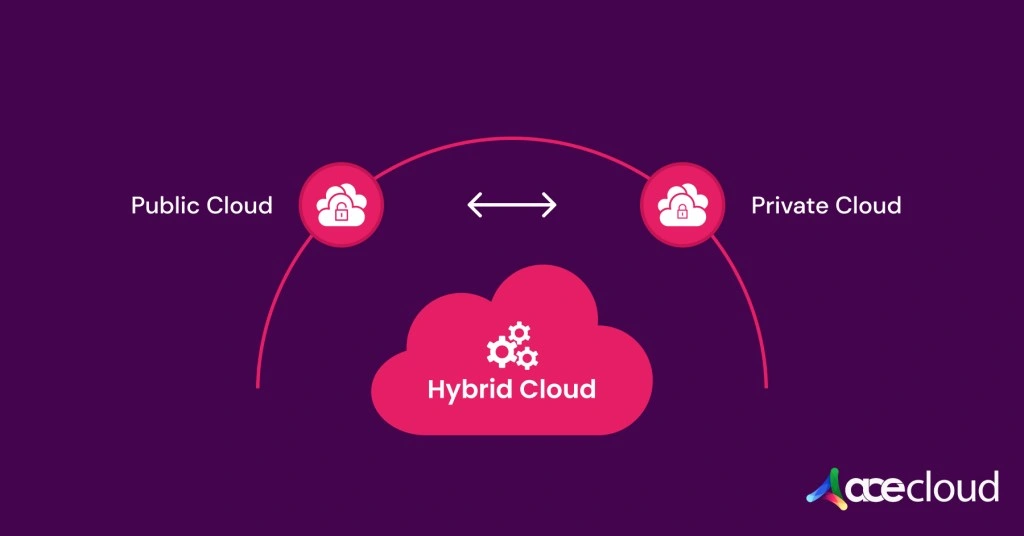
A hybrid cloud is an IT infrastructure that combines public and private cloud computing storage and services.
As a result, it enables automation, administration and application portability between clouds for an organization’s computing workload.
This enables the workload to be transferred between private and public clouds. With a hybrid cloud, businesses have more flexibility and data deployment choices.
Place each workload where it fits best
Keep regulated or latency sensitive data in private cloud. Run seasonal front-end traffic, analytics or AI training in public cloud.
Smooth migration path
Instead of a risky “big bang” move, you can shift workloads in phases. Legacy apps stay near existing systems while new services land in public cloud.
Resilience and vendor choice
Having more than one environment reduces dependency on a single provider and can support higher availability goals.
The catch is complexity: You need solid networking, identity, observability and governance to make hybrid work as one logical platform rather than a pile of silos.
Cost, Value and Cloud Architecture Comparison
FinOps practices, continuous rightsizing and smart storage choices matter in any architecture. Cost optimization is not only a public cloud topic.
| Architecture | Cost / Value Profile | When It Works Best | Extra Notes |
|---|---|---|---|
| Public cloud | Often higher unit cost, but you avoid paying for idle capacity. | Spiky, experimental or unpredictable workloads that may need global reach. | Great for fast experiments and scaling up or down without owning hardware. |
| Private cloud | Can offer lower marginal cost per unit once the platform is in place. | Large, steady workloads that run all day and night. | Better for long running, predictable demand where capacity planning is possible. |
| Hybrid cloud | Lets you balance cost by placing each workload in the most efficient environment. | Keeping steady workloads on private capacity while bursting or innovating in public cloud. | Useful when you want flexibility for new projects without moving everything off private infrastructure. |
| All architectures | Cost optimization is an ongoing discipline, not a one-time decision. | Any environment with meaningful cloud spend. | FinOps practices, continuous rightsizing and smart storage choices matter everywhere. |
Security, Compliance and Risk Comparison
For most organizations, a workload first view works best. Ask what data the workload touches, what regulations apply and what the blast radius would be in case of a breach. Then choose public, private or hybrid placement that fits that risk profile.
| Architecture | Security / Compliance Characteristics | Key Risks or Questions |
|---|---|---|
| Public cloud | Providers invest heavily in security features, compliance certifications and global infrastructure. | Many incidents stem from customer misconfigurations, not platform flaws. Customers must manage identity, access and configuration carefully. |
| Private cloud | Gives more direct control over controls, policies and environment design. | That control is powerful and risky. You design, maintain and monitor everything yourself, so weak processes directly translate into gaps. |
| Hybrid cloud | Lets you place sensitive workloads where they fit best while still using cloud scale services. | Raises extra questions. How will identity work across on premises and cloud. How do you keep encryption, logging and incident response consistent across environments. |
| All architectures | A workload first approach leads to better decisions about placement. | For each workload, ask what data it touches, which regulations apply and what the blast radius would be in case of a breach, then choose public, private or hybrid to match that risk profile. |
Performance, Latency and Data Gravity Comparison
Large datasets are hard to move frequently. This is sometimes called data gravity. If most of your analytics and AI workloads depend on a single large dataset, the architecture choice often follows where that data lives.
| Architecture / Concept | How It Affects Performance and Latency | Practical Implications |
|---|---|---|
| Public cloud | Regions place services closer to global users, which reduces latency for customers and partners. | Good fit for internet facing apps, APIs and services that serve users in many geographies. |
| Private cloud | Deployed in your own facilities, which keeps latency low for internal systems and local operations. | Useful for factories, trading floors, hospitals or other environments that need tight integration with local infrastructure. |
| Hybrid cloud | Often keeps “systems of record” close to home while “systems of engagement” run near users. | Requires well designed APIs and data pipelines between environments, so performance remains predictable. |
| Data gravity | Large datasets are hard and expensive to move frequently, so compute often follows the data. | If most analytics and AI workloads depend on one large dataset, the choice of public, private or hybrid usually follows where that dataset lives. |
How to Choose the Right Mix for Your Organization?

Instead of starting with “public vs private vs hybrid” as abstract labels, start with a small set of questions.
1. What are your top 10 workloads?
For each one, note its criticality, latency needs, compliance requirements and traffic pattern.
2. Where does sensitive data live today?
Map regulated, customer and intellectual property data. Identify what must stay in specific regions or facilities.
3. How fast does each workload need toevolve?
Rapidly changing products often benefit from public cloud services. Stable core systems can be slower to move.
4. What skills does your team have now?
A sophisticated private or hybrid platform needs people who understand networking, automation, observability and security at scale.
5. What is your vendor risk appetite?
Some teams are comfortable betting heavily on one hyperscaler. Others prefer a balance across multiple providers and private capacity.
Your answers will usually point to a mix. For many organizations, hybrid becomes the natural outcome, not an abstract goal.
The Bottomline
Cloud architecture choices are really business model decisions. Public cloud gives speed, elasticity and access to advanced services. Private cloud gives control, predictability and strong alignment with regulatory needs. Hybrid cloud gives flexibility, but only pays off if you design it deliberately.
Most companies will keep using all three in some form. The winners will be those that treat architecture as a living strategy, revisit it as workloads and regulations evolve and keep the focus on value per dollar, not just raw spend.
If you keep a clear map of workloads, data and risks, the “public vs private vs hybrid” question becomes much easier to answer and your cloud footprint will support your roadmap instead of slowing it down.
Frequently Asked Questions
Public cloud means you rent resources from a provider like AWS, Azure or Google Cloud and share the underlying infrastructure with other customers in a logically isolated way. Private cloud means the infrastructure is dedicated to your organization, often in your own data center or a hosted facility. Hybrid cloud connects public and private environments, so workloads and data can move or work together across both.
It depends on your workload profile. Public cloud often works best when demand is spiky, unpredictable or global, because you pay only for what you use and avoid idle capacity. Private cloud can be more cost effective for large, steady workloads that run all the time once the platform cost is justified. Hybrid lets you place each workload where it delivers the best value and then adjust over time.
Not by default. Public cloud providers invest heavily in security, compliance and global infrastructure. Many incidents come from misconfigurations on the customer side, not from the platforms. Private cloud gives you more control but also more responsibility, since your own team must design, maintain and monitor every control. In any model, security depends on how well you manage identity, access, configuration and monitoring.
Hybrid cloud helps when you want to keep sensitive or regulated data in a tightly controlled environment, while still using public cloud for scale, new services or burst capacity. It is useful during long migrations, when some systems stay on premises and new ones land in the public cloud. It also suits organizations that want to reduce dependency on a single provider and keep more flexibility for the future.
Start with your top workloads, not with technology labels. List their compliance needs, latency requirements, traffic patterns and how fast each one needs to change. Map where your most sensitive data lives today and how strong your in-house operations team is. If you value speed and experimentation, public cloud may be the default. If you have strict regulations or many legacy systems, private or hybrid may fit better.
Yes, but it is much easier if you plan for that flexibility from the beginning. Use open standards, container platforms and good API design, so workloads are less tied to one environment. Treat migrations as a staged process, moving one group of workloads at a time rather than everything in one big cutover. Many organizations discover that they naturally evolve into a hybrid model as they grow.

Related Post




Get in Touch

Credits First!
- 24*7 Human Support
- Pay-as-you-go Pricing
- No Egress Cost
- Multi Tier Security