Mid-sized enterprises often sit in a tricky middle ground where control matters as much as speed and budgets must stretch without sacrificing reliability. A private cloud can look like the best of both worlds, yet the details decide whether it is the right move for you.
This article explains what a VMware private cloud is, then weighs the practical pros and cons for a mid-sized organization. We will stay focused on decision value and we will close with a simple next step you can use immediately.
What is a VMware Private Cloud?
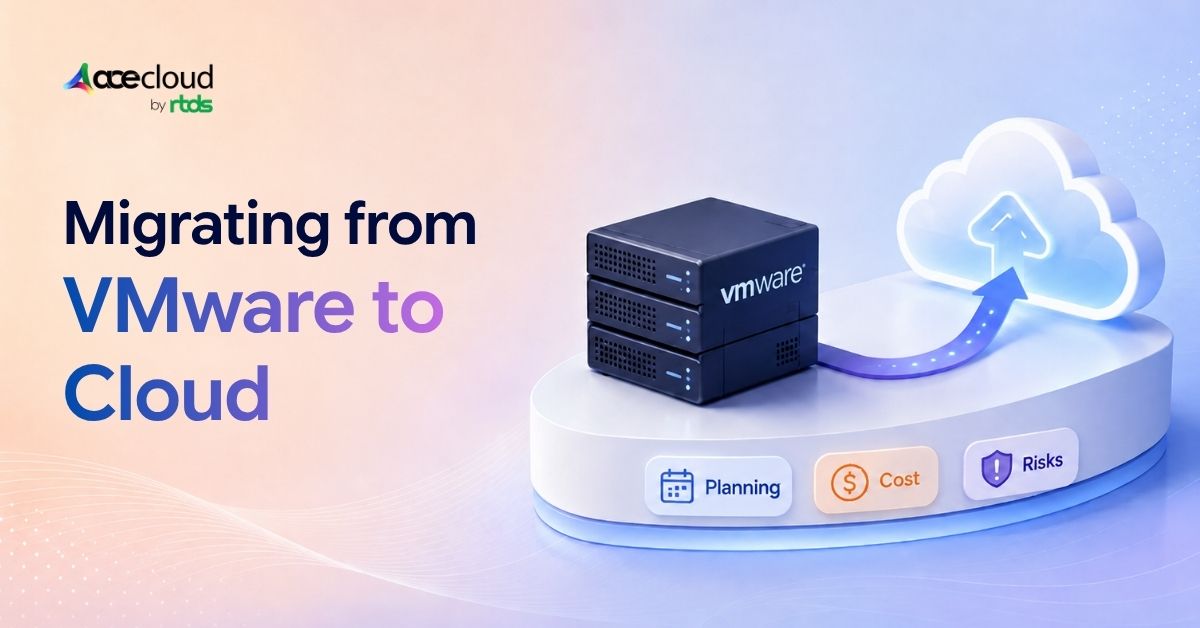
A VMware private cloud is a single-tenant cloud built on VMware’s virtualization stack, delivered either on your own hardware or hosted by a provider.
Instead of buying separate servers, storage and networking tools that you manage as isolated pieces, you operate an integrated platform with policy control, automation and a self-service experience.
You still run virtual machines and you can also run Kubernetes if you choose. But you do it on infrastructure that is dedicated to your organization.
Also Read: Virtual Machines in Cloud Computing: Benefits, Types, and Best Practices
How VMware Works and Private Cloud Deployment Options?
Here’s how VMware Private Cloud functions.
- Virtual machines are run by ESXi hypervisors while vCenter gives you central management, templates and role-based access.
- Storage is provided by vSAN which aggregates disks inside your hosts or by external storage arrays if that better fits your design.
- Networking and security are delivered through NSX, which enables overlays, micro-segmentation, load balancing and site-to-site connectivity.
- Automation and governance are facilitated by VMware Aria products or Cloud Director to provide self-service portals, quotas and policies.
- VMware Tanzu allows you to run Kubernetes alongside your VMs with consistent controls.
You can deploy this stack in three common ways.
- On-premises private cloud that you operate yourself, which maximizes control and data locality.
- Hosted or fully managed private cloud where a provider runs the platform and meets agreed SLAs while you keep tenancy isolation.
- Hybrid setup that links your private cloud to other sites or public clouds using HCX, VPNs or direct links, which can simplify migrations and disaster recovery.
Each model offers similar operational concepts, yet the run responsibility and commercial terms differ in important ways.
When does VMware Private Cloud fit Mid-sized Enterprises?
A VMware private cloud fits well when your workload profile is steady, your performance needs are predictable and your data must stay controlled.
It also fits when you already run a meaningful VMware estate and want to modernize operations without a costly rebuild of every application.
Use cases such as VDI, ERP databases, analytics platforms with defined patterns and line-of-business systems benefit from consistent latency and clear placement policies.
Moreover, if you have compliance obligations, data residency constraints or strict RPO and RTO targets, a private cloud can provide confidence through dedicated resources and deterministic designs.
Conversely, if your demand is spiky or highly seasonal, you will want a burst strategy that does not force you to own under-utilized hardware for most of the year.
Also Read: Checklist: Move From AWS To An Open-Source Private Cloud
Pros for Mid-sized Enterprises
Here are the advantages of using VMware private cloud for mid-sized enterprises.
- Strong isolation and control: come with VMware private cloud. Because the platform is single tenant, you set placement, performance and security policies that reflect your risk posture and you can align them to business tiers.
- Operational maturity: Features like vMotion, HA and DRS reduce maintenance disruption and improve resilience, while lifecycle tools simplify upgrades that otherwise create risk.
- Hybrid optionality: Consistent vSphere APIs and HCX can ease migrations, cross-site mobility and DR patterns without re-architecting every workload.
- Broad application coverage: You can run legacy VMs, modern services, databases and even GPU-enabled workloads on the same platform, then add Kubernetes through Tanzu when you are ready.
- Data placement clarity: It helps keep sensitive data on-premises or in specific hosted locations and you can place compute close to users who care about latency.
- Deep talent pool of VMware administrators, integrators and partners helps mid-sized teams execute projects faster and reduce delivery risk.
Cons and Risks of VMware Private Cloud
Here are the disadvantages of using VMware Private Cloud.
- Cost structure is the first area that deserves careful modelling. VMware’s packaging has emphasized subscription bundles in recent years. Therefore, you should expect to evaluate editions and inclusions rather than stacking many individual point products. The right bundle can streamline operations; however, the wrong fit can inflate TCO for mid-sized footprints.
- Capacity is the second consideration. You scale by adding hosts which gives predictability, yet it lacks the instant elasticity of a large public cloud. Consequently, you should plan buffer capacity and a burst path for peak events or one-off projects.
- Skills and responsibility Even with strong automation, you still need people who understand vSphere, storage, networks and security, unless you take a managed route.
- Platform lock-in Deeper use of NSX, vSAN and management tooling simplifies daily life, yet it can increase switching costs later. Mitigate that risk by standardizing container platforms, portable backup formats and clear interconnect patterns that preserve exit options.
- Ecosystem dynamics Partner landscapes and program terms can shift, so you should prefer providers with transparent renewal terms, clear escalation paths and the capacity to support you through multi-year growth.
Cost and TCO of VMware Private Cloud
A mid-sized decision benefits from a disciplined three-year TCO view that separates one-time and recurring costs.
- Start with hardware for hosts, storage devices and network gear if you are building on-premises or with reserved capacity fees if you are buying a managed private cloud.
- Add licenses for the VMware stack, then include support, facilities and power where relevant.
- Layer people costs for operations, security and platform engineering, even if partially offset by a managed service.
- Now compute unit economics that helps leadership compare apples with apples. Track a ₹ per VM per month, a ₹ per vCPU-hour, a ₹ per GB-RAM-hour and a ₹ per TB-month for storage.
- These metrics reveal optimization opportunities and make trade-offs visible. Build sensitivity tests that model 20 percent workload growth, short seasonal peaks and a disaster recovery event that requires temporary extra capacity.
- Additionally, examine the licensing bundle choices in the current catalogue and map what is included against your needs, since this is where hidden cost or hidden value often lives.
The goal is not to minimize line items, it is to right-size the platform, so your teams meet SLOs at a predictable and defensible cost.
Practical Evaluation Checklist
Here’s how you can evaluate a decision to adopt VMware Private Cloud for your mid-sized enterprise.
- Begin with a workload inventory that classifies applications by performance profile, latency sensitivity and data gravity. For each tier, document SLOs, RPOs and RTOs, then decide which workloads require strict locality and which can move.
- Next, define success criteria that are easy to measure, such as an availability target, a recovery time target and a per-workload unit cost. Map security and industry compliance requirements into network zones, micro-segmentation policies and backup standards you can test.
- Create a small pilot with N+1 hosts that proves the landing zone, the identity model and the micro-segmentation plan. Migrate a handful of representative workloads and measure performance, resilience and day-two effort.
- In parallel, design a burst strategy using HCX or similar tools so that rare peaks never force you to carry idle capacity through the year.
- Moreover, plan the operating model early. Document patch cadence, backup tests, DR drills and change windows and assign clear ownership for cost, security and resilience.
When these practices are in place from day one, the private cloud behaves like a service rather than a collection of servers.
When a VMware Private Cloud is a Strong Choice?
Here are the scenarios when you should strongly consider VMware Private Cloud.
- Choose it when your workloads are steady, your applications value consistent performance and your data need a clear home.
- Choose it when your team already understands vSphere and wants the fastest path to better operations without rewriting a large estate.
- Choose it when compliance and recovery targets are easier to meet with dedicated resources and deterministic designs.
If you expect sustained growth with predictable patterns, a private cloud can deliver a clean runway and fewer surprises.
Take the Next Step!
A VMware private cloud gives mid-sized enterprises control, predictable performance and a mature operational model that handles mixed workloads well.
However, it also asks you to model subscription choices carefully, plan capacity with intent and invest in the right skills or a managed partner.
The winning choice depends on your workload shape, compliance needs and time to value.
If you want a fast, low-risk way to move forward, start with a sizing and TCO exercise that compares a self-managed design against a managed private cloud, then add a public cloud baseline for leverage.
Private cloud experts at AceCloud can help you build a reference design, a three-year TCO with unit economics and a pilot plan that proves performance and resilience before you commit.
Private cloud experts at AceCloud can help you build a reference design, a three-year TCO with unit economics and a pilot plan that proves performance and resilience before you commit. Call us at +91-789-789-0752today!