

Introduction
Leveraging cloud services can significantly reduce software testing costs for small and medium-sized businesses (SMBs). Cloud-based testing offers an efficient, cost-effective solution, reducing the expenses and time required for comprehensive testing processes. Minimizing costs and accelerating time to market is crucial for software development companies, especially tech startups.
As more companies adopt DevOps and Cloud DevOps practices, moving software testing to the cloud is a logical progression. Software development firms must remain agile and swift to stay competitive, much like ballet dancers and world-class athletes.
The Rise of Cloud-Based Testing
Cloud-based testing provides numerous benefits, including scalability through the public cloud’s on-demand service model. This allows for multiple parallel tests without the constraints of traditional infrastructure.
Cloud-Based Testing is Here to Stay
Cloud software testing’s advantages were particularly obvious during the COVID-19 pandemic. While the pandemic may now seem like a distant memory, cloud software testing remains crucial.
For instance, cloud-based testing facilitates easy collaboration among remote team members for quicker test cycles, regardless of social distancing. When combined with other benefits like cost reduction and virtualization environments, cloud testing offers significant advantages over traditional software testing approaches.
The Importance of Testing Hardware and Software
While the focus is often on testing software to create bug-free applications that work as desired across different browsers, devices, and workloads, hardware also undergoes rigorous testing.
For example, you wouldn’t take chances with a launch vehicle for a $10 billion payload into space or a rover mission to Mars. Extensive testing ensures hardware functions perfectly under various conditions.
Similarly, the software requires thorough testing. NASA’s extensive testing of the Lunar Rover before the Apollo missions ensured its flawless performance on the moon. This level of rigorous testing is crucial for software as well.
Understanding Cloud Software Testing
Cloud software testing involves utilizing cloud environments and infrastructure, such as VMs and other resources, to test software. This method evaluates performance, stability, functionality, and more.
Traditional on-premises testing faces limitations like budgets, deadlines, and hardware constraints. In contrast, cloud software testing leverages the cloud’s scalability, transforming fixed capital expenditures into operational flexible expenses—a welcome cost-saving opportunity for SMBs.
Types of Cloud Software Testing
Software testing in the traditional software company set-up involves traveling down a well-worn path since the types of testing and the reasons for performing them are all proven and well-established. It’s all settled. When it comes to these types of software testing, we elaborate on a few below.
As to software cloud testing, if a software test can be conducted on-premises, it can also be conducted using cloud resources or on the cloud — occasionally, in a much more efficient manner.
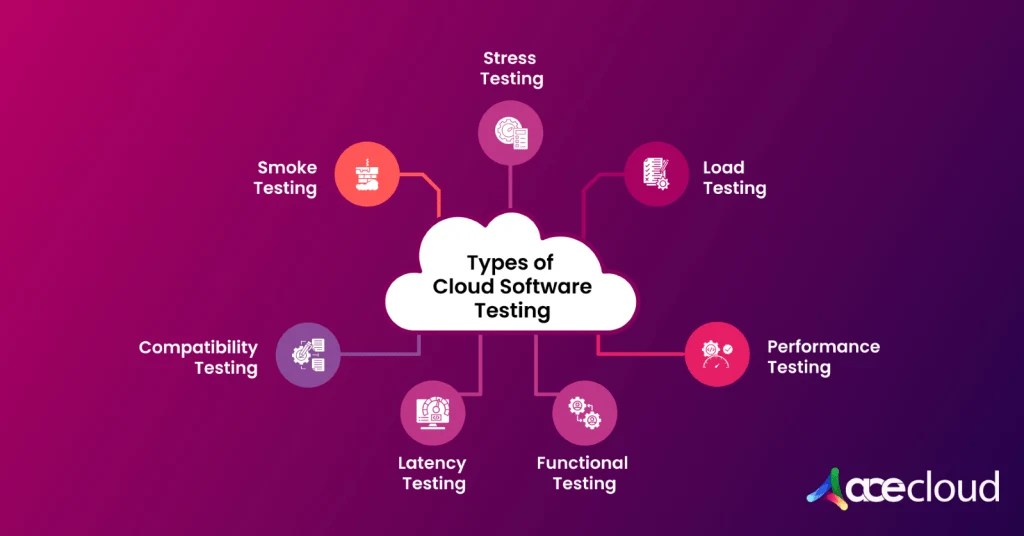
- Stress Testing
Stress testing measures software’s ability to handle stress or pressure. It falls under performance testing, simulating high traffic conditions through spike and soak tests. The cloud’s scalability allows for stress testing without significant capital expenditures. - Load Testing
Load testing, another type of performance testing, increases an application’s workload to determine its load handling limit. Using cloud infrastructure, load testing can scale up users in a test environment, saving costs compared to on-premises infrastructure. - Performance Testing
Performance testing assesses baseline performance characteristics like loading time and server response. Cloud software testing is ideal for performance testing due to the scalable nature of cloud resources. - Functional Testing
Functional testing services ensure that applications work as expected, and by moving these services to the cloud, resources can be provisioned quickly, speeding up the testing process despite changing business requirements. - Latency Testing
Latency testing evaluates web page response times and performance under slow internet connections. Cloud-based testing tools provide up-to-date information about website or app performance. - Compatibility Testing
Compatibility testing checks software performance across different devices, operating systems, and browsers. Cloud resources enable extensive compatibility testing through virtualization. - Smoke Testing
Smoke testing is a preliminary test to ensure basic functionality, benefits from the cloud’s accessibility, and allows testing anytime, anywhere.
Benefits of Cloud Software Testing
There are several advantages of testing on the cloud compared to traditional testing paradigms and methodologies.
Here are the major advantages of adopting a cloud testing strategy:
- Cost Savings: Setting up on-premises testing hardware is expensive. Cloud resources, available on a pay-as-you-go basis, save on capital expenditure, maintenance, and upgrade costs.
- Scalability: Cloud resources are highly scalable, allowing you to increase or decrease resources as needed, avoiding idle resources or shortages.
- Customized Test Environments: Cloud testing resources come optimized with the right hardware-software configurations, enabling performance and load testing in various scenarios.
- Easy Accessibility:Cloud-based testing provides 24/7 access to resources, enabling testers to address test case changes or client requests promptly.
- Increased Testing Speed:Cloud testing supports parallel testing across multiple operating systems, platforms, and devices, saving time and fitting well with agile development and CI workflows.
- Reduced Manpower:Cloud-based automation testing tools optimize employee allocation, reducing the need for extensive manpower.
- Simplified Disaster Recovery:Cloud testing simplifies disaster recovery. Public cloud providers store data on multiple servers in different locations, making data restoration easy.
- DevOps Compatibility: Cloud testing fits well with DevOps practices, promoting integration between development and operations.
Challanges of Cloud Software Testing
Despite its advantages, cloud testing presents some challenges:
| Vendor Lock-In | Security and Privacy Issues | Compliance Issues | SLA Fine Print | Hidden Costs |
| Unique cloud architectures and services may hinder switching providers. Annual fees or long-term agreements can also lead to vendor lock-in. | Cloud data security depends on the provider’s adherence to best practices. Ensure the provider offers DDoS protection, anti-ransomware measures, cloud firewalls, and SIEM/EDR. | Ensure the cloud provider complies with regulatory requirements like HIPAA or GDPR before migrating to your business. | Review the Service Level Agreement (SLA) carefully to understand data backup assurances, uptime guarantees, and responsibilities. | Be aware of costs for exceeding resource quotas during a billing cycle. Clarify billing policies to avoid unexpected charges. |
Cloud Optimization Cost for Software Testing
Optimizing cloud costs for software testing is a strategic move that can help SMBs to save significantly. Businesses can balance performance and cost-efficiency by carefully managing and optimizing cloud resources. Cloud optimization involves right-sizing instances, scheduling workloads during off-peak hours, and leveraging auto-scaling features to ensure that resources are used efficiently without overspending.
Cloud cost optimization for software testing reduces expenses and enhances the overall testing process. Cloud-based tools allow businesses to automate cost management and resource allocation, ensuring that testing environments are optimized for both cost and performance. Additionally, cloud providers offer cost monitoring and reporting tools that provide visibility into spending patterns, enabling better financial planning and decision-making.
Conclusion
By leveraging cloud testing, SMBs can significantly reduce costs and save time. Properly tested software is more likely to succeed, much like the well-tested JWST that continues to provide spectacular observations.
Embracing cloud testing can help you stay ahead of the competition. Aceloud offers comprehensive cloud computing and testing solutions to your software testing processes. Book a free consultation and get expert advice today!

Related Post










Get in Touch

Credits First!
- 24*7 Human Support
- Pay-as-you-go Pricing
- No Egress Cost
- Multi Tier Security