

Introduction
In this blog we are going to discuss about OpenStack Public Cloud and how it is acting as catalyst in this market. In the last two decades, we have advanced toward cloud computing and now rely heavily on it for data and infrastructure management. Although the public cloud was initially viewed with skepticism, Statista states that 60% of corporate data is now housed in the cloud.
Moreover, according to a forecast by Gartner, high-end public cloud services will experience rapid growth in the coming years, bolstering cloud computing technologies.
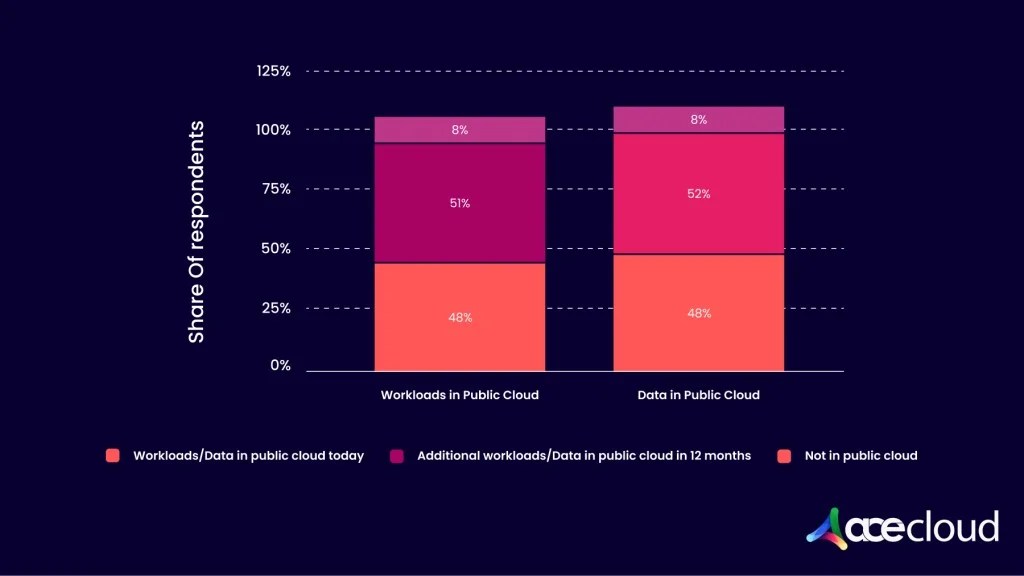
Cloud computing allows businesses to set up a virtual office with the flexibility of connecting anywhere, at any time. While cloud computing is a blessing for businesses, it does come with several drawbacks, including data security, scalability, a scarcity of qualified staff, network compatibility, and performance issues.
As a result, businesses are hesitant to transition to cloud computing. However, with OpenStack tools and modules, it becomes easier for people to manage their cloud services, automate tasks, apply security controls, and improve the performance of virtual machines (VMs). It is a set of cloud infrastructure deployment and management tools that addresses all the challenges of cloud computing.
Introduction to OpenStack
OpenStack is a set of open-source software modules and tools that serve as a foundation for building and managing Public and Private Cloud infrastructure. OpenStack allows users to easily create VMs and other instances for a cloud environment. It helps to provision, pool, and manage enormous clusters for computing, storage, and network resources for Infrastructure-as-a-service (IaaS) platforms. OpenStack’s dashboard and APIs (Application Programming Interfaces) help manage bare metal hardware, VMs, and containers.
The vast developer community is continuously improving OpenStack, making it more robust and highly secure. Other OpenStack components enable high-availability operations by providing orchestration, fault management, and services. The global OpenStack Service Market was valued at USD 3,335.6 million in 2021 and is projected to reach USD 13,910 million by 2028, demonstrating a CAGR of 22.2% during the forecast period.

Top 5 Advantages of Opting for OpenStack
The public cloud market is competitive, with many players trying to capture the growing market share. OpenStack has made a significant impact in this area and offers several benefits for businesses.
The key to its success is providing a solution that allows customers, developers, and cloud providers greater control over their infrastructure than other platforms. It offers robust features and supports large-scale deployments, high availability, data protection, scalability, flexibility, and reliability. Here are the top 5 reasons to opt for OpenStack for your business:
- Top-notch Industry Support: OpenStack was founded as a framework for allowing enterprises to deliver free and open-source cloud computing services using even basic hardware. Since its establishment, many IT behemoths have supported it and invested in its growth, giving rise to a robust developer community that collaborates with users to provide the ideal platform for each business requirement.
- Compatible: OpenStack APIs work with public cloud systems, making them compatible and allowing easy porting of IaaS client applications from proprietary public cloud platforms to OpenStack-based IaaS providers.
- Scalable: OpenStack public clouds are highly scalable, allowing enterprises to obtain more servers rather than just deploying larger ones. They are designed to control large pools of computing, storage, and networking resources throughout a data center, giving businesses the ability to quickly scale servers up and down.
- Highly Secure: Securing an OpenStack cloud is like securing any other IT infrastructure. It requires a diverse collection of tools and abilities and a thorough grasp of security, with role-based access restrictions and varying levels of access.
- Convenient Control Panel: OpenStack has an easily accessible control panel that provides visibility, control, and quick access to power management capabilities. As a result, customers find it extremely simple to monitor and control their cloud services by gaining a clear picture of resource utilization.
How Does OpenStack Play a Crucial Role in Public Cloud?
According to Statista, OpenStack is the most widely used open-source platform for constructing public cloud environments. One notable feature of OpenStack is its ability to deploy cloud solutions regardless of the size of a company or business. It offers a robust basis for cloud solutions, from containers to virtual machines, making it both practical and economical across various industries.
OpenStack is more than just virtualization technology; it also provides orchestration capabilities to help manage infrastructure more efficiently. It utilizes your existing virtualized infrastructure, built using well-known hypervisors such as KVM, VMware vSphere, or Microsoft Hyper-V, to construct public or private cloud environments. OpenStack enables broad provisioning, lifecycle automation, orchestration, user self-service, cost reporting and billing, and other functions.
Suggested Read: Cloud Computing Matrix: Public, Private, and Hybrid Cloud Architectures
What Are the Use Cases of OpenStack?
OpenStack is drastically changing the rules of IT infrastructure, providing users with a path toward software-defined virtual data centers. Enterprise clients and service providers use OpenStack to transform their business models by reshaping their IT use cases. Here are a few examples of how enterprises are leveraging the agility and scalability of OpenStack:
- Public Cloud: OpenStack is one of the most popular open-source platforms for deploying public cloud infrastructure. Whether your organization is a multibillion-dollar publicly listed corporation or a startup, you can use it to set up public clouds with services that compete with large public cloud providers.
- Creating Containers: Container portability requires developers and operations to effectively develop, test, and deploy applications across public and private environments. OpenStack provides an accessible platform for large-scale container orchestration and allows a single, wizard-driven means of provisioning new clusters and scaling existing ones. Moreover, containerized applications are deployed on OpenStack with full automation, including virtual machines and networks.
- Network Functions Virtualization: As an open-source platform for virtualization, OpenStack enables service providers and corporations to deploy network functions on commodity server hardware and handle their workloads. These applications also rely on OpenStack for their hosting in the cloud.
- Private Cloud: OpenStack’s private cloud distributions can provide more significant benefits than custom-coded private cloud. Hosted private cloud (where businesses pay a cloud service provider for support and maintenance) or on-premises private clouds are more secure but require more maintenance and higher expenses to run, as organizations need to hire employees to manage the servers.
How does OpenStack work?
OpenStack leverages two fundamental technologies: a base operating system like Linux and a virtualization platform like VMware or Citrix. The virtualization engine oversees the virtualized hardware resources required by OpenStack projects, while the OS handles the instructions and data transferred from OpenStack.
Once the OS, virtualization platform and OpenStack components have been correctly deployed and configured, administrators can provision and manage the instanced resources that applications require. The actions and requests on the dashboard result in a series of API calls authenticated by the security service and forwarded to the destination component, which performs the corresponding duties.
For example, an administrator logs into OpenStack and oversees the cloud environment via a dashboard. They may build, connect, and define network behavior for new computing and storage instances. They can also use the API to connect to other services, such as monitoring the performance of a provided sample and utilizing resource billing and charge-back.
Key Components of OpenStack Public Cloud
Most OpenStack users start with a modest set of core components and gradually add more to expand their cloud’s operational and business capabilities over time. OpenStack comprises several components with different code names and a modular design. Here is a quick overview of the key components:
- Dashboard (Horizon): OpenStack Horizon is the official graphical interface for automating cloud-based resources and is the only component visible to users as a Dashboard. It provides third-party services such as monitoring, billing, and other management tools to service providers and commercial vendors.
- Identity Service (Keystone): OpenStack Keystone maintains a master list of all OpenStack cloud users, matched to all cloud services for which they have permission. It connects with existing back-end services like LDAP while serving as a centralized authentication mechanism for the cloud computing infrastructure. The catalog also includes an endpoint registry of a searchable list of services installed in an OpenStack-based cloud.
- Object Storage (Swift): OpenStack Swift builds redundant and scalable data storage. The stored data can then be used, retrieved, and modified. It features a distributed design that improves redundancy, scalability, and performance. Swift is object storage that is widely available, shareable, and finally consistent, enabling businesses to store substantial amounts of data securely, cost-effectively, and efficiently. Swift guarantees data replication and distribution across several devices, making it perfect for scale-out storage at a low cost.
- Image Service (Glance): OpenStack Glance assists in discovering, registering, and restoring virtual machine images. It has a client-server architecture and provides a REST API that allows users to query virtual machine image information and receive the actual image. Glance uses cached pictures as templates for deploying new VM instances.
- Networking (Neutron): OpenStack Neutron provides networking capabilities like network management and IP address management. It ensures that the network isn’t a bottleneck in cloud infrastructure deployment by giving customers control over network parameters through self-service. Users can establish their networks and link devices and servers to one or many of them.
- Block Storage (Cinder): OpenStack Cinder offers compute instances with application-specific block-level storage devices. Cloud users can regulate their storage demands by integrating block storage volumes with Dashboard and Nova. Cinder supports all major storage platforms and is perfect for storing databases and creating scalable file systems.
- Compute (Nova): OpenStack Nova is the primary compute engine behind OpenStack. OpenStack Compute is a cloud computing fabric controller that works with virtualization technologies, bare metals, and high-performance computing architectures to manage pools of computer resources. Nova’s architecture allows for cloud design freedom without the need for proprietary software or hardware and the capacity to integrate legacy systems and third-party products. The service manages hypervisors and virtual instances.
AceCloud has chosen to use OpenStack to deploy its public cloud infrastructure because of its popularity, unlimited scalability, and diverse developer community, making it better over time and the most cost-effective option in the long term.
Why Choose the OpenStack-based AceCloud for Your Business?
AceCloud has chosen to use OpenStack to deploy its public cloud infrastructure because of its popularity, unlimited scalability, and diverse developer community. These attributes make OpenStack better over time and the most cost-effective option in the long term. Here are some reasons why the OpenStack-based AceCloud’s public cloud is ideal for your business:
- Manage and maintain virtual processors (CPU), configure servers, storage disks (SSDs and HDDs), and technical requirements for RAM.
- Use resources such as compute and storage on a pay-as-you-go basis to rent servers, networks, VMs, OS, and other on-demand IT resources.
- Assess resource usage, view active virtual machines, and gain visibility, control, and easy access to power management tools.
- Retrieve and control resource utilization at the level of users, roles, and projects with role-based access controls.
Choose AceCloud to fulfill all your cloud requirements and let us manage your infrastructure so you can focus on growing your business.
Call us at+91-789-789-0752and get expert advice today!
Related Post









Get in Touch

Credits First!
- 24*7 Human Support
- Pay-as-you-go Pricing
- No Egress Cost
- Multi Tier Security