

As the business scenario has gone global over the past couple of decades, the requirement for a scalable, agile, and high-performing infrastructure has also skyrocketed. Legacy IT infrastructure does not cut it anymore. Today we are going to discuss AMD vs NVIDIA, and we will compare them on various factors.
Every business now leverages new-age technologies like AI, machine learning, and blockchain for deep data insights, forecasting, predictive analysis, and more. However, you need an IT setup more capable than monolithic servers to facilitate the rapid data processing these technologies require.
GPUs (Graphics Processing Units), as the name suggests, were initially developed to accomplish tasks that involved graphic-intensive tasks, such as gaming, multimedia content, or 3D imaging. However, as time progressed, businesses started utilizing GPUs for more complex tasks, like training AI models, Machine Learning, financial modeling, and cryptocurrency mining. According to Fortune Business Insights, the GPU market is estimated to grow at a CAGR of 28.6 percent in 2024 by 2032.
GPUs help businesses deploy a high-performance computing (HPC) architecture that facilitates parallel processing required for complex computational tasks. However, some considerations should be made before deploying a GPU-based HPC environment. These include analyzing the business requirements, auditing the existing IT infrastructure, and determining budget constraints. The most important consideration is selecting the right GPUs.
The two most preferred GPU-manufacturing companies in the market are AMD (Advanced Micro Devices) and NVIDIA. Both companies have proven their capabilities when it comes to GPU technologies and have evolved with time. Therefore, choosing between the two can be challenging for businesses.
Let’s compare AMD and NVIDIA on some essential parameters to help you decide which is better for your business.
Key Differences: AMD vs NVIDIA GPUs
Market Share of AMD vs NVIDIA
According to TechRadar, NVIDIA dominated the GPU industry with a market share of 88% in the first quarter of 2024, up from 80% in the first quarter. Consequently, AMD’s market share stands at 12% globally.
Performance Analysis AMD vs NVIDIA
- Gaming: Gaming performance is what both AMD and NVIDIA target with their high-end GPUs. Nonetheless, NVIDIA has an entire range of top-end GPUs. Now, the RX 7900 XTX is seen as the king of gaming hardware, especially at 4K resolution with GPUs. Plus, NVIDIA has an added advantage in real-time ray tracing because of their proprietary RT technology, so these GPUs are very strong at this, too.
In comparison, AMD utilizes RDNA 2 and RDNA 3 architecture to power their Radeon RX 6000 and RX 7000 series, which perform exceptionally well in rasterization. Their ray tracing is still behind NVIDIA, but at least they’ve been closing the gap somewhat.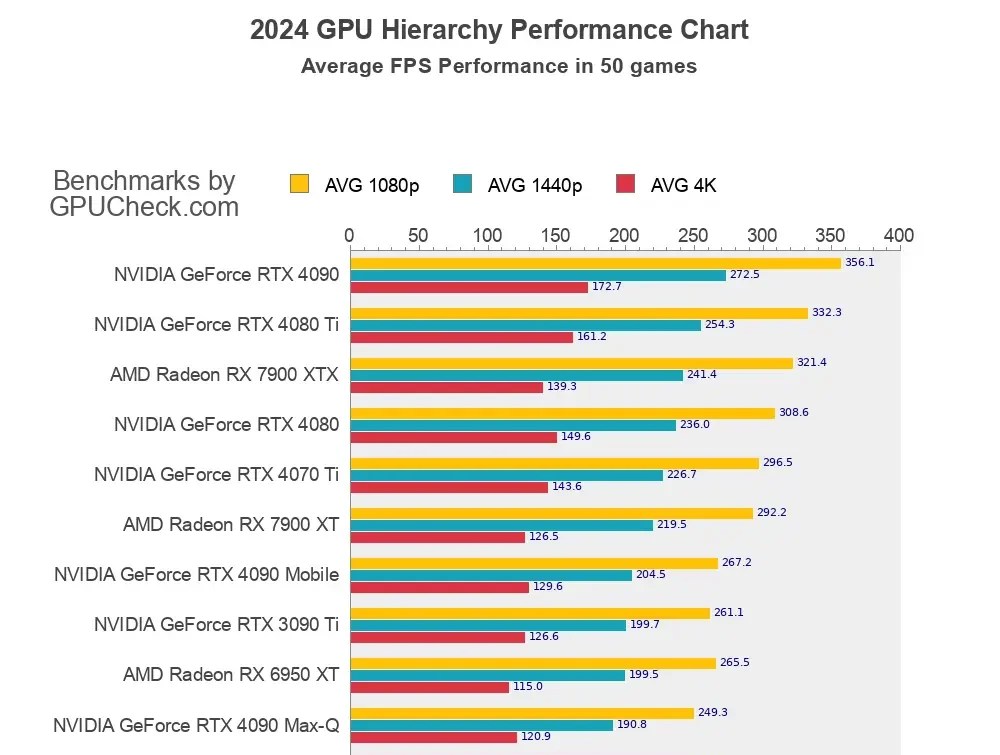
Source: 2024 GPU Benchmark and Graphics Card Comparison Chart – GPUCheck United States / USA - AI/ML and Compute: In areas beyond gaming, such as AI, ML, and scientific computing, NVIDIA takes the lead. NVIDIA’s CUDA (Compute Unified Device Architecture) framework has become the gold standard for GPU-accelerated tasks in these domains. CUDA is widely supported in many deep learning frameworks like TensorFlow and PyTorch, making it the go-to choice for AI and scientific research professionals.
While AMD has ROCm (Radeon Open Compute) for GPU-based computation, its ecosystem is not as mature or widely adopted as NVIDIA’s CUDA. For those working in AI/ML, particularly researchers and developers, NVIDIA’s GPUs, like the NVIDIA A100 or RTX 6000, are often preferred due to their superior support and performance.
Price Analysis AMD vs NVIDIA
AMD is known for its cheap delivery compared to NVIDIA, which is all over the range of competing GPUs. For example, AMD undercuts so much from NVIDIA’s equivalent GPUs, whether budget RX 6600 or high-end RX 7900 XTX. This makes AMD attractive to gamers and performance consumers who want a cost-effective solution.
Meanwhile, NVIDIA generally charges a premium for its cards, but the premium comes with added benefits like DLSS (Deep Learning Super Sampling), improved ray tracing performance, and a bigger software ecosystem. NVIDIA has always been on the pricier side of the table, especially among high-end GPUs.
For example, the NVIDIA GeForce RTX 4090 costs more than AMD’s Radeon RX 7900 XTX but also beats it across the board.
AMD is typically the more affordable option for frugal users, or gamers who don’t need the utmost performance for ray tracing. But for bleeding-edge, highest-performance, and whatever else the market has to offer, maybe you pay a little extra for NVIDIA.
Power Efficiency analysis AMD vs NVIDIA
Power efficiency has become essential, especially for gamers and professionals working in data centers where power consumption directly impacts operational costs.
NVIDIA, with its Ada Lovelace architecture, has made significant strides in power efficiency. The newer NVIDIA GPUs offer a better performance-to-watt ratio, meaning you get more processing power while consuming less energy. This is crucial in both gaming and compute-heavy environments like AI/ML workloads, where high efficiency translates to cost savings in the long run.
AMD’s latest RDNA 3 architecture also focuses on improving efficiency. While AMD has narrowed the gap significantly, NVIDIA still has a slight edge. AMD’s higher-end GPUs, such as the RX 7900 XT and RX 7900 XTX, offer excellent performance. However, they tend to consume more power compared to their NVIDIA counterparts, like the RTX 4080 or RTX 4090.
Software and Drivers
- NVIDIA Software and Drivers: NVIDIA’s software ecosystem is one of its strongest selling points. Features like GeForce Experience, ShadowPlay (for recording and streaming gameplay), and DLSS (which uses AI to upscale lower-resolution images to higher resolutions) are popular among gamers. DLSS 3.0 has significantly impacted by allowing games to run at higher frame rates without sacrificing visual quality.
NVIDIA also offers Studio Drivers for creators and professionals, optimizing applications like Adobe Premiere, Blender, and DaVinci Resolve. This makes NVIDIA GPUs highly desirable for video editors, 3D artists, and content creators. - AMD Software and Drivers: AMD has also substantially improved its software ecosystem recently. The AMD Radeon Software Adrenalin suite provides features similar to GeForce Experience, such as performance monitoring, game optimization, and recording/streaming tools. AMD’s FidelityFX Super Resolution (FSR) is a counterpart to NVIDIA’s DLSS, though it’s not as effective regarding image quality and performance.
However, AMD has historically struggled with driver issues, particularly on the day of new game releases. While the company has improved its drivers significantly over time, some users still report issues with stability and bugs compared to NVIDIA’s more polished software.
Conclusion
NVIDIA vs AMD both offer power-packed GPUs that you can utilize to foster AI acceleration and innovation in the business process. Therefore, choosing between them depends on factors, like budget, type of workload, and business requirements.
AceCloud is a GPU-as-a-service provider with over 15 years of experience. We offer the GPUs of your choice with cloud capabilities, like remote access, on-demand scalability, and enhanced security, so you don’t need to host the servers on the local premises. Get a high-performance cloud GPU environment with round-the-clock customer support and flexible pricing plans. Book a free consultation with an AceCloud expert today.

Related Post










Get in Touch

Credits First!
- 24*7 Human Support
- Pay-as-you-go Pricing
- No Egress Cost
- Multi Tier Security